Guides
What Is a Ghost Kitchen?
What a ghost kitchen is, delivery-first operations, virtual brands, cloud kitchens, common business models, benefits, challenges, and how the model differs from traditional restaurants.
Key Takeaways
- A ghost kitchen is a delivery-first commercial kitchen without a dine-in dining room, also called a cloud kitchen, virtual kitchen, or dark kitchen.
- The model separates production and packaging from front-of-house hospitality; the customer experience happens mostly online.
- Formats range from single-brand delivery kitchens to multi-brand virtual restaurants and kitchen as a service rentals.
- Compare costs, permits, and tradeoffs in our ghost kitchen vs traditional restaurant guide, and validate delivery demand by trade area at Restaurant Site Finder.
A ghost kitchen is a commercial food-production space built for delivery and takeout rather than dine-in service. Instead of welcoming guests into a dining room, a ghost kitchen restaurant prepares orders that customers place through websites, apps, phone ordering, or third-party delivery platforms.
This model is also called a cloud kitchen, delivery-only kitchen, virtual kitchen, or dark kitchen. The names vary, but the basic idea is the same: separate the cooking operation from the traditional front-of-house restaurant experience.
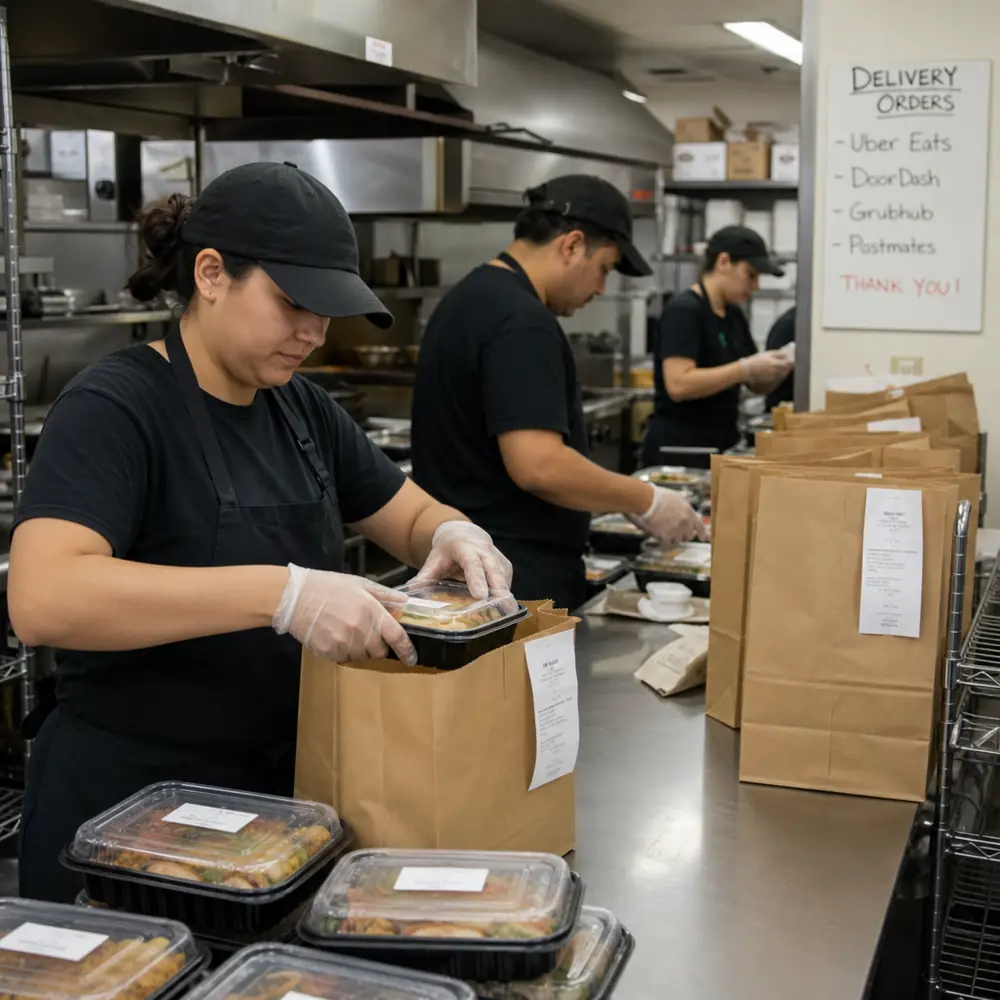
What is a ghost kitchen restaurant?
A ghost kitchen restaurant is a food business that operates from a professional kitchen without a public dining room, host stand, or traditional storefront experience. Customers usually discover the brand online, place an order digitally, and receive the food by delivery or pickup.
The ghost kitchen definition is simple, but the business model can take several forms. One operator might run a single delivery-only kitchen for one menu. Another might prepare food for multiple brands from the same space. A restaurant group might use a ghost kitchen to reach a new neighborhood without building a full-service location.
The key difference is not the food itself. A ghost kitchen can sell burgers, salads, pizza, meal prep, desserts, coffee, or nearly any cuisine that travels well. The difference is the operating setup: the business focuses on production, packaging, online ordering, and delivery logistics instead of seating, décor, servers, and table turnover.
The virtual kitchen concept in plain language
The virtual kitchen concept turns a restaurant brand into a primarily digital experience. The customer may never see the kitchen, but they still interact with the brand through its menu, photography, reviews, packaging, delivery timing, and food quality.
That is why the phrase "virtual restaurant model" is often used alongside ghost kitchen. The restaurant exists in the customer's phone before it exists anywhere else. A strong concept needs a clear menu, a recognizable name, reliable fulfillment, and food that holds up between the kitchen and the customer's door.
A ghost kitchen is not automatically less "real" than a traditional restaurant. It still needs food safety processes, trained staff, equipment, inventory management, quality control, and customer service. What changes is where the customer experience happens: online ordering replaces the dining room as the main point of interaction.
Defining characteristics of a ghost kitchen
Most ghost kitchens share a few core traits. These characteristics help separate the model from catering companies, food trucks, home kitchens, and conventional restaurants.
- Delivery-first operations: The kitchen is designed around off-premise orders, whether through in-house delivery, pickup, or delivery apps.
- Limited or no customer seating: Some locations may offer pickup windows, but the model does not depend on a dining room.
- Digital ordering: Orders usually come from online menus, branded websites, marketplace apps, or integrated point-of-sale systems.
- Production-focused layout: Space is prioritized for cooking stations, storage, packaging, prep, and order staging.
- Flexible branding: One kitchen may support one restaurant brand, several virtual brands, or a mix of existing and new concepts.
- Menu engineering for travel: Items must be designed to arrive in good condition after packaging and transport.
- Lower front-of-house needs: The business may need fewer roles tied to hosting, serving, bussing, and dining room management.
These traits do not guarantee success, but they define the operating logic. A ghost kitchen business wins or loses on operational consistency, demand generation, delivery performance, and product fit.
How does a ghost kitchen work?
A ghost kitchen works by receiving orders digitally, preparing food in a commercial kitchen, packaging the order for transport, and handing it off for delivery or pickup. The process looks simple from the customer's side, but behind the scenes it depends on tight coordination between menu systems, kitchen timing, inventory, packaging, and delivery logistics.
A typical order flow may look like this:
- A customer finds the brand online. They may search a delivery app, visit the restaurant's website, scan a social media post, or reorder from a previous purchase.
- The order enters the kitchen system. Staff receive the ticket through a tablet, point-of-sale system, or kitchen display screen.
- The kitchen prepares the food. Cooks follow recipes and timing standards designed for delivery quality and speed.
- The order is checked and packaged. Packaging matters because it affects temperature, texture, presentation, and spill prevention.
- The order is staged for handoff. A courier, staff driver, or customer pickup process completes the transaction.
- The customer experience continues after delivery. Reviews, refunds, loyalty offers, and repeat ordering all shape the brand's reputation.
This is where cloud kitchen explained simply means "a kitchen built around online demand." The kitchen may be hidden from public view, but the brand is not hidden. In fact, ghost kitchens often need stronger digital marketing than traditional restaurants because online visibility is their version of foot traffic.
Ghost kitchens, cloud kitchens, and virtual restaurants
People often use these terms interchangeably, but they can point to slightly different parts of the same ecosystem.
A ghost kitchen usually refers to the physical kitchen operation that does not offer a traditional dine-in experience. A cloud kitchen is a similar term that emphasizes online ordering and delivery infrastructure. A virtual restaurant often refers to the brand or menu that exists digitally and may be cooked inside a ghost kitchen, an existing restaurant, or a shared kitchen facility.
For example, a pizza shop with unused evening capacity might create a separate online-only wing brand from the same kitchen. That wing brand is a virtual restaurant. If the kitchen itself has no dine-in restaurant attached and exists mainly for delivery production, it is commonly described as a ghost kitchen or cloud kitchen.
A related phrase is kitchen as a service. This usually describes a provider that rents commercial kitchen space, equipment access, utilities, and sometimes operational support to food brands. Instead of building a kitchen from scratch, an operator can use a ready-made facility and focus on menu, staffing, marketing, and fulfillment.
What is a ghost kitchen concept compared with a traditional restaurant?
A ghost kitchen concept is a restaurant idea designed specifically for digital ordering, delivery, and takeout. Compared with a traditional restaurant, it puts less emphasis on atmosphere and more emphasis on menu clarity, speed, packaging, and online conversion.
Traditional restaurants often build value through hospitality, location, ambience, plating, music, service style, and community presence. Ghost kitchens still need a brand personality, but that personality must come through in different ways. Menu photos, item names, descriptions, packaging, order accuracy, and delivery reliability do much of the work that a dining room would normally handle.
The differences become easier to see when you focus on the customer journey:
- Discovery: A traditional restaurant may rely on street visibility and local reputation. A ghost kitchen depends heavily on search, delivery apps, social media, reviews, and repeat digital orders.
- Decision-making: A dine-in guest may be influenced by the room, staff, or specials board. A delivery customer is comparing photos, prices, fees, cuisine type, ratings, and estimated arrival times.
- Experience: A traditional restaurant controls the full environment. A ghost kitchen must make food travel well and arrive as close as possible to the intended experience.
- Operations: A dine-in restaurant balances tables, servers, reservations, and kitchen flow. A ghost kitchen balances ticket volume, delivery timing, courier handoffs, and packaging stations.
- Brand trust: A storefront can feel familiar because people pass it every day. A virtual brand earns trust through consistency, transparency, reviews, and repeat quality.
Neither model is automatically better. They solve different problems. For a full comparison of capital, permits, and margins, see ghost kitchen vs traditional restaurant.
Common ghost kitchen business models
The ghost kitchen business is not one single format. Operators use the model in different ways depending on capital, market demand, menu type, and growth goals.
Single-brand delivery-only kitchen
This is the simplest version. One restaurant brand operates from a commercial kitchen and sells only through delivery or pickup. The brand may have its own website, app presence, and delivery marketplace listings.
This model works best when the concept is clear and the menu is focused. A narrow menu can make prep, training, inventory, and quality control easier. It can also help customers understand the brand quickly when they are scrolling through many options.
Multi-brand kitchen
A multi-brand ghost kitchen prepares orders for several restaurant concepts from the same space. For example, one kitchen might run separate online brands for bowls, sandwiches, desserts, and late-night snacks.
The advantage is that one facility can serve different customer needs throughout the day. The challenge is complexity. Each brand needs distinct positioning, accurate menus, reliable inventory, and quality standards that do not collapse under order volume.
Existing restaurant with virtual brands
Some traditional restaurants add virtual brands to use spare kitchen capacity. A restaurant that already has staff, equipment, and ingredients may create an online-only menu that fits its capabilities.
This can be efficient when the new brand uses overlapping ingredients and similar cooking processes. It can become a problem if the virtual menu distracts from dine-in guests, slows the kitchen, or confuses customers about what the restaurant actually offers.
Shared kitchen or kitchen as a service
In a kitchen as a service setup, food entrepreneurs rent access to a compliant commercial kitchen rather than building their own. The facility may provide stations, equipment, storage, cleaning systems, utilities, and sometimes software or delivery coordination.
This approach can reduce some barriers to entry, but it does not remove the need for a strong business plan. Operators still have to manage food costs, staffing, permits, brand positioning, customer acquisition, and day-to-day execution.
Ghost kitchen benefits
The most common ghost kitchen benefits come from focusing resources on production and delivery instead of traditional restaurant buildout and front-of-house service. Those benefits are practical, but they are not automatic.
Potential advantages include:
- Lower front-of-house complexity: Without a dining room, the operator can avoid managing servers, hosts, table layouts, reservations, and many guest-facing service details.
- More flexible market testing: A brand can test menus, cuisines, neighborhoods, and dayparts with less commitment than a full restaurant rollout.
- Operational focus: The kitchen can be designed around prep, cooking, packaging, and delivery flow rather than splitting attention across dine-in and off-premise service.
- Multiple concepts from one space: A well-run kitchen may support more than one virtual restaurant model if the menus and workflows are compatible.
- Expansion possibilities: An established brand may use ghost kitchens to serve new delivery zones without immediately opening a full storefront.
- Data-driven menu decisions: Digital ordering can make it easier to see which items sell, which photos convert, which bundles work, and where customers reorder.
The practical implication is clear: a ghost kitchen can give operators flexibility. But flexibility only helps when the business has disciplined execution. Poor packaging, weak branding, unreliable delivery, or an unfocused menu can erase the advantages quickly.
The challenges behind the model
A ghost kitchen may look lean, but it is not effortless. Many of the hard parts of running a restaurant still apply, and some become even more important because the customer has fewer sensory cues before ordering.
Common challenges include:
- High dependence on digital visibility: If customers cannot find the brand online, the kitchen has no natural dining room traffic to fall back on.
- Delivery platform costs and rules: Third-party marketplaces can bring demand, but they may also add fees, ranking pressure, and limited control over the customer relationship.
- Packaging performance: Fries can steam, sauces can leak, and delicate items can lose appeal in transit. The menu must be built for the journey.
- Brand trust: Customers may hesitate if they cannot see a storefront, recognize the name, or understand who is preparing the food.
- Operational bottlenecks: Courier crowding, order spikes, tablet overload, and inaccurate timing can damage the experience.
- Menu confusion: Running too many virtual brands from one kitchen can create inventory mistakes and dilute quality.
These challenges do not mean the model is flawed. They mean a ghost kitchen should be treated as a serious restaurant operation, not just a shortcut to online sales.
Practical examples and misconceptions
A definition becomes easier to understand when you can see what fits and what does not. The following examples show how the model appears in real-world situations without assuming one exact setup.
Common examples include:
- A delivery-only taco brand operating from a rented commercial kitchen.
- A local restaurant launching an online-only burger menu from its existing back-of-house.
- A dessert concept selling through delivery apps and a branded ordering page with no dine-in seating.
- A shared facility where several food businesses use separate prep areas and sell different menus.
- A regional restaurant brand using a cloud kitchen to serve a new delivery zone.
Common misconceptions include:
- "A ghost kitchen is a home kitchen." In normal business use, the term refers to a commercial food-production setup, not someone casually cooking from home.
- "A virtual restaurant is fake." The dining room may be absent, but the food operation, staff, ingredients, and customer experience are real.
- "Ghost kitchens are only for big chains." Larger brands may use them, but independent operators and small concepts can also use delivery-only models.
- "Any menu works for delivery." Some foods travel poorly or require packaging changes before they make sense in a delivery-first format.
- "Lower overhead means easy profit." Savings in one area can be offset by delivery fees, marketing costs, food waste, labor, and operational mistakes.
What makes a good ghost kitchen concept?
A good ghost kitchen concept is easy to understand online, efficient to produce, built for transport, and compelling enough to earn repeat orders. It should match real customer demand while staying realistic for the kitchen's equipment, staff, ingredients, and service area.
The best concepts usually have a few things in common. The menu is focused rather than bloated. The food photographs well and arrives in good condition. The brand promise is clear in seconds, because customers scrolling through delivery options rarely study a menu for long.
Use this checklist when evaluating a ghost kitchen idea:
- Can a new customer understand the cuisine, value, and occasion quickly?
- Do the main dishes hold temperature, texture, and appearance during delivery?
- Are ingredients shared across items to reduce waste and simplify prep?
- Can the kitchen execute the menu consistently during rush periods?
- Is the packaging suitable for sauces, steam, stacking, and travel time?
- Does the brand have a plan for reviews, repeat orders, and customer support?
- Are the delivery radius and estimated times realistic for the food being sold?
This checklist matters because a ghost kitchen has fewer chances to recover from a weak first impression. In a dining room, a server might fix confusion or explain a dish. In a delivery-only kitchen, the menu page, packaging, and food have to speak for themselves.
Why the ghost kitchen model matters
The ghost kitchen model matters because it reflects a broader shift in how people buy restaurant food. For many customers, convenience, speed, and digital access are now part of the dining decision. They may not need a table every time they want restaurant-quality food.
For operators, the model creates another path into the food business. It can support testing, expansion, niche cuisines, and delivery-focused brands. It can also help existing restaurants use capacity more creatively, as long as the added orders do not damage the core operation.
For customers, ghost kitchens can mean more choices in a delivery area. The tradeoff is that customers need to pay attention to reviews, menu clarity, delivery expectations, and whether the brand communicates transparently. A good ghost kitchen feels convenient and reliable; a weak one feels anonymous.
Location still matters for delivery-first formats, rent, courier access, and residential density within your radius drive unit economics. Screen candidate addresses with free trade-area analysis at Restaurant Site Finder before you commit to a lease or kitchen-as-a-service contract.
The bottom line
A ghost kitchen is a delivery-only kitchen model built around online ordering rather than dine-in hospitality. It may power one brand, several virtual restaurants, or a kitchen as a service setup for food operators who need commercial production space.
The concept works best when the menu is focused, the food travels well, the brand is clear, and the operation is disciplined. In other words, a ghost kitchen is not just a restaurant without tables. It is a restaurant model redesigned around digital demand, delivery logistics, and the customer's experience after the food leaves the kitchen.
Run a free location analysis
Enter any address to get competitor mapping, market gaps, opportunity scoring, and concept ideas.
Analyze your location free Shop equipment at Horeca Store