Finance
How Much Does It Cost to Open a Restaurant in 2026
How much it costs to open a restaurant in 2026, startup ranges by concept, full cost breakdown, one-time vs operating expenses, financial planning, working capital, funding options, and common budget mistakes.
Key Takeaways
- Most U.S. restaurant openings in 2026 plan between roughly $175K and $750K, but space condition, service model, and working capital drive the real number, not a national average.
- Build a line-by-line restaurant cost breakdown separating one-time startup costs from monthly operating expenses before you sign a lease.
- Protect working capital for delayed openings, soft sales, and early mistakes, undercapitalization kills more restaurants than weak menus.
- Model break-even sales and prime cost; validate rent and trade area with Restaurant Site Finder.
Opening a restaurant in 2026 usually requires a six-figure startup budget, a realistic runway for the first several months, and a clear understanding of which costs are one-time versus recurring. For many U.S. operators, the broad planning range is roughly $175,000 to $750,000, while small counter-service concepts may come in lower and large full-service buildouts in major markets can exceed $1 million. The smartest way to approach opening a restaurant is not to chase an "average" number, but to build a concept-specific restaurant cost breakdown that reflects your space, menu, service model, labor needs, and working capital.
How much does it cost to open a restaurant in 2026?
The direct answer is: most restaurant startup expenses fall somewhere between about $175,000 and $750,000 in the U.S., but your actual cost can be far lower or far higher depending on the concept. A lean food business startup using a small second-generation space may need much less than a ground-up full-service restaurant with a bar, custom dining room, and extensive kitchen infrastructure. When people search "How Much Does It Cost to Open a Restaurant in 2026?", they are usually asking for one number; in practice, the better question is how much capital your specific model needs to open safely and survive the early months.
A 2026 startup budget should account for more than construction and equipment. It also needs lease deposits, architecture and design, permits, legal work, technology, furniture, signage, initial inventory, hiring, training, marketing, insurance, professional fees, and cash reserves. Restaurants also enter 2026 with elevated operating pressure: the National Restaurant Association estimates that total expenses for an average restaurant rose 36% between 2019 and 2026, with food and labor each representing about 33 cents of every sales dollar in a typical restaurant model.
That matters because a restaurant can look "funded" on paper and still run out of cash if the opening takes longer than expected, inspections cause delays, or early sales ramp up slowly. The cost to open is not only the amount needed to unlock the doors. It is the amount needed to build the restaurant, open it, operate it through early volatility, and still have enough cash to correct mistakes.
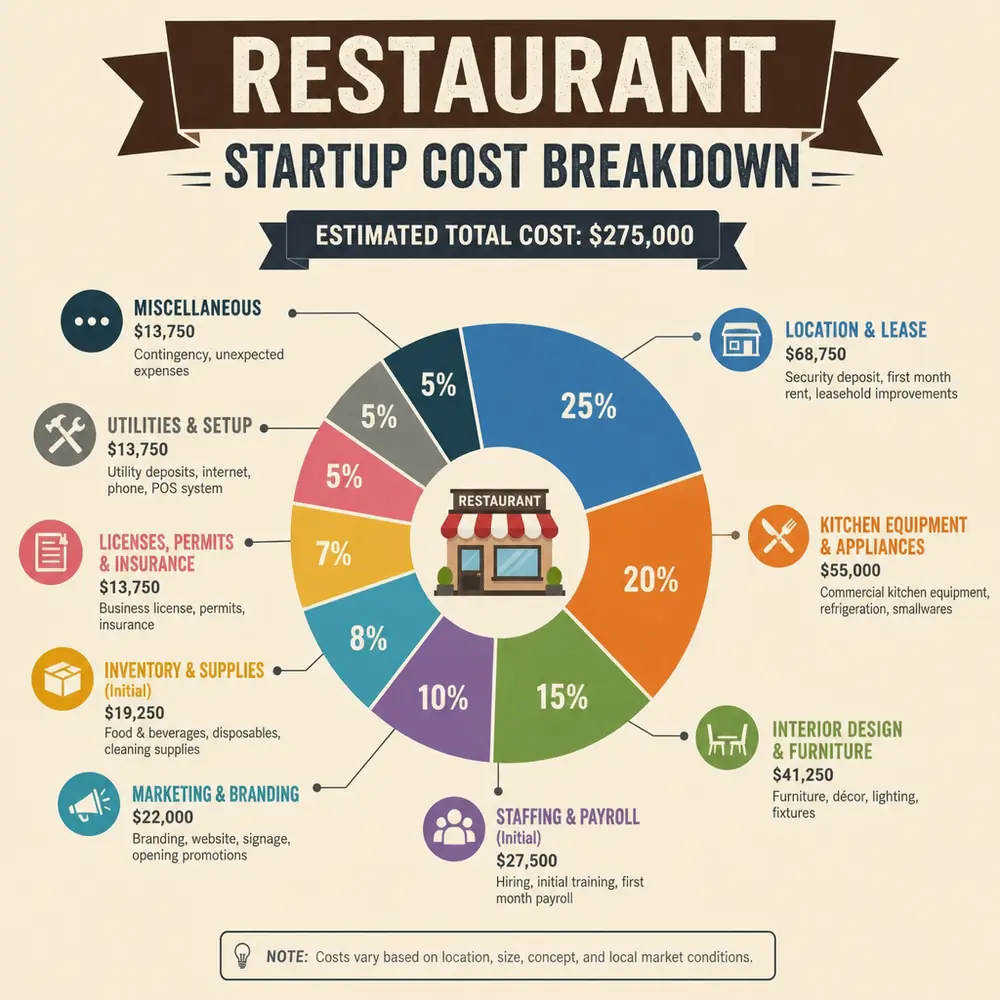
What are the main cost ranges by restaurant type?
Restaurant costs vary because formats vary. A coffee kiosk, pizza shop, fast-casual bowl concept, neighborhood bistro, cocktail bar, and fine-dining restaurant are not just different brands; they are different financial machines. They require different kitchens, different staffing patterns, different seating plans, different permitting paths, and different amounts of working capital.
For planning purposes, use these broad 2026 ranges as starting points, not promises:
- Food truck, cart, or small mobile concept: Often below a traditional brick-and-mortar restaurant, but still requires vehicle or trailer costs, commissary access, permits, equipment, insurance, branding, and maintenance.
- Small quick-service restaurant: Commonly planned around a lower six-figure budget, especially when the menu is tight, the space is small, and the buildout is not heavy.
- Fast-casual restaurant: Often lands in the mid-six figures because it combines counter service with higher brand, design, packaging, technology, and throughput expectations.
- Full-service restaurant: Commonly requires a larger budget because the operator pays for a dining room, service stations, more staff training, more equipment, guest-facing finishes, reservations or table-management tools, and sometimes a bar.
- Bar, brewpub, or restaurant with significant alcohol service: Can become expensive quickly due to specialized buildout, refrigeration, draft systems, glassware, compliance, security, and licensing requirements.
- Fine dining or chef-driven destination concept: Often requires the largest capital cushion because the guest experience, staffing ratio, tableware, finishes, kitchen capability, and pre-opening training expectations are higher.
Square's 2026 restaurant startup guidance gives a useful public benchmark: quick-service concepts may fall around $150,000 to $300,000, fast casual around $200,000 to $500,000, and full-service restaurants around $300,000 to $750,000 or more, with some major-market projects exceeding $1 million.
These ranges are helpful, but the condition of the space often matters more than the label. A "simple" sandwich shop in a raw shell with no grease trap, no hood, no adequate electrical service, and no approved plumbing can cost more than a full-service restaurant that takes over a properly equipped second-generation space. Before you fall in love with a site, price the infrastructure, start with how to choose a restaurant location and free trade-area screening at Restaurant Site Finder.
What is a complete restaurant cost breakdown?
A useful restaurant cost breakdown separates startup expenses into logical categories. This prevents the budget from becoming one large, vague number and helps you see where money is actually going. It also makes restaurant financial planning easier when lenders, investors, landlords, contractors, and partners ask how much you need and why.
Real estate, deposits, and occupancy costs
Your location decision sets the tone for the entire budget. Before you spend on construction, you may need application fees, lease deposits, first month's rent, legal review, broker costs, utility deposits, common area maintenance estimates, and pre-opening rent. If you buy property, the cost structure changes again and may include a down payment, inspections, closing costs, financing fees, taxes, and property improvements.
A lease can look affordable until you account for the full occupancy picture. Base rent is only one part. Many commercial leases also include insurance requirements, property taxes, common area charges, maintenance obligations, trash fees, parking responsibilities, and repair clauses. A tenant improvement allowance can help, but it rarely eliminates the need for cash.
When evaluating a restaurant lease, ask:
- How many months of rent are due before opening?
- Is there a rent-free buildout period, and when does rent begin?
- Who pays for HVAC, roof, plumbing, grease trap, and electrical upgrades?
- Are food uses already permitted in the space?
- Are there restrictions on hours, alcohol, patio service, signage, or ventilation?
- What happens if permitting or construction takes longer than expected?
A strong lease is not just about getting the lowest rent. It is about matching the rent, term, improvement obligations, and timeline to the sales your concept can realistically generate.
Design, architecture, engineering, and professional fees
Many first-time operators underestimate soft costs. Before the contractor starts building, you may need architects, engineers, designers, code consultants, attorneys, accountants, and permit expediters. These professionals help translate your restaurant idea into plans that can pass review, function during service, and support safe operations.
Design cost is not just about aesthetics. A well-planned kitchen reduces wasted steps, bottlenecks, food safety risks, and labor strain. A well-planned dining room improves guest flow, server movement, pickup areas, waiting zones, and revenue potential. Poor design can create permanent inefficiencies that cost far more than the original design fee.
Plan for professional support in areas such as:
- Space planning and kitchen layout
- Mechanical, electrical, and plumbing drawings
- Hood system, fire suppression, and ventilation coordination
- Accessibility and restroom compliance
- Lease review and entity setup
- Accounting system design
- Insurance and risk review
- Menu costing and financial modeling
If your budget is tight, do not skip the technical work. Instead, simplify the concept so the project requires fewer custom solutions. See the restaurant business plan guide for lender-ready structure.
Construction, buildout, and leasehold improvements
Buildout is often the largest and most unpredictable startup category. It may include demolition, framing, flooring, walls, plumbing, electrical, HVAC, restrooms, kitchen infrastructure, hood installation, fire suppression, lighting, millwork, counters, bars, patio work, painting, and final finishes. RestaurantOwner.com's survey of independent operators found construction represented a major share of startup cost, and it also showed a median budget overrun of 15%, with higher overruns for many projects.
The biggest buildout risk is hidden infrastructure. A space may look close to ready but still need costly upgrades behind the walls. Grease interceptors, hood shafts, electrical panels, gas lines, floor drains, water service, and fire systems can make or break the numbers. This is why a restaurant-savvy contractor should walk the space before you sign a lease.
Buildout costs rise when you add:
- A larger kitchen or multiple cook lines
- Heavy ventilation or long duct runs
- Custom bars, banquettes, or millwork
- Multiple restrooms or accessibility upgrades
- Patio service or outdoor structures
- Major electrical or gas upgrades
- High-end finishes and custom lighting
- Delays caused by permitting, inspections, or change orders
Build a contingency into the construction budget. If the project is complex, the space is old, or the plans are still evolving, a small contingency is not enough. Cost overruns are not rare exceptions in restaurant construction; they are common planning realities.
Kitchen equipment and smallwares
Kitchen equipment is where the menu becomes physical. Every item you plan to sell creates a need for storage, prep, cooking, holding, cooling, washing, and service. Equipment may include ovens, ranges, fryers, grills, refrigeration, freezers, prep tables, mixers, dish machines, sinks, shelving, ice machines, beverage systems, coffee equipment, and hot holding.
Smallwares are just as important. Pots, pans, knives, cutting boards, sheet pans, ladles, tongs, storage containers, scales, thermometers, dish racks, utensils, and cleaning tools can quietly consume a large amount of cash. A restaurant with a broad menu needs more equipment and smallwares than a focused concept.
To control this category, build the equipment list from the menu instead of from a catalog. Ask what each menu item requires at peak volume. Then ask whether the item earns enough gross profit to justify the equipment, storage, prep time, and labor it demands. Use the restaurant equipment checklist and commercial kitchen equipment buying guide; request bundled quotes from Horeca Store early.
Cost-control options include:
- Buying used equipment from reputable suppliers when appropriate
- Leasing selected equipment if cash flow benefits outweigh long-term cost
- Choosing a tighter menu that shares equipment across many items
- Avoiding specialty equipment for low-volume menu items
- Negotiating maintenance and warranty terms
- Confirming power, gas, water, and drain requirements before purchase
Used equipment can reduce upfront cost, but it also carries repair risk. Critical equipment such as refrigeration, dishwashing, and line cooking should be evaluated carefully because failure during service can affect revenue, food safety, and guest trust.
Furniture, fixtures, signage, and decor
Furniture, fixtures, and decor shape the guest experience before the first bite. This category may include tables, chairs, booths, barstools, host stands, shelving, mirrors, art, lighting, menu boards, exterior signage, awnings, planters, patio furniture, uniforms, and restroom fixtures. It can be lean and functional, or it can become a major design investment.
The right level of spending depends on your positioning. A fast-casual lunch concept may prioritize durable seating, clear menu boards, and efficient pickup zones. A date-night restaurant may need lighting, acoustics, tabletop quality, and comfort that support longer visits and higher check averages. A coffee shop may need outlets, seating variety, and visual warmth for repeat visits.
Do not let decor spending outrun the concept's economics. If the guest will not pay more, visit more often, or remember the brand more clearly because of a design choice, question whether that design choice belongs in the first-phase budget. You can upgrade some guest-facing details after sales prove demand.
Licenses, permits, and inspections
Every restaurant needs permissions before it can legally operate. Requirements vary by city, county, and state, so this category should be researched locally rather than estimated from a national average. You may need a business license, food service permit, health department approval, building permits, signage permits, fire inspections, certificate of occupancy, music licensing, seller's permit, patio permit, and alcohol license if applicable.
Liquor licensing can be one of the most variable startup costs. In some markets, it is a standard application process. In others, license availability is limited, transfers are competitive, and the cost can become a major capital item. Timeline risk is also important: a delayed license may force you to open without a revenue stream that your financial plan assumed.
Create a permit tracker with:
- The agency responsible for each approval
- Required forms, plans, and inspections
- Application fees and renewal fees
- Estimated review timelines
- Dependencies between approvals
- The person responsible for follow-up
- The earliest and latest realistic approval dates
Permitting delays can create indirect costs such as extra rent, contractor remobilization, delayed hiring, spoiled pre-opening inventory, and postponed revenue. Your budget should include time as well as fees. See the restaurant permits and licenses guide for sequencing.
Technology, POS, and back-office systems
Restaurant technology is now part of the opening budget, not an optional upgrade. Most restaurants need a point-of-sale system, payment processing, kitchen printers or kitchen display screens, handheld ordering if used, online ordering, menu management, reporting, gift cards, loyalty tools, labor scheduling, payroll, accounting, inventory, reservations, and Wi-Fi.
The cost of technology includes hardware, software subscriptions, payment processing, installation, training, support, integrations, and replacement devices. A cheaper system can become expensive if it slows service, creates reporting gaps, or forces manual work. A more robust system can be wasteful if the restaurant pays for features the team will not use.
Choose technology around operational needs:
- Counter-service concepts need speed, simple modifiers, tipping flow, and online ordering.
- Full-service restaurants need table management, coursing, split checks, seat numbers, and server accountability.
- Bars need fast tabs, pre-authorizations, recipe controls, and tight cash management.
- Delivery-heavy concepts need menu syncing, order throttling, packaging workflows, and reliable kitchen routing.
- Multi-location concepts need consolidated reporting, permissions, and standardized menus.
The goal is not to buy every tool. The goal is to reduce friction where friction costs money: order errors, long ticket times, missed items, untracked discounts, inaccurate labor reports, and weak cash controls.
Opening inventory and supplies
Initial inventory includes food, beverages, alcohol if applicable, paper goods, packaging, cleaning supplies, chemicals, uniforms, office supplies, printer paper, labels, guest checks, first-aid items, and restroom supplies. It is tempting to stock heavily before opening, but excess inventory ties up cash and increases spoilage risk.
Start with a par-level plan. Estimate how much you need for training, soft opening, first full week, and vendor lead times. Perishable inventory should be conservative until you understand demand. Shelf-stable goods can be stocked more comfortably, but even those should be tied to realistic sales.
Opening inventory should also reflect your menu engineering. A menu with many unique ingredients increases cash tied up in stock and raises waste risk. A menu with cross-utilized ingredients can feel abundant to guests while staying efficient for the kitchen.
Pre-opening payroll, recruiting, and training
Labor costs begin before revenue does. You may need to pay managers, chefs, trainers, hourly staff, payroll taxes, onboarding costs, uniforms, background checks, and training meals before the first official service. A full-service restaurant may require more pre-opening training than a simple counter-service operation because staff must learn table service, menu language, wine or beverage standards, reservation flow, and guest recovery.
Training is easy to cut when cash gets tight, but weak training shows up immediately in order errors, slow service, wasted food, poor reviews, and staff turnover. Opening weeks are emotionally intense. The team needs clear systems, not just enthusiasm.
A practical pre-opening labor plan includes:
- Hiring timeline by role
- Training hours by position
- Paid orientation and compliance training
- Menu tastings and service rehearsals
- Mock service with controlled guest counts
- Manager coverage before and after launch
- Payroll cash reserved before first revenue
Do not hire everyone too early, but do not hire so late that opening becomes chaotic. The right timeline depends on training complexity and local labor availability.
Branding, marketing, and launch promotion
Marketing expenses begin before the sign goes up. You may need a logo, website, photography, menu design, social media setup, local PR, email capture, printed materials, search listings, launch events, influencer outreach, direct mail, paid ads, window graphics, and community partnerships. Marketing does not need to be extravagant, but it does need to be intentional.
The highest-return pre-opening marketing often focuses on local awareness and first-party customer relationships. A restaurant should claim and complete its local listings, publish accurate hours, show real photos, explain the concept clearly, and give nearby residents a reason to pay attention. If online ordering or reservations are part of the plan, test them before launch.
A lean launch checklist can include:
- Clear brand name, logo, and exterior visibility
- Mobile-friendly website with menu, hours, location, and contact details
- Claimed Google, Apple, Yelp, and relevant local profiles
- Email or SMS signup for opening updates
- Staff-ready menu descriptions
- Professional or high-quality food and interior photography
- Soft-opening guest list and feedback process
- Grand-opening offer that protects margins
Avoid discounting so aggressively that new customers learn to value the restaurant only when it is cheap. A better launch offer creates trial while preserving the brand.
What drives restaurant startup expenses the most?
The biggest drivers are usually space condition, service model, menu complexity, market costs, alcohol service, construction scope, and the amount of working capital you reserve. Two restaurants with the same square footage can have dramatically different startup costs if one takes over a fully equipped second-generation restaurant and the other converts a raw retail space. The costliest decisions are often made before the lease is signed and before the menu is finalized.
Space condition
A second-generation restaurant space can save money if the hood, grease trap, restrooms, plumbing, electrical service, and layout are usable. But "used to be a restaurant" does not automatically mean "cheap to reopen." Equipment may be worn out, permits may not transfer, the layout may not match your concept, or code requirements may have changed.
A raw space gives you control but increases cost and risk. You may be building the restaurant from the slab up: utilities, walls, bathrooms, ventilation, fire systems, and finishes. That can be worth it for a proven operator with strong capital, but it is dangerous for an underfunded first location. Compare ghost kitchen vs. traditional restaurant tradeoffs if rent and buildout are tight.
Menu complexity
Menu complexity affects almost every cost category. More menu items can mean more equipment, more prep labor, more storage, more vendors, more training, more waste, and slower service. A focused menu is not only easier to execute; it is often cheaper to open.
Before adding an item, ask whether it uses ingredients already in the kitchen, whether it can be prepped efficiently, whether it slows the line, and whether it produces enough gross profit. If an item needs a special piece of equipment and sells only occasionally, it may belong in a future menu phase rather than the opening menu.
Service model
Full service is more labor-intensive than counter service. It also requires more dining room systems, service training, tableware, guest recovery processes, and management oversight. Counter service can reduce labor complexity, but it may require stronger packaging, pickup flow, digital ordering, and speed-focused kitchen design.
Neither model is automatically better. The right model is the one whose cost structure fits your price point, market, and guest expectations. If guests expect speed and convenience, a full-service model may add cost without adding enough value. If guests expect hospitality, pacing, and ambiance, a counter-service model may limit check average.
Market and labor conditions
Costs vary sharply by city and neighborhood. Rent, wages, contractor pricing, insurance, utilities, permit timelines, and delivery demand all change by market. National averages are useful for orientation, but they are not a substitute for local quotes.
Restaurant operators in 2026 are also planning in an environment where cost control remains central. The National Restaurant Association's 2026 outlook described measured industry growth alongside persistent cost pressures, cautious consumer spending, and hiring challenges for many operators. Pair local quotes with restaurant market analysis before you commit.
Working capital
Working capital is the cash that keeps the restaurant alive after construction is done. It pays for payroll, rent, food, utilities, insurance, marketing, repairs, debt service, and mistakes while sales stabilize. The U.S. Small Business Administration advises entrepreneurs to organize startup needs into one-time and monthly expenses so they can estimate funding needs and understand when the business may turn profitable.
Underfunding working capital is one of the most dangerous mistakes in a food business startup. A restaurant can have a beautiful buildout and still fail because it opened with too little cash to handle slow weekdays, refunds, equipment repairs, staff turnover, or delayed vendor terms.
One-time startup costs versus ongoing operating costs
Restaurant financial planning becomes clearer when you separate the money needed to open from the money needed to operate. One-time expenses get you to launch. Ongoing expenses determine whether the restaurant can survive after launch.
Common one-time startup expenses
Your one-time opening budget may include:
- Lease deposits and utility deposits
- Legal formation and lease review
- Architecture, engineering, and design
- Permits, inspections, and application fees
- Construction and leasehold improvements
- Kitchen equipment and installation
- Furniture, fixtures, decor, and signage
- POS hardware and installation
- Website, branding, and launch marketing
- Initial inventory and supplies
- Recruiting, onboarding, and pre-opening payroll
- Training, tastings, and mock service
- Insurance deposits or initial premiums
- Contingency for overruns
Some expenses that feel one-time will return later. Equipment needs maintenance, licenses renew, furniture breaks, menus change, and technology upgrades. Treat the opening budget as the first investment, not the last investment.
Common monthly operating expenses
Your monthly operating budget may include:
- Rent and occupancy costs
- Payroll, payroll taxes, and benefits
- Food, beverage, and paper goods
- Utilities, trash, and pest control
- Insurance
- Software subscriptions
- Payment processing fees
- Repairs and maintenance
- Laundry, linens, and uniforms
- Marketing and promotions
- Accounting, bookkeeping, and professional services
- Loan payments or investor distributions
- Licenses, dues, and recurring compliance costs
Food and labor deserve special attention because they are usually the biggest controllable cost categories. The National Restaurant Association notes that food and labor each account for approximately one-third of every dollar in sales in a typical restaurant, leaving slim room for everything else. Track prime cost weekly, see what is prime cost in restaurant business.
How do you build a restaurant financial plan before signing a lease?
A restaurant financial plan should show how much capital you need, where it will be spent, how long it will last, what sales are required to break even, and what happens if the opening is delayed or sales are weaker than expected. The plan should be built before you commit to a lease because the lease locks in one of your largest fixed obligations. If the numbers do not work before signing, they rarely become easier after construction begins.
Start with the concept economics
Begin with the basic business model. Define the service style, seating, hours, average check, expected covers, takeout mix, delivery mix, bar sales if applicable, and menu price range. Then estimate sales by daypart rather than relying on one monthly guess.
For example, a lunch-heavy concept should model weekdays differently from weekends. A dinner restaurant should model early week softness. A coffee shop should separate morning rush from afternoon traffic. These patterns affect staffing, prep, inventory, and cash flow.
Build conservative assumptions first. It is better to be pleasantly surprised by demand than to finance a restaurant that only works if every seat is full and every labor shift is perfect.
Estimate sales capacity realistically
Sales capacity is limited by seats, kitchen throughput, hours, ticket times, order channels, and staff. A 60-seat restaurant does not automatically have 60 paying guests every hour. You need to estimate turns, no-shows, average party size, service duration, and demand by day.
For counter-service concepts, capacity depends on order speed, kitchen line speed, pickup organization, and digital order flow. If the kitchen can only produce 80 orders per hour at peak, marketing that drives 140 orders per hour creates failures instead of profit.
Build a prime cost model
Prime cost is food, beverage, and labor combined. It is the center of restaurant profitability because it reflects what it costs to produce and serve what you sell. A concept with high ingredient cost needs labor efficiency or premium pricing. A concept with high service labor needs strong average checks and disciplined scheduling.
Do not use a single food cost percentage for the whole menu without checking item-level margins. A steak entree and a pasta dish may have very different cost structures. A cocktail, dessert, or side may contribute profit differently from a main dish. Menu costing should happen before the menu is printed.
Calculate break-even sales
Break-even sales are the sales required to cover fixed and variable costs. Your fixed costs include items such as rent, insurance, salaried management, base utilities, software, and debt payments. Variable costs include food, beverage, hourly labor, packaging, and payment fees.
A practical break-even process looks like this:
- List fixed monthly costs.
- Estimate variable cost as a percentage of sales.
- Subtract the variable cost percentage from 100% to estimate contribution margin.
- Divide fixed costs by contribution margin.
- Compare the result to realistic sales capacity.
- Repeat the model using conservative, expected, and strong sales scenarios.
If the break-even point requires unrealistic traffic, the answer is not "market harder." The answer may be a smaller space, different service model, tighter menu, lower rent, cheaper buildout, higher pricing, or a different location. See restaurant profit margins and unit economics for deeper modeling.
Plan for three cash scenarios
Every opening budget should include multiple scenarios:
- Base case: Realistic sales, normal construction timeline, manageable hiring, and expected costs.
- Downside case: Delayed opening, higher buildout cost, softer sales, or higher payroll.
- Stress case: Major equipment repair, permit delay, failed inspection, slow first quarter, or key manager replacement.
The downside case is not pessimism. It is responsible planning. If the restaurant only survives the base case, it is undercapitalized.
What does a sample startup budget structure look like?
The following structure is not a universal price list. It is a planning framework you can adapt to your concept. Use local quotes, contractor estimates, vendor proposals, and permit research to replace placeholders with real numbers.
A lean counter-service concept
A smaller counter-service restaurant might prioritize a tight menu, compact footprint, limited seating, used equipment where safe, simple decor, and efficient labor. The startup budget may concentrate on kitchen equipment, lease deposits, light buildout, POS, signage, opening inventory, and several months of working capital.
This model can work well when the menu is operationally simple and the location has built-in demand. The danger is underbuilding capacity. If the kitchen, pickup area, or storage is too small, the restaurant may struggle at exactly the moment demand grows.
Key budget priorities:
- Reliable core cooking and refrigeration equipment
- Fast ordering and payment flow
- Clear signage and menu communication
- Packaging and pickup organization
- Conservative opening inventory
- Cash reserve for early payroll and rent
A fast-casual restaurant
A fast-casual concept usually spends more on brand, design, guest flow, digital ordering, and throughput. The kitchen may need more capacity than a simple counter-service shop because guests expect speed during rush periods. Seating, packaging, and online ordering must work together.
The budget should protect the systems that affect volume. A weak expo station, confusing pickup shelf, or poorly configured line can reduce sales during peak windows. Saving money on the wrong operational detail can create permanent drag.
Key budget priorities:
- Efficient cookline and prep flow
- Durable, brand-aligned interiors
- Online ordering and menu management
- Strong packaging program
- Labor model for peak throughput
- Launch marketing to nearby workers and residents
A full-service restaurant
A full-service restaurant has more moving parts. The budget may include a larger dining room buildout, bar setup, tableware, reservations, host stand, service stations, server training, beverage inventory, linens, and more management coverage. It also needs enough working capital to cover a larger payroll while the team improves execution.
The dining room must support the financial model. Seat count, table mix, turn times, average check, and staffing levels all interact. A beautiful room with too few revenue-generating seats can struggle. A crowded room with poor acoustics and service flow can disappoint guests.
Key budget priorities:
- Dining room layout and service flow
- Kitchen capacity matched to seating
- Bar and beverage controls if applicable
- Staff training and mock service
- Guest recovery and manager systems
- Larger cash reserve for payroll and ramp-up
What funding options exist for opening a restaurant?
Most restaurant founders use a mix of funding sources. The right blend depends on credit profile, experience, collateral, personal savings, investor interest, project size, and risk tolerance. Whatever the source, funders will want to see a credible restaurant cost breakdown and a plan for repayment or return.
Common funding sources include:
- Personal savings: Gives control but concentrates personal risk.
- Friends and family: Can be flexible, but agreements should be formal and clear.
- Bank or SBA-backed loans: May offer structured financing, but lenders usually require strong documentation, creditworthiness, and a realistic plan.
- Investors: Can provide larger capital but may require ownership, reporting, and shared control.
- Equipment financing: Can preserve cash, though total cost may be higher over time.
- Landlord tenant improvement allowance: Can reduce upfront buildout cash, but terms matter.
- Crowdfunding or community investment: May help brand awareness, but it rarely replaces a full capital plan.
- Grants or local programs: May be available in some areas, especially for small business development, workforce goals, or neighborhood revitalization.
Avoid funding the buildout but not the runway. If you raise exactly enough to open, you may have no margin for the first few months of operations. Lenders and investors will usually take your plan more seriously when it includes working capital, contingency, and conservative sales assumptions.
What cost-saving strategies do not weaken the restaurant?
Saving money is not the same as cutting corners. The best cost-saving strategies reduce waste, complexity, and risk while preserving the guest experience. The worst ones create safety issues, service problems, or expensive rework.
Smart ways to reduce startup cost include:
- Choose a second-generation restaurant space carefully. Existing infrastructure can save money if it is code-compliant and compatible with your concept.
- Simplify the opening menu. Fewer items can reduce equipment needs, prep time, training, inventory, and waste.
- Phase nonessential design upgrades. Open with durable, brand-appropriate basics and improve details after demand is proven.
- Buy used equipment selectively. Focus on reputable dealers, service records, and critical reliability.
- Negotiate lease terms, not just rent. Buildout period, tenant allowance, repair obligations, and renewal options can be worth more than a small rent discount.
- Standardize ingredients. Cross-utilization helps reduce spoilage and improves purchasing control.
- Get multiple contractor bids. Compare scope carefully so you are not choosing a low bid that excludes important work.
- Build systems before hiring heavily. Clear recipes, prep lists, checklists, and training materials reduce paid confusion.
- Test the menu with pop-ups or catering. Early feedback can prevent expensive menu mistakes.
Areas where you should be cautious about cutting include fire safety, refrigeration, food safety, plumbing, ventilation, insurance, payroll compliance, and accounting. These are not cosmetic expenses; they protect the business.
What common mistakes make restaurant openings more expensive?
Many cost overruns are preventable. They happen because operators commit too early, estimate too broadly, or confuse optimism with planning. The earlier you identify these traps, the easier they are to avoid.
Signing the lease before pricing the buildout
A lease can create urgency. The landlord wants commitment, the location feels perfect, and the founder wants momentum. But signing before a contractor, architect, and equipment professional evaluate the space can turn a promising deal into a financial burden.
Always understand the cost of making the space usable for your specific restaurant. A rent number is meaningless if the required buildout is unaffordable.
Building a menu that is too broad
A large menu feels like a way to attract more guests, but it often increases cost and complexity. More ingredients mean more storage, more prep, more training, more equipment, and more waste. New restaurants benefit from focus because focus improves consistency.
Start with the dishes you can execute well, price correctly, and produce efficiently. Expansion can come later.
Underestimating pre-opening time
Every extra week before opening can create additional rent, payroll, utilities, insurance, and interest costs. Delays may come from permits, inspections, equipment lead times, contractor schedules, design revisions, or hiring challenges. A realistic timeline is a financial tool.
Build time buffers into the budget. If you do not use them, you have extra cash. If you need them, they may save the business.
Forgetting owner pay
Many founders assume they can go unpaid indefinitely. That may be possible for some, but it is not a financial plan. If the owner needs income to survive, the budget should include it or clearly state how personal expenses will be covered.
Owner stress becomes business stress. A restaurant that depends on unpaid owner labor should still understand the true cost of that labor.
Treating sales projections as facts
Sales projections are estimates. They are shaped by assumptions about traffic, check average, hours, capacity, weather, competition, reviews, staffing, and consumer spending. New restaurants should model conservative ramp-up rather than assume immediate maturity.
If your projected profit disappears when sales are 15% lower than expected, the plan needs more cushion.
What should be on a pre-opening financial checklist?
Before you commit serious money to opening a restaurant, review the numbers in a disciplined way. This checklist can help you organize decisions and identify gaps.
- Define the concept, service model, target customer, and menu scope.
- Get local rent comps and understand full occupancy costs.
- Have a restaurant-savvy contractor inspect the space.
- Confirm hood, grease trap, plumbing, gas, electrical, HVAC, and fire requirements.
- Price equipment from the actual menu and expected volume.
- Estimate design, engineering, legal, accounting, and permit costs.
- Build a month-by-month opening timeline.
- Separate one-time startup costs from recurring monthly expenses.
- Add construction and operating contingencies.
- Cost every menu item and estimate gross margin.
- Build conservative, expected, and strong sales forecasts.
- Calculate break-even sales.
- Plan at least several months of working capital.
- Confirm funding sources before signing binding commitments.
- Review lease terms with qualified legal support.
- Set up bookkeeping, payroll, tax, and reporting systems before opening.
This checklist is intentionally practical. The goal is not to make the process feel complicated. The goal is to keep expensive surprises from appearing after your cash is already committed.
Final takeaways for 2026 restaurant financial planning
Opening a restaurant in 2026 is possible, but it requires sharper math than many founders expect. Startup costs are high, operating margins are thin, and food, labor, occupancy, utilities, supplies, and payment costs leave little room for guesswork. The strongest plans connect the concept to the budget: menu, space, labor model, equipment, pricing, and working capital all need to support one another.
If you are early in the process, do not start by asking for the cheapest way to open. Start by asking what size and style of restaurant you can fund responsibly. A smaller, focused, well-capitalized restaurant is often healthier than a larger, underfunded one.
Use national ranges as a benchmark, then replace assumptions with local quotes. Price the space before signing. Build your restaurant cost breakdown line by line. Protect working capital. If the numbers still work under conservative conditions, you are much closer to opening a restaurant that can last beyond the excitement of launch.
Frequently Asked Questions
How much does it cost to open a restaurant in 2026?
Most U.S. restaurant startup expenses fall between roughly $175,000 and $750,000, but lean counter-service concepts can land lower and large full-service buildouts in major markets can exceed $1 million. Your actual total depends on space condition, service model, menu complexity, and working capital.
What are the biggest restaurant startup expenses?
Buildout and leasehold improvements, kitchen equipment, real estate deposits and pre-opening rent, professional fees, permits and licenses, pre-opening payroll, and working capital reserves typically drive the budget. Space condition often matters more than concept label, a raw shell costs far more than a usable second-generation restaurant space.
How much working capital do you need to open a restaurant?
Plan for several months of fixed costs, rent, payroll skeleton, utilities, insurance, debt service, and marketing, plus a variable cushion for food and hourly labor while sales ramp. Underfunding working capital is one of the most common reasons new restaurants fail after a successful buildout.
Can you open a restaurant for under $100,000?
Sub-$100,000 openings are possible with food trucks, ghost kitchens, pop-ups, or heavily equipped second-generation spaces, but insurance, permitting, inventory, and pre-opening labor often push realistic totals higher. Budget honestly or delay until capital matches the concept.
What is the difference between startup costs and operating costs?
Startup costs are one-time expenses to reach opening, lease deposits, construction, equipment, permits, branding, initial inventory, and pre-opening payroll. Operating costs recur monthly, rent, food, labor, utilities, insurance, software, repairs, and loan payments, and determine whether the restaurant survives after launch.
Run a free location analysis
Enter any address to get competitor mapping, market gaps, opportunity scoring, and concept ideas.
Analyze your location free Shop equipment at Horeca Store