Site Selection
Choosing the Best Location for Restaurants
Learn how a restaurant location analysis tool uses demographics, foot traffic, competitor mapping, and catchment zones to help you choose the best site for your culinary venture.
Key Takeaways
- Gut-feel site selection is outdated, location intelligence and geospatial analytics remove blind spots manual scouting misses.
- Score demographics, psychographics, foot traffic by daypart, visibility, competitors, and catchment zones before you tour spaces.
- Integrate real estate economics and zoning overlays so premium rent or liquor restrictions do not surprise you after signing.
- Start with Restaurant Site Finder, then validate finalists on-site and with our site selection checklist.
Opening a new restaurant is an exhilarating venture, but it is also one of the most high-stakes decisions an entrepreneur can make. You can have an award-winning menu, a visionary chef, and an impeccable interior design, but if your restaurant is situated in the wrong neighborhood, achieving profitability will be an uphill battle.
In the modern hospitality industry, relying on instinct to pick a spot is a relic of the past. Today, successful restaurateurs, franchisors, and investors rely on data. Through the power of location intelligence, business owners are transforming the way they approach expansion. By using a specialized restaurant location analysis tool, you can remove the guesswork from your strategy, minimize financial risk, and set the stage for long-term operational success.
In this comprehensive guide, we will explore how adopting a modern, data-driven approach can help you choose the best location for your next culinary venture. For a deeper dive on free AI scoring, see Restaurant Site Finder: Free AI Restaurant Location Analysis Tool.
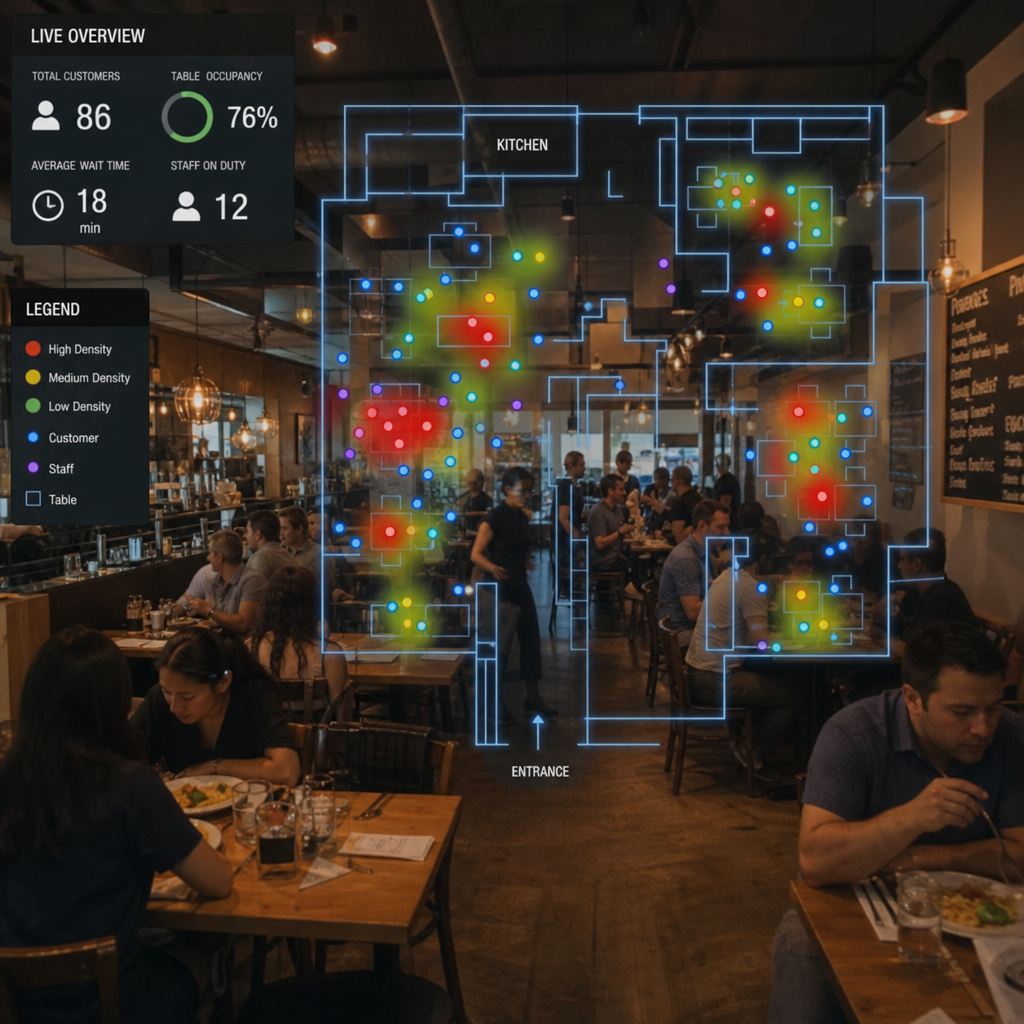
The Shift in Site Selection: Moving Beyond "Gut Feeling"
Historically, finding the right property meant driving around neighborhoods, counting cars from a sidewalk, and hoping a "For Lease" sign appeared in a trendy district. This old-school method is not only incredibly time-consuming but also riddled with blind spots.
When comparing manual scouting vs geospatial selection, the differences in accuracy and efficiency are staggering. Manual scouting gives you a snapshot of a single moment in time, perhaps a busy Tuesday lunchtime. However, it fails to show you what happens on a rainy Sunday, or how the local demographics are projected to shift over the next five years.
This is where location analysis software comes into play. Geospatial technology allows you to layer thousands of data points onto a digital map, revealing patterns that are invisible to the naked eye. Instead of simply crossing your fingers, you can make decisions backed by hard numbers, ensuring your investment is placed in an area primed for growth.
What is a Restaurant Location Analysis Tool?
At its core, a restaurant location analysis tool is a specialized software platform designed to evaluate the viability of a specific geographic area for a food and beverage business. Think of it as a highly advanced site evaluation tool that combines mapping technology with vast databases of consumer, behavioral, and real estate data.
These platforms often utilize GIS software for site selection (Geographic Information Systems). GIS technology takes raw data, like average household income, local traffic speeds, and competitor locations, and visualizes it geographically.
By using a comprehensive site analysis tool, you can answer critical questions:
- Are there enough of my target customers living within a two-mile radius?
- Is the rent proportionate to the expected foot traffic?
- Will a new competitor opening nearby cannibalize my sales?
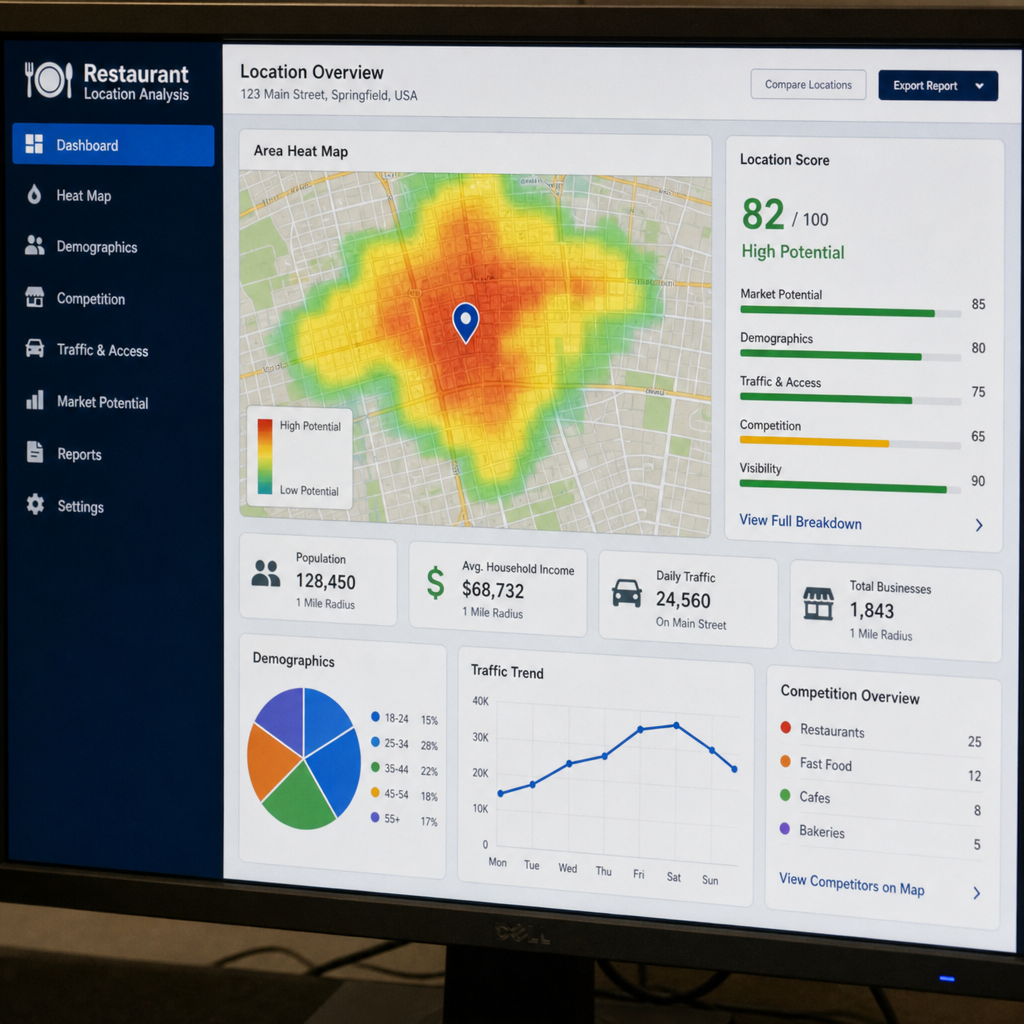
Key Factors to Analyze for Perfect Restaurant Positioning
Achieving the ideal restaurant positioning requires a deep understanding of several intersecting factors. A great location for a quick-service drive-thru coffee shop will look drastically different from the ideal location for a sit-down fine-dining steakhouse. Here is what you need to evaluate.
1. Understanding Local Demographics and Psychographics
You cannot choose a location without intimately knowing who lives, works, and plays in the surrounding area. Basic demographics, like age, gender, and income, are a good starting point, but they don't tell the whole story.
Modern restaurant analytics require a deeper dive. By utilizing customer demographic profiling for hospitality, you can pinpoint exactly where your ideal diners are clustered. But to truly understand your audience, you must also look at psychographic data for audience segmentation. Psychographics tell you why people buy. Are the residents in this neighborhood health-conscious vegans who value sustainability, or are they busy young professionals looking for late-night comfort food?
When you combine demographics with psychographics, you unlock the ability of predicting revenue by neighborhood demographics. If your business model requires an average check size of $50 per person to be profitable, the software will highlight only the neighborhoods where the local discretionary income supports that pricing tier.
2. Traffic, Visibility, and Accessibility
A beautiful storefront is useless if no one can see it or reach it. Evaluating movement around your prospective site is a non-negotiable step in restaurant site selection.
Foot Traffic: For urban concepts, fast-casual spots, and cafes, analyzing pedestrian foot traffic patterns is vital. A sophisticated tool will show you not just how many people walk by, but when they walk by. A location might have massive foot traffic at 8:00 AM due to a nearby subway station, but turn into a ghost town by 6:00 PM.
Storefront Visibility: Knowing how to evaluate storefront visibility can save you from signing a lease on a "hidden" property. Is the building obscured by mature trees, large pillars, or awkward street curves? If pedestrians and drivers can't see your signage until they have already passed it, your walk-in acquisition rate will plummet.
Vehicular Access: For suburban or destination restaurants, evaluating drive-time accessibility for diners is more important than simple geographic distance. A location might only be three miles away from a residential hub, but if those three miles include two congested highways, a toll booth, and tricky left-hand turns without a traffic light, diners will opt for an easier alternative.

3. Competitive Landscape and Market Gaps
You must know who you are up against. However, viewing competitors strictly as a negative force is a mistake. Sometimes, clustering near similar businesses can actually boost your sales by establishing an area as a "dining destination."
Using spatial analytics for competitive intelligence allows you to map out every direct and indirect competitor in your target area. You can view their estimated sales volumes, read aggregated sentiment from online reviews, and see how long they have been in business.
More importantly, this intelligence is crucial for identifying underserved food service markets. Your tool might reveal a neighborhood with a high density of families and a high median income, but a severe lack of quality, family-friendly dining options. Finding these "white spaces" or market gaps allows you to enter a neighborhood with built-in demand and virtually no immediate competition. See our guide on restaurant market saturation trends for more context.
Defining Your Territory: Catchment and Delivery Zones
In the past, a restaurant's "territory" was loosely defined as the neighborhood it was built in. Today, understanding your reach is a highly scientific process.
Catchment Areas
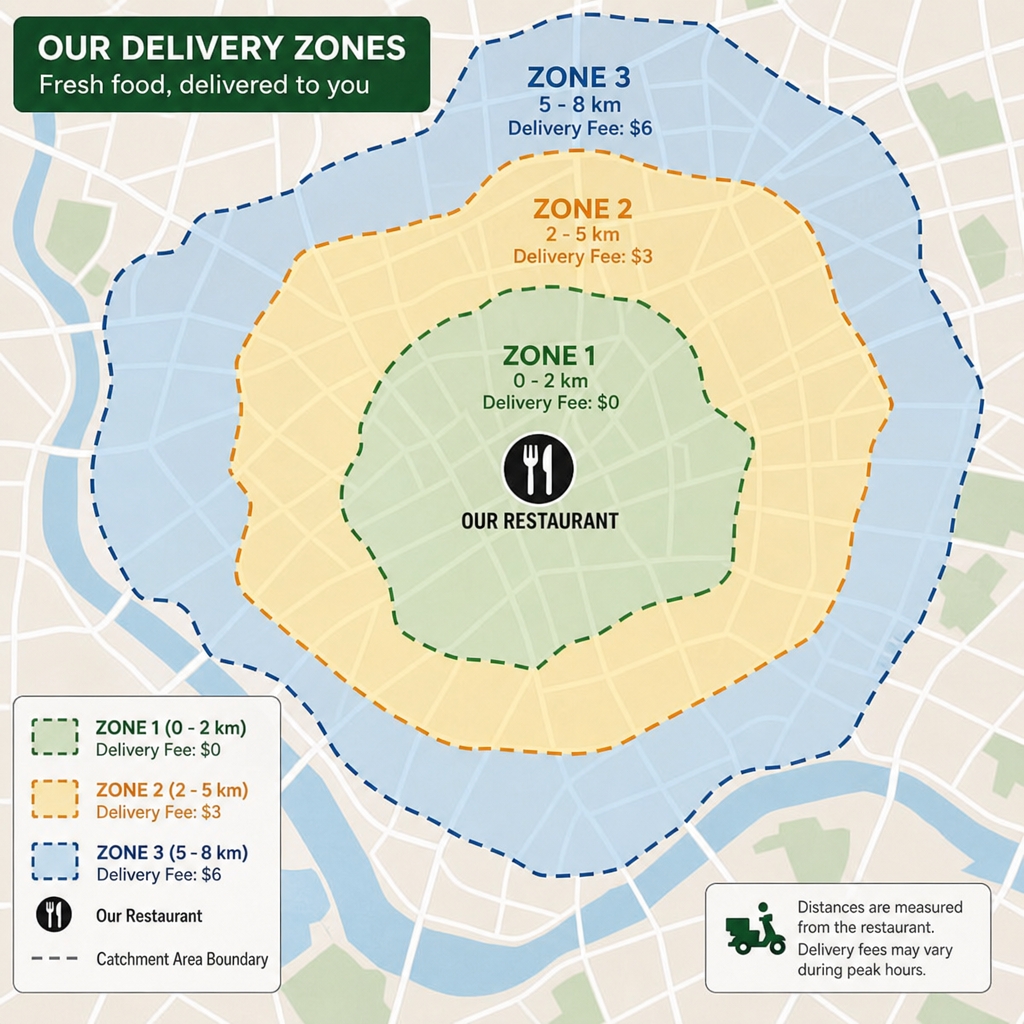
Defining restaurant catchment area boundaries is the process of mapping out the exact geographic zone from which you will draw the majority of your customers. A catchment area is rarely a perfect circle. It is shaped by natural and man-made barriers, such as rivers, train tracks, and multi-lane highways. A reliable location analysis tool will dynamically draw these boundaries based on real travel times rather than simple straight-line distances. Learn more in our trade area analysis guide.
Delivery Radii
With the explosion of third-party delivery apps and ghost kitchens, optimizing delivery radius for kitchens has become a foundational pillar of modern restaurant strategy. If your delivery radius is too small, you leave money on the table. If it is too large, your food arrives cold, leading to poor reviews and refunds. Geospatial tools allow you to map out 10-minute, 15-minute, and 20-minute delivery zones factoring in real-time traffic data, ensuring your food quality remains exceptionally high upon arrival.
The Business Side: Franchises, Real Estate, and Zoning
The physical characteristics of a neighborhood are only half the battle. You must also navigate the complex web of real estate economics, franchise rules, and local governance.
Franchise Requirements
For those operating within a franchise model, site selection is usually strictly governed by corporate guidelines. Franchise site selection criteria often include strict mandates on minimum parking spaces, specific traffic counts, and required distances from other franchisees to prevent sales cannibalization. A high-quality restaurant location analysis tool allows franchise operators to input these specific parameters, instantly filtering out any properties that do not meet the brand's stringent requirements.
Real Estate Economics
No site selection process is complete without commercial real estate data integration. It is not enough to know that a corner lot is highly visible; you need to know the price per square foot, the history of the property, and the terms of the lease. By integrating real estate data into your location intelligence platform, you can calculate projected ROI instantly. You can weigh the cost of premium rent on a high-traffic street against the marketing dollars you would need to spend to draw people to a cheaper, hidden location.
Navigating the Law
Finally, never underestimate the power of red tape. Urban planning and zoning regulations dictate what you can and cannot do with a piece of property. A site might look perfect for a bustling sports bar, but if the local zoning laws prohibit the sale of alcohol after 10:00 PM, or ban the installation of commercial kitchen ventilation systems, the site is useless to you. Modern site analysis software often includes overlays for municipal zoning, helping you avoid devastating legal roadblocks before you sign a lease.
Step-by-Step Guide to Using a Restaurant Location Analysis Tool
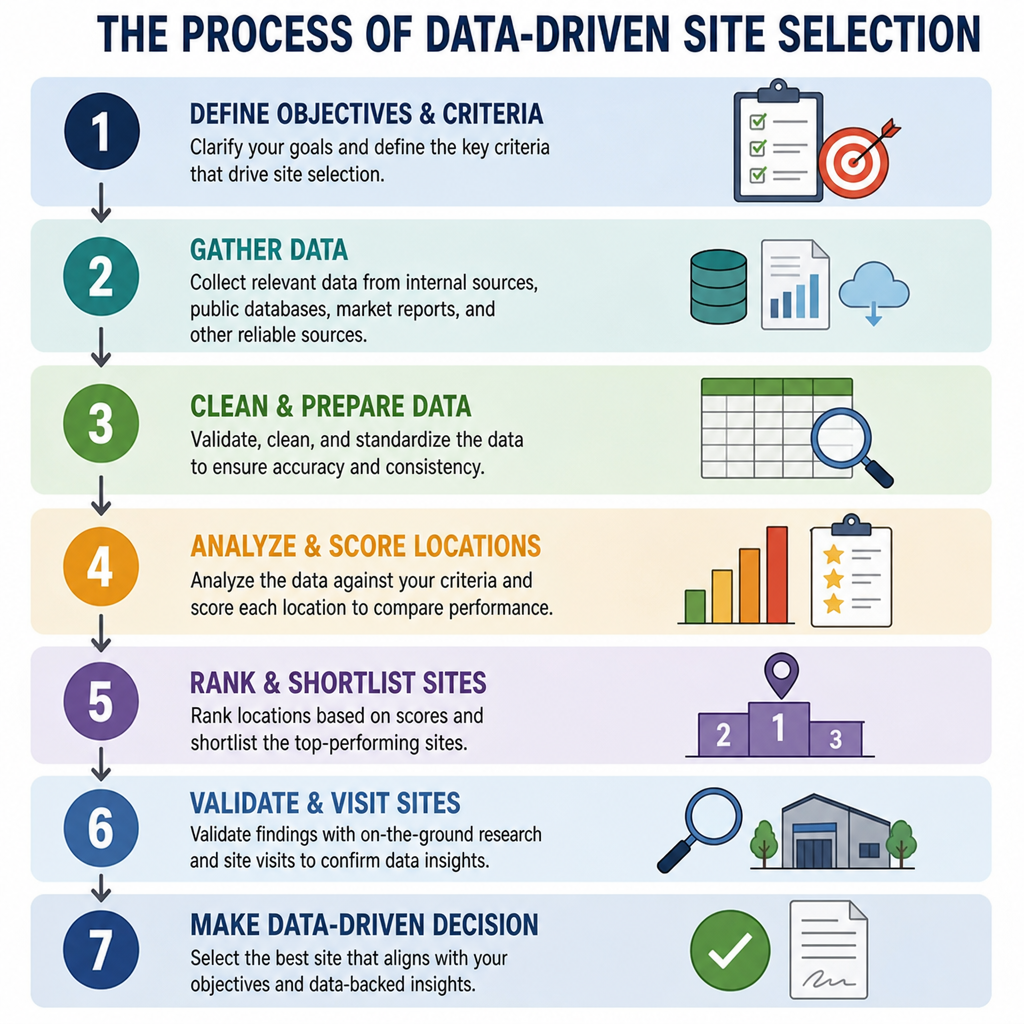
If you are ready to implement a data-driven strategy for your next opening, here is a practical, step-by-step workflow to get the most out of your software.
Step 1: Define Your Concept's DNA: Before opening the software, clearly define what makes your restaurant tick. Write down your target demographic, your average ticket size, your peak operating hours, and your space requirements.
Step 2: Input Your Criteria: Feed this DNA into your site evaluation tool. Set your filters. For example: Show me areas with a median age of 25-40, an average household income over $75,000, and an average daily traffic count of at least 15,000 vehicles.
Step 3: Analyze the Heat Maps: Look at the visual data generated. Identify the "hot spots" where your target audience lives or works.
Step 4: Layer the Competitor Data: Turn on the competitor view. Are these hot spots already saturated with businesses similar to yours? If so, look for secondary hot spots that represent underserved markets.
Step 5: Evaluate Available Real Estate: Once you have narrowed down a prime neighborhood, pull up the commercial real estate data integration tab. Look for available properties within that specific micro-neighborhood.
Step 6: Run the Catchment and Accessibility Tests: For the top three properties, run drive-time and foot-traffic simulations. Ensure that getting to your front door is frictionless for the consumer.
Step 7: Finalize with a Site Visit: Data is incredibly powerful, but it should be paired with human observation. Once the software has identified the absolute best site, visit it in person to confirm the physical condition of the building and the overall "vibe" of the street.
How to Leverage Restaurant Analytics for Long-Term Success
The utility of a restaurant location analysis tool does not end on the day you sign your lease. The most successful hospitality groups use these tools continuously to adapt to changing market conditions.
Neighborhoods evolve. A new apartment complex might be built down the street, bringing an influx of young families. A major corporate office might relocate, drastically reducing your weekday lunch rush. By continuously monitoring your area with restaurant analytics, you can pivot your marketing strategies, adjust your menu, and tweak your operating hours to match the changing landscape.
Furthermore, when it is time to open your second, third, or tenth location, the data from your successful first location becomes the blueprint. You can look at the exact demographic and traffic mix that made your first store profitable, and instruct your software to find "lookalike" neighborhoods in other cities or states. This allows for scalable, low-risk expansion.
Conclusion
Choosing where to open your restaurant is a decision that will ripple through every aspect of your business, from your daily sales volume to your marketing budget and staff retention. In today's highly competitive hospitality landscape, relying on intuition or a simple drive-by is no longer sufficient.
By embracing location intelligence and utilizing a robust restaurant location analysis tool, you transition from guessing to knowing. You gain the power to understand complex demographic shifts, evaluate pedestrian and vehicular accessibility, outmaneuver competitors, and seamlessly navigate real estate and zoning hurdles.
Investing in a data-driven site selection process is not just about finding a building; it is about finding a home where your culinary vision can truly thrive. Run a free analysis with Restaurant Site Finder, trust the data, and set your new restaurant up for a lifetime of success.
Run a free location analysis
Enter any address to get competitor mapping, market gaps, opportunity scoring, and concept ideas.
Analyze your location free Shop equipment at Horeca Store