Site Selection
Effective Strategies for Restaurant Market Research
A complete guide to restaurant market research covering primary and secondary research, customer personas, competitive gap analysis, feasibility studies, SWOT, site selection, and hands-on dining insights.
Key Takeaways
- Restaurant market research is non-negotiable, passion alone does not pay the bills; data-driven preparation separates thriving restaurants from shuttered storefronts.
- Combine primary research (surveys, focus groups) with secondary data (census, industry reports) for the most accurate picture.
- Build customer personas, map competitive gaps, run a feasibility study, and apply SWOT before signing a lease.
- Accelerate site research free at Restaurant Site Finder.
Opening a restaurant is a dream shared by many, often fueled by a passion for culinary excellence and a desire to bring people together. However, the reality of the hospitality business is that passion alone does not pay the bills. The difference between a thriving local hotspot and a shuttered storefront usually comes down to one critical factor: preparation. This is where restaurant market research becomes the cornerstone of your business plan.
Whether you are launching a fast-casual vegan cafe or a high-end steakhouse, understanding your local environment is non-negotiable. Making decisions based on gut feelings rather than data is a fast track to failure. By diving deep into the dining market, you can mitigate risks, tailor your offerings, and position your brand for long-term profitability.
In this comprehensive guide, we explore the essential strategies and actionable steps you need to know about how to do market research for a restaurant, ensuring your culinary venture is built on a foundation of solid data.
The Foundation of Food Industry Research
At its core, food industry research is the systematic process of gathering, analyzing, and interpreting information about your target market, competitors, and the overall economic environment. It is the compass that guides your business decisions, from menu design to marketing campaigns.
When you engage in thorough food restaurant market research, you are answering vital questions: Who are my customers? What do they want to eat? How much are they willing to pay? Who is already serving them?
Primary vs Secondary Research for Food Service
To build a robust market evaluation, you must utilize two main types of research methodologies:
- Primary Research: This involves gathering first-hand data directly from your potential customers. It includes surveys, interviews, and direct observations. Because it is tailored specifically to your business, primary research yields highly specific dining insights.
- Secondary Research: This involves analyzing existing data that has already been collected by others. This includes government census data, food industry consumer trend reports, and broad restaurant statistics published by industry associations.
For the most accurate market analysis, a healthy mix of both primary and secondary research is essential.
Understanding Your Target Audience
You cannot create a successful restaurant if you do not know who you are feeding. Developing a deep understanding of consumer behavior in your specific area is the most critical step in your research journey.
Developing Restaurant Customer Personas
A target audience is more than just an age range and an income bracket. To truly understand your potential guests, you need to create detailed restaurant customer personas. A persona is a semi-fictional representation of your ideal customer based on market research and real data.
For example, instead of targeting "millennials," you might create a persona named "Eco-Conscious Emily", a 28-year-old professional who values sustainable sourcing, prefers plant-based options, and is willing to pay a premium for ethically sourced ingredients. Building 3 to 4 distinct personas helps you tailor your marketing messages and menu offerings with laser precision.

Local Population Density and Spending Habits
Your restaurant's success is physically bound to its geographic location. Therefore, analyzing local population density and spending habits is paramount. You need to know if there are enough people within a 3-to-5-mile radius to sustain your business.
Look into demographic data to determine the average household income, employment rates, and discretionary spending in your target neighborhood. A high population density of college students might support a late-night, budget-friendly pizzeria, but it likely won't sustain a fine-dining establishment requiring a $150 average spend per head.
Analyzing the Competition and Market Gaps
You are not operating in a vacuum. To carve out your slice of the pie, you must conduct a thorough competitive landscape analysis for food businesses in your area.
Identifying Gaps in the Local Dining Market
Your goal should not be to open the fifth burger joint on a three-block stretch. Instead, you want to focus on identifying gaps in the local dining market. What is missing? What are local residents constantly driving out of town to find?
To find these gaps, create a spreadsheet of all direct competitors (those serving similar cuisine) and indirect competitors (those competing for the same dining dollars, even if the food is different). Note their price points, menu offerings, operating hours, and target demographics. If you notice a neighborhood has a high density of young families but lacks family-friendly restaurants with healthy kids' menus, you have just found a lucrative gap.
Calculating Market Share for New Eateries
Once you know who your competitors are, you can begin calculating market share for new eateries. While exact numbers are difficult to pin down before opening, you can estimate the total market demand by looking at the population's dining-out budget.
If your target neighborhood spends an estimated $10 million annually on dining out, and there are currently 20 restaurants in the area, you can estimate what percentage of that revenue you realistically need to capture to hit your financial goals. This keeps your revenue projections grounded in reality rather than optimism.
Evaluating Feasibility and Strategy
Before signing a lease or securing a loan, you must synthesize your research into actionable strategic frameworks.
How to Conduct a Restaurant Feasibility Study
Learning how to conduct a restaurant feasibility study is what separates aspiring dreamers from savvy entrepreneurs. A feasibility study takes your initial concept and stress-tests it against the realities of the market. It typically includes:
- Concept Overview: A detailed description of your theme, menu, and service style.
- Market Feasibility: Evidence that a demand exists based on your restaurant industry market research.
- Financial Feasibility: Projected startup costs, operating expenses, break-even analysis, and revenue projections.
- Operational Feasibility: An assessment of whether you can source the necessary labor and management to run the venue.
If the numbers in your feasibility study do not add up, it is much cheaper to pivot your concept now than after you have opened your doors.
SWOT Analysis for Dining Establishments
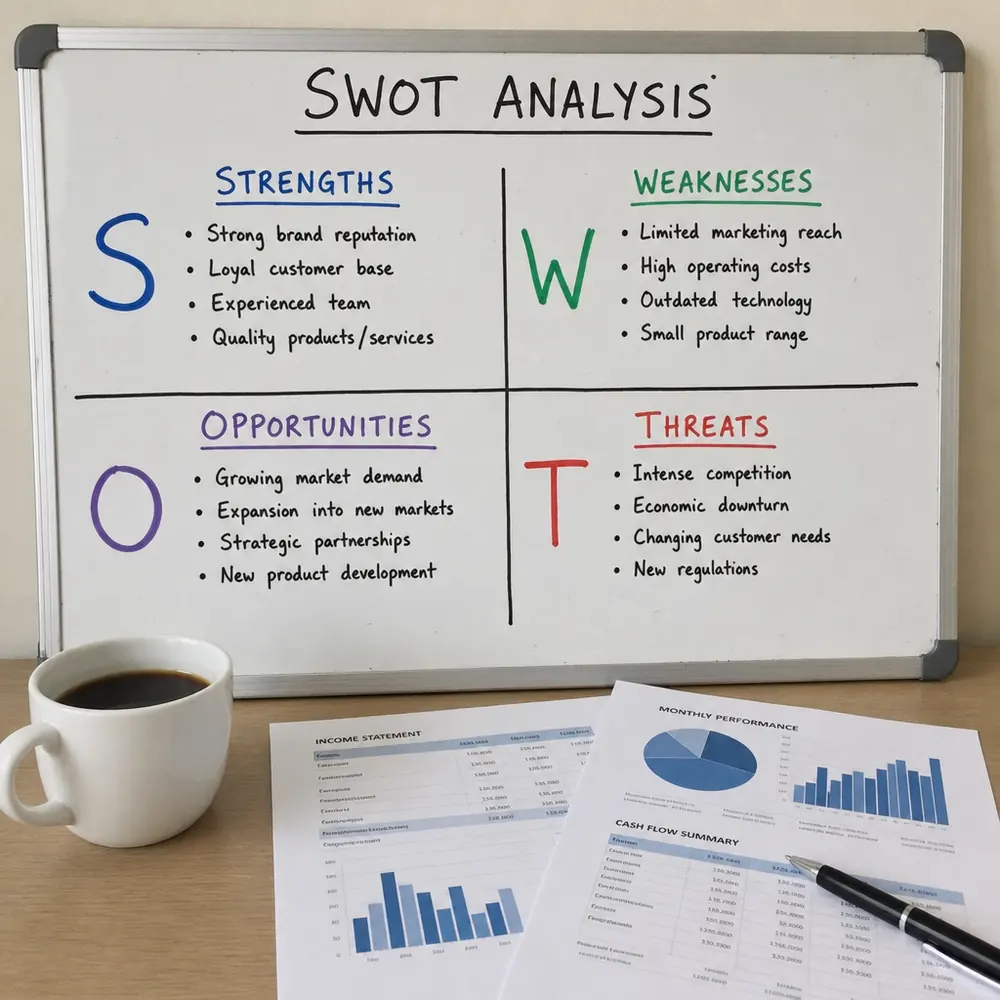
A classic business tool that remains highly effective is the SWOT analysis for dining establishments. This exercise forces you to look at your business objectively:
- Strengths: What do you do better than anyone else? (e.g., An exclusive partnership with a famous local chef).
- Weaknesses: Where are you vulnerable? (e.g., Lack of prior restaurant ownership experience).
- Opportunities: What external factors can you capitalize on? (e.g., A new office building opening across the street).
- Threats: What external factors could hurt you? (e.g., Rising food costs or a looming economic downturn).
For comprehensive market research, restaurant operators should update their SWOT analysis annually to stay ahead of the curve.
Location, Operations, and Pricing Strategies
With your audience defined and your concept proven feasible, it is time to look at the physical and operational logistics of your dining establishment.
Restaurant Site Selection Criteria
In the hospitality world, location can make or break you. Your restaurant site selection criteria should be heavily influenced by the data you gathered earlier. Key factors to consider include:
- Visibility and Signage: Can pedestrians and drivers easily see your restaurant?
- Foot and Vehicle Traffic: How many people pass by your location daily?
- Accessibility and Parking: Is it easy for customers to get to you?
- Zoning and Infrastructure: Does the building already have proper ventilation, grease traps, and commercial zoning?
Run a free location analysis at Restaurant Site Finder to score any address on competitor density, demographic match, and opportunity before you tour properties.
Restaurant Supply Chain Assessment
A brilliant menu means nothing if you cannot reliably source the ingredients. A thorough restaurant supply chain assessment ensures that you can get the quality of products you need, consistently, and at a price that allows for profitability.
Research local farmers, artisanal producers, and broadline distributors. Understand the volatility of commodity prices. If your concept relies heavily on fresh seafood, but you are located in a landlocked area with poor distribution routes, your profit margins will be constantly under threat.
Restaurant Pricing Strategy Development
Pricing your menu is a delicate balancing act. Effective restaurant pricing strategy development relies on three pillars:
- Cost-Plus Pricing: Calculating the exact cost of the ingredients on a plate and marking it up to achieve your desired food cost percentage (typically between 25% and 35%).
- Competitor-Based Pricing: Looking at what your direct competitors charge for similar items and pricing yours accordingly.
- Perceived Value Pricing: Pricing based on what the customer believes the experience is worth.
Hands-On Tactics for Deep Dining Insights
While secondary data is incredibly valuable, nothing beats the insights you get directly from the people eating your food.
Focus Groups for Menu Testing
Before finalizing your menu, host focus groups for menu testing. Invite a diverse group of individuals who fit your target customer personas. Serve them variations of your proposed dishes and ask for honest feedback on taste, presentation, portion size, and what they would be willing to pay.
This process not only prevents you from launching a menu item that falls flat, but it also generates early word-of-mouth marketing among your testers.
Restaurant Mystery Shopper Programs
If you are purchasing an existing restaurant or managing a chain, implementing restaurant mystery shopper programs is an incredible way to gather unbiased, real-world data. Mystery shoppers act as regular customers but report back on specific metrics: wait times, cleanliness, server knowledge, and food quality.
Analyzing Online Restaurant Reviews for Insights
For existing businesses, the internet is a goldmine of data. Dedicate time to analyzing online restaurant reviews for insights. Don't just look at the star rating; read the text.
Are multiple customers complaining that the music is too loud? Are people consistently raving about your seasonal cocktails? Analyzing Yelp, Google, and TripAdvisor reviews for common keywords and sentiments allows you to make micro-adjustments that yield massive improvements in customer satisfaction.

Navigating the Restaurant and Pub Industry Market Research
The food service industry is not a monolith. Different sectors require different research approaches. For instance, restaurant and pub industry market research will look very different from research for a quick-service drive-thru.
If you are opening a pub or a bar-centric restaurant, your research must heavily weigh local liquor laws, late-night public transportation options, and the competitive landscape of entertainment in addition to food. Understanding the nuances of your specific niche is what turns generic data into highly actionable restaurant insights.
Keeping Up with Market Trends
The culinary landscape is notoriously fast-paced. What is wildly popular today might be completely obsolete in three years. Therefore, staying on top of market trends is a continuous requirement, not a one-time task.
To keep your finger on the pulse of the market research restaurant industry professionals rely on, make it a habit to regularly review food industry consumer trend reports from organizations like the National Restaurant Association, Mintel, or Technomic.
Are consumers shifting toward non-alcoholic mocktails? Is there a rising demand for hyper-local sourcing or zero-waste kitchens? By keeping track of these broader restaurant statistics and trends, you can continuously evolve your menu and marketing to stay relevant.
Conclusion
Conducting comprehensive restaurant market research is not an option; it is an absolute necessity for survival and growth in the highly competitive hospitality sector. From mastering how to do market research for a restaurant to executing a flawless restaurant site selection criteria plan, every data point you collect serves as a building block for your future success.
By understanding your target audience, carefully monitoring the competitive landscape, and constantly adapting to changing consumer behaviors, you can build a dining experience that not only attracts guests but turns them into lifelong, loyal patrons.
Take the time to do the research, crunch the numbers, and let data guide your culinary vision to sustained profitability. Start with a free AI-powered location scan at Restaurant Site Finder, then explore our restaurant market analysis guide for deeper methodology.
Frequently Asked Questions
How do you do market research for a restaurant?
Combine primary research (surveys, interviews, focus groups) with secondary research (census data, industry reports). Analyze demographics, competition, spending habits, and market gaps.
What is a restaurant feasibility study?
It stress-tests your concept through concept overview, market feasibility, financial feasibility, and operational feasibility before you commit capital.
What is the difference between primary and secondary restaurant research?
Primary research gathers first-hand customer data; secondary research analyzes existing census, industry, and trend reports.
How do you find gaps in the local dining market?
Map direct and indirect competitors by cuisine, price, hours, and demographic, then identify underserved segments in your trade area.
Is Restaurant Site Finder free for market research?
Yes. Enter any US address at restaurantsitefinder.com for competitor mapping and opportunity scoring.
Run a free location analysis
Enter any address to get competitor mapping, market gaps, opportunity scoring, and concept ideas.
Analyze your location free Shop equipment at Horeca Store