Guides
Essential Tips for Starting a Restaurant
Essential tips for starting a restaurant, concept clarity, business planning, location fit, menu design, team training, cost control, marketing, and a controlled opening before launch day.
Key Takeaways
- Define your concept in a one-page brief before you spend on design, equipment, or lease deposits, service style drives every later decision.
- Build an honest restaurant business plan with startup costs, cash flow, and break-even point math, not projections written only for lenders.
- Choose a location that matches your guest and format; validate trade areas with Restaurant Site Finder before signing.
- Train systems, control prime cost, start marketing early, and open with a controlled test service, not a chaotic first Saturday.
Starting a restaurant is exciting, but it is also a serious business decision that requires planning, discipline, and a clear understanding of your market. A successful restaurant business is built on more than great food; it needs a focused concept, reliable operations, strong financial controls, and consistent restaurant marketing. The tips below will help you move from idea to opening day with fewer surprises and a stronger foundation.
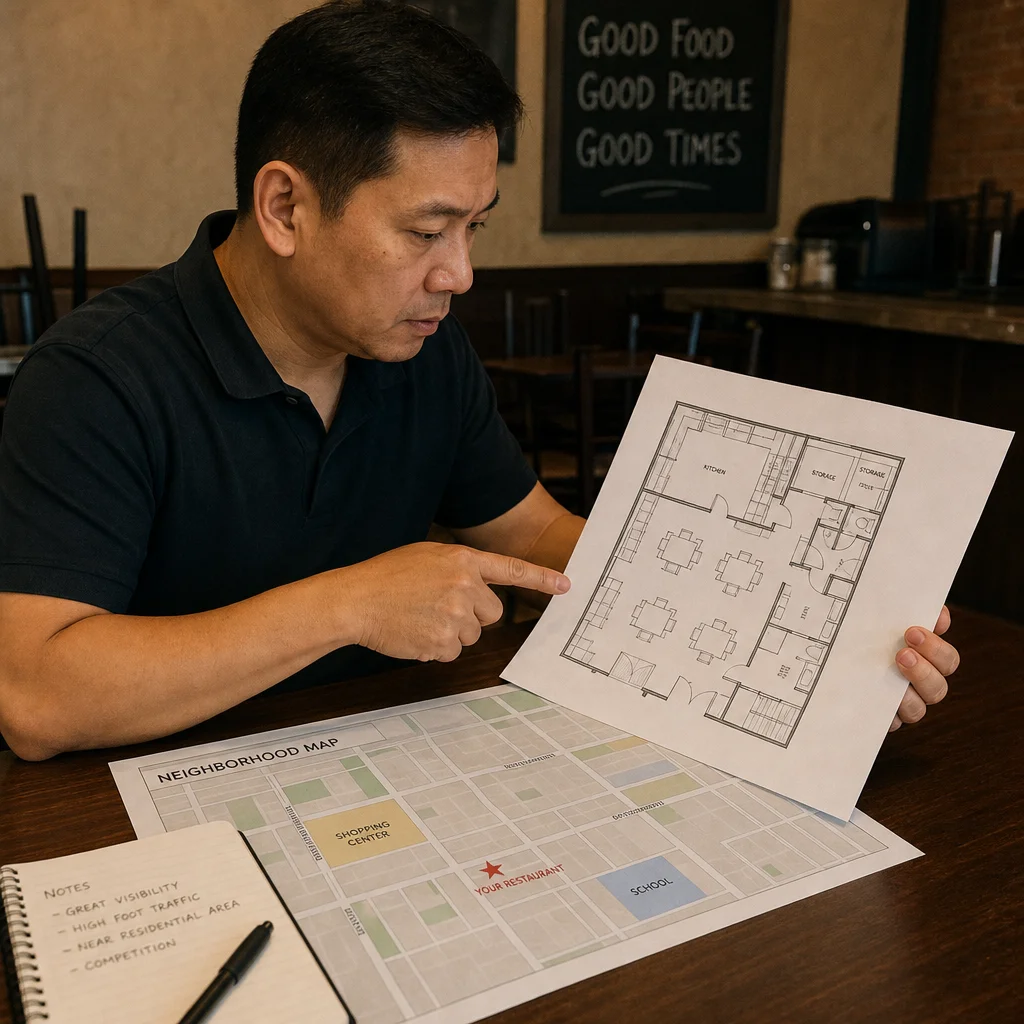
What should you decide before opening a restaurant?
Before opening a restaurant, decide who you serve, what experience you provide, how you will make money, and what systems will keep the business running smoothly. These choices shape everything else, from your menu and location to hiring, pricing, and food service standards. The clearer your decisions are early on, the easier it becomes to avoid costly changes later.
A restaurant can look simple from the dining room, but behind the scenes it is a network of decisions happening at once. Ingredients must arrive on time. Staff must know their roles. Guests must understand why they should choose you instead of another option nearby. If your concept is vague, every later decision becomes harder.
Start by writing a one-page concept brief. This is not a full business plan yet; it is a practical snapshot of your idea. Include the type of cuisine, service style, target customer, atmosphere, price range, and the reason your restaurant deserves a place in the market. For a deeper framework, see our restaurant concept development guide.
A useful concept brief should answer:
- Who is the ideal guest?
- What problem or craving does the restaurant solve?
- Is the experience quick, casual, premium, family-friendly, social, or convenient?
- What will guests remember after they leave?
- What makes the concept realistic for your budget and location?
This early clarity helps you make aligned decisions. A small lunch-focused café has different staffing, equipment, menu, and marketing needs than a full-service dinner restaurant. A delivery-heavy food service model requires different packaging, timing, and technology than a dine-in experience.
Build a practical business plan
A business plan does not need to be complicated, but it does need to be honest. Many new owners focus heavily on design, branding, and recipes while underestimating rent, labor, insurance, repairs, permits, waste, and slow early sales. A strong plan forces you to look at the numbers before you commit too much money.
Your business plan should explain the concept, market, startup costs, operating costs, pricing strategy, staffing needs, and sales goals. It should also include a realistic timeline. Restaurant openings often involve delays, so give yourself room for inspections, equipment installation, hiring, staff training, and test service. Use our how to write a restaurant business plan guide for lender-ready structure.
Focus especially on cash flow. A restaurant business can be busy and still struggle if expenses are too high or payments are poorly timed. Build a conservative budget that includes a cushion for unexpected costs. Equipment can break, construction can run long, and initial marketing may need more support than expected.
Key planning areas include:
- Startup costs: Lease deposits, renovations, equipment, furniture, signage, technology, licenses, legal fees, opening inventory, and pre-opening payroll.
- Monthly fixed costs: Rent, utilities, insurance, software, loan payments, and management salaries.
- Variable costs: Food, beverages, hourly labor, packaging, merchant fees, cleaning supplies, and delivery-related expenses.
- Sales assumptions: Expected covers, average check size, order volume, operating days, and seasonal changes.
- Break-even point: The sales level needed to cover your regular costs.
Do not create projections only for investors or lenders. Use them as a management tool. Once the restaurant opens, compare actual results with your plan and adjust quickly. Cross-check totals against our 2026 restaurant opening cost ranges.
Choose a location that supports the concept
Location can strengthen a restaurant, but it cannot fix a weak concept or poor operations. The best site is not always the busiest or most attractive space. It is the location that matches your target guest, service model, budget, and visibility needs.
Look at the area through the eyes of your future customer. If you are planning a weekday lunch spot, office density and walking traffic matter. If you are planning a neighborhood dinner restaurant, parking, evening foot traffic, nearby households, and local competition may matter more. If you expect strong takeout sales, ease of pickup and delivery access become important.
Before signing a lease, study the neighborhood at different times of day and week. A street that looks active on Saturday afternoon may be quiet on weekday evenings. A space with low rent may have visibility issues, limited ventilation, difficult parking, or expensive buildout needs. Screen finalists with our Restaurant Site Finder guide for opening a new restaurant and free location analysis tool.
Consider these location factors:
- Visibility from the street or main traffic path
- Access for pedestrians, drivers, cyclists, and delivery couriers
- Nearby businesses, offices, schools, apartments, or entertainment venues
- Competitors and complementary businesses
- Zoning and permitted food service use
- Kitchen infrastructure, ventilation, plumbing, and electrical capacity
- Lease terms, renewal options, and restrictions
Negotiate carefully. Rent is one of the largest fixed costs in a restaurant business, and a lease that is too expensive can create pressure every month. If possible, have a qualified professional review the lease before signing.
Design a menu that is focused and profitable
A good menu is not simply a list of dishes you enjoy making. It is an operational, financial, and brand tool. It tells guests what kind of restaurant you are, guides kitchen workflow, affects inventory, shapes labor needs, and influences profitability.
New restaurants often make the menu too large. A broad menu may seem appealing because it offers more choice, but it can create problems. More ingredients mean more storage, more waste, more prep time, and more training. A focused menu is easier to execute consistently and easier for guests to understand.
Each menu item should earn its place. Consider ingredient cost, prep complexity, cook time, equipment needs, staff skill, guest demand, and how well it fits the concept. Items that share ingredients can help reduce waste and simplify purchasing. For example, one roasted vegetable can appear in a salad, grain bowl, and side dish if each use feels intentional.
Use these menu development principles:
- Keep the opening menu manageable.
- Build around ingredients you can source reliably.
- Test recipes for taste, portion size, speed, and consistency.
- Price items based on food cost percentage and perceived value, not guesswork.
- Include options that work well during busy service.
- Avoid dishes that require too many special ingredients or fragile steps.
- Revisit the menu after launch based on sales, waste, and guest feedback.
Menu design also affects restaurant marketing. Clear categories, appealing descriptions, and a strong signature item make it easier to promote the restaurant online and in person. Guests need something simple to remember and recommend.
Create systems before the first guest arrives
Great service depends on systems, not luck. When a restaurant is busy, staff need clear procedures for opening, closing, prep, cleaning, ordering, reservations, complaints, and emergencies. Without systems, every shift depends too heavily on whoever happens to be working that day.
Standard operating procedures do not need to be complicated. They should be practical, visible, and easy to train. Start with the tasks that happen every day. Document how the dining room is set, how ingredients are stored, how orders are entered, how food is checked before leaving the kitchen, and how issues are escalated.
Useful systems to create early include:
- Opening and closing checklists
- Prep lists by station
- Cleaning schedules
- Inventory counts
- Vendor ordering routines
- Food safety procedures
- Reservation and waitlist processes
- Cash handling and payment procedures
- Guest complaint response steps
- Staff communication channels
These systems protect consistency. They also make training easier as the team grows. If only one person knows how something works, the business becomes fragile. Documented processes help the restaurant run even when the owner is not on site.
How do you hire and train the right restaurant team?
You hire the right team by looking for people who can support your service style, learn your systems, and treat guests and coworkers with respect. Experience can help, but attitude, reliability, communication, and willingness to follow standards are just as important. Training then turns individual employees into a coordinated team.
Begin by defining roles clearly. A server in a casual counter-service restaurant needs different skills than a server in a full-service dining room. A line cook in a compact menu operation needs speed and consistency, while a prep cook may need strong organization and attention to detail.
Write job descriptions that explain responsibilities, schedule expectations, physical requirements, and workplace standards. During interviews, ask practical questions about busy shifts, teamwork, guest complaints, and reliability. Be realistic about the work. Overselling the job may lead to quick turnover.
Training should cover more than tasks. New employees need to understand the restaurant's concept, menu, hospitality standards, safety practices, and communication expectations. They should know what to do when something goes wrong, not just when everything goes right.
A simple training checklist might include:
- Brand and guest experience overview
- Menu tasting and ingredient notes
- Service steps from greeting to goodbye
- Point-of-sale practice
- Food safety and cleanliness standards
- Emergency procedures
- Role-specific station training
- Shadow shifts with experienced staff
- Feedback after each training shift
Strong training reduces confusion and builds confidence. It also shows employees that the business is organized, which can improve morale from the start.
Control costs without hurting quality
Cost control is one of the most important habits in restaurant management. The goal is not to cut everything as cheaply as possible. The goal is to understand where money goes, reduce waste, and protect the guest experience while keeping the business financially healthy.
Track food cost, labor cost percentage, waste, discounts, refunds, and sales mix. Small issues can become expensive if nobody is watching. Over-portioning, poor inventory rotation, inefficient scheduling, and excessive menu complexity can quietly reduce profit.
Start with consistent recipes and portioning. If one cook uses more of an expensive ingredient than another, your cost calculations become unreliable. Use scales, scoops, ladles, and clear prep instructions where appropriate. Train the team on why consistency matters, not just how to plate a dish.
Inventory should be frequent enough to catch problems early. You do not need to count every item every day, but high-cost or high-waste items deserve close attention. Compare purchases, usage, and sales to spot unusual patterns.
Practical cost-control habits include:
- Review vendor invoices regularly.
- Track best-selling and slow-moving items.
- Use prep levels based on expected demand.
- Rotate inventory correctly to reduce spoilage.
- Schedule labor around real traffic patterns.
- Monitor comps, voids, and refunds.
- Update pricing when costs change significantly.
Quality should remain central. Guests notice when portions become inconsistent or ingredients decline. Smart cost control protects value rather than weakening it.
Build restaurant marketing into the launch plan
Restaurant marketing should begin before opening day, not after sales feel slow. People need time to notice you, understand your concept, and decide to visit. A launch plan helps build awareness, collect early interest, and create momentum.
Start with the basics: a clear name, consistent visual identity, accurate online listings, a simple website or landing page, and social profiles that explain what you offer. Share useful updates as the opening approaches, such as menu previews, behind-the-scenes preparation, hiring announcements, and progress photos. Need a name? Try our restaurant name generator.
Local marketing matters. Introduce the restaurant to nearby residents, businesses, community groups, and complementary local operators. If your concept fits office workers, connect with nearby workplaces. If it is family-friendly, focus on neighborhoods and local events. If it is date-night oriented, emphasize atmosphere, reservations, and signature dishes.
Your opening marketing checklist can include:
- Claim and complete major online business profiles.
- Add high-quality food, interior, and exterior photos.
- Create a simple website with hours, location, menu, and contact details.
- Build an email list for opening updates.
- Post consistently on relevant social platforms.
- Invite friends, neighbors, or local partners to soft-opening events if appropriate.
- Prepare signage that clearly communicates the opening.
- Encourage early guests to share honest feedback.
After opening, restaurant marketing becomes an ongoing rhythm. Promote seasonal items, special events, catering, delivery, loyalty offers, or community involvement when relevant. More importantly, make sure the actual experience matches the message. Marketing can bring guests in once, but food and service bring them back.
Prepare for a controlled opening
Opening day should not be the first time your team works together under pressure. A controlled opening gives you a chance to test systems, timing, equipment, recipes, service flow, and communication before full demand arrives.
Many restaurants use friends-and-family meals, limited hours, reduced menus, or reservation-only previews to identify problems. The purpose is not perfection. The purpose is learning. Watch where tickets slow down, where guests seem confused, where staff need clearer direction, and which dishes are harder to execute than expected.
During test service, gather feedback in a structured way. Ask about food temperature, timing, menu clarity, atmosphere, friendliness, and overall ease of the experience. Avoid trying to fix everything at once. Prioritize issues that affect safety, consistency, speed, and guest satisfaction.
Before expanding hours or seating, confirm that:
- Staff understand their roles.
- The kitchen can handle expected ticket volume.
- Ordering and payment systems work reliably.
- Core menu items are consistent.
- Cleaning and reset routines are manageable.
- Guest feedback is being reviewed and addressed.
- Managers know how to handle common problems.
A slower, more controlled start can protect your reputation. Guests may forgive small opening hiccups, but repeated confusion, long waits, or inconsistent food can be harder to overcome.
Keep learning after launch
Opening a restaurant is not the finish line. It is the beginning of a new phase where real guest behavior replaces assumptions. Pay attention to what people order, when they visit, what they praise, what they leave behind, and what they ask for repeatedly.
Use data and observation together. Sales reports can show what is happening, but staff conversations and guest feedback help explain why. Maybe a dish sells well but slows down the kitchen. Maybe a lunch item is popular but priced too low. Maybe guests love the food but struggle to find parking or understand the ordering process.
Set a regular review rhythm. Weekly reviews can focus on immediate operations, while monthly reviews can cover menu performance, marketing results, labor patterns, and financial progress. This habit helps you make calm decisions instead of reacting only when problems become urgent.
The best restaurant operators stay curious. They protect the core idea while improving the details. Over time, small refinements in service, menu, scheduling, purchasing, and communication can make the restaurant business stronger and more resilient.
Final takeaway
Starting a restaurant takes creativity, but lasting success depends on preparation and consistency. Define your concept, plan your finances, choose the right location, build a focused menu, train your team, control costs, and treat restaurant marketing as an ongoing part of the business. When strong food service meets clear systems and genuine hospitality, your restaurant has a much better chance to grow from an exciting idea into a sustainable operation.
Before you sign a lease or order equipment, run a free location scan at Restaurant Site Finder and review our restaurant equipment checklist for new owners so opening day starts on solid ground.
Run a free location analysis
Enter any address to get competitor mapping, market gaps, opportunity scoring, and concept ideas.
Analyze your location free Shop equipment at Horeca Store