Finance
Restaurant Rent: How Much Should You Pay?
Restaurant rent, how much you should pay, sales-based affordability tests, full occupancy costs, commercial rent drivers, NYC considerations, food truck vs restaurant, lease terms, checklist, and smart cost management.
Key Takeaways
- Restaurant rent should fit projected sales and full overhead, not just how attractive the space looks or what the landlord asks.
- Calculate total occupancy cost (rent plus CAM, taxes, insurance, utilities, and buildout) and stress-test against slow months before signing.
- Compare value, not price alone: a higher-rent site with visibility and existing kitchen infrastructure may outperform a cheap raw space.
- Validate whether projected sales can support the lease with free analysis at Restaurant Site Finder.
Restaurant rent is one of the biggest fixed expenses in a food business, and the right number depends on your sales potential, location, format, lease terms, and total overhead. A great space can help you attract customers, but a rent bill that is too high can weaken cash flow before you ever solve staffing, food cost, utilities, repairs, and marketing. This guide explains how to think about restaurant rent costs, compare lease options, and decide what you can realistically afford.
How much should a restaurant pay in rent?
A restaurant should usually pay rent that fits comfortably inside projected sales, not rent based only on how attractive the location looks. Many operators use rent as a percentage of gross sales as a quick test, then check it against full restaurant overhead costs to see whether the business can still make money after payroll, food, utilities, insurance, maintenance, and debt payments. If the rent only works when every seat is full and every month is strong, the lease is probably too risky.
A common planning approach is to keep base rent and related occupancy expenses within a manageable slice of revenue. That does not mean every restaurant has the same limit. A small counter-service shop, a fine dining restaurant, a bakery, and a bar all have different labor models, ticket sizes, buildout needs, and sales patterns.
The better question is not simply "What are the commercial rent prices in this neighborhood?" It is "What level of sales must this location produce to make the rent safe?" A busy corner can justify higher rent if it reliably brings traffic, visibility, delivery demand, and repeat visits. A cheaper space can become expensive if it needs major construction, has poor visibility, or limits your hours of operation. See what percentage of sales rent should be for benchmark ratios.
Rent is only one part of restaurant overhead
Restaurant rent costs are easy to focus on because they appear as one clear monthly number. The danger is treating rent as separate from the rest of the business. In reality, rent competes with every other dollar your restaurant needs to operate.
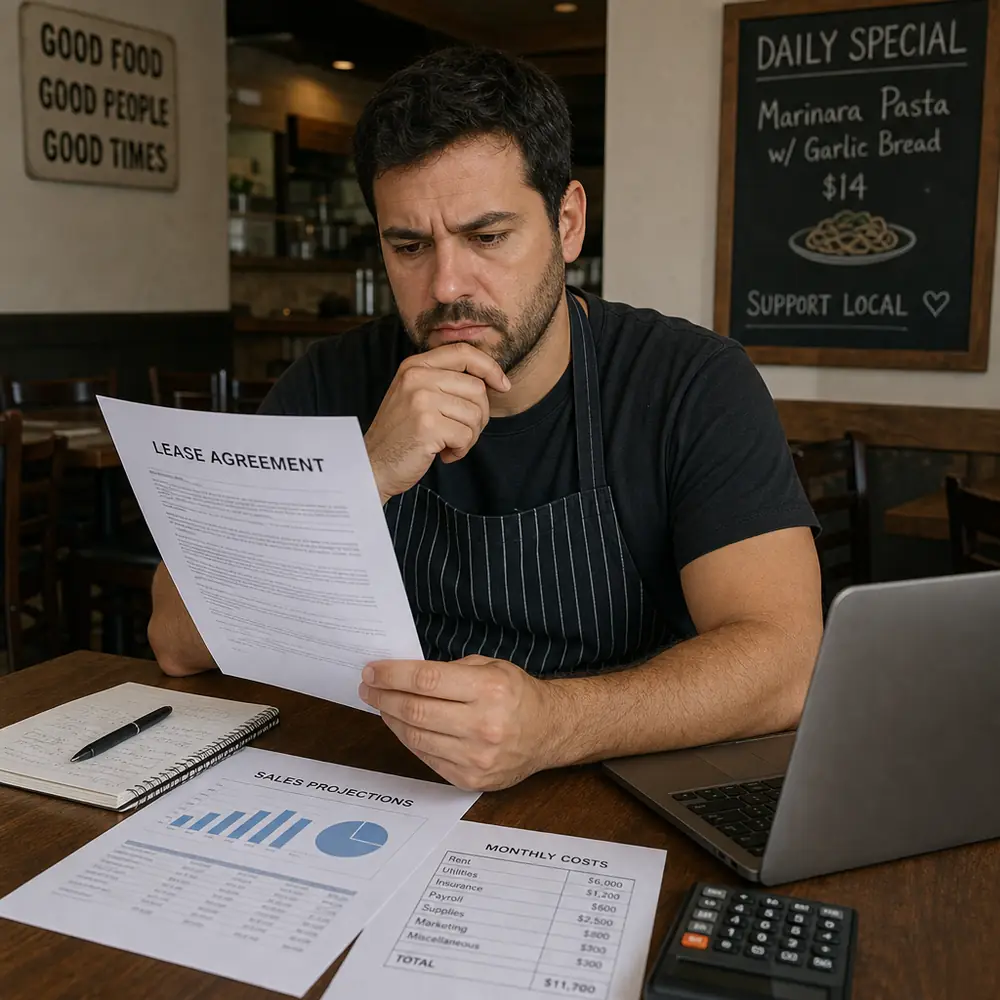
Restaurant overhead costs may include fixed and semi-fixed expenses such as utilities, internet, point-of-sale systems, accounting, insurance, equipment maintenance, cleaning services, pest control, licenses, trash removal, security, and software. Some of these costs are predictable, while others rise as your sales grow or as your building gets older.
When reviewing restaurant lease rates, look beyond the base rent. A lease may include common area maintenance charges, property taxes, insurance contributions, percentage rent, annual escalations, late fees, repair obligations, and restrictions on signage or outdoor seating. Two spaces with the same advertised rent can have very different real monthly costs once those items are included.
Before signing, estimate your full occupancy cost. That may include:
- Base monthly rent
- Additional rent, such as taxes, insurance, or building fees
- Utilities that are not included in the lease
- Maintenance responsibilities assigned to the tenant
- Required permits, inspections, or compliance upgrades
- Buildout costs, especially plumbing, ventilation, grease traps, electrical, and accessibility improvements
- Security deposit, prepaid rent, legal review, and broker fees where applicable
A lease that looks affordable at first glance can become stressful if it shifts too many building expenses to the tenant. Always ask what is included, what is excluded, and what can increase during the lease term. Restaurant profit margins and unit economics shows how occupancy fits the full P&L.
The sales-based rent test
A practical rent decision starts with revenue. Estimate conservative monthly sales, then compare rent to that number. If you are opening a new concept, use cautious assumptions instead of best-case projections. If the restaurant already exists, look at actual monthly sales across slow, average, and strong periods.
Here is a simple way to think through it:
- Estimate realistic monthly gross sales.
- Calculate base rent as a percentage of those sales.
- Add taxes, maintenance fees, insurance charges, and utilities tied to the space.
- Compare total occupancy cost to your expected sales.
- Rework the model using a slow month, not just an average month.
For example, if your projected sales drop during winter, after a local event season, or during school breaks, your rent does not drop with them. Fixed costs are most dangerous when revenue is uneven. That is why a rent number should be tested against slower periods before you commit.
It also helps to reverse the math. If a landlord quotes a monthly rent, ask how much revenue the restaurant would need to generate for that rent to feel healthy. If the required sales seem unrealistic for the seating capacity, service style, hours, or neighborhood traffic, the space may not be the right fit.
What affects commercial rent prices for restaurants?
Commercial rent prices are shaped by more than square footage. Restaurant spaces are specialized, and landlords often price them based on visibility, foot traffic, infrastructure, and the risk or value of a food-service tenant. A second-generation restaurant with an existing hood, walk-in cooler, grease trap, and dining room layout may command more rent, but it can also reduce the cost and time needed to open.
Location matters, but "location" is not one thing. A space near offices may perform well at lunch and struggle at dinner. A tourist area may bring volume but require higher marketing, staffing, and speed. A residential neighborhood may build loyal repeat customers but need a strong evening and weekend strategy.
Important rent drivers include:
- Foot traffic and visibility: Corner spaces, transit corridors, and high-traffic streets often cost more.
- Condition of the space: A restaurant-ready space can reduce buildout costs, while a raw space may require major investment.
- Size and layout: Too much square footage can raise rent, labor, cleaning, and utility costs without increasing revenue.
- Kitchen infrastructure: Ventilation, gas, electrical capacity, plumbing, and refrigeration can affect both rent and startup costs.
- Lease length and flexibility: Longer terms may create security, but they also lock you into obligations.
- Local demand: Popular dining districts, dense urban markets, and limited restaurant inventory often push lease rates higher.
The key is to compare value, not just price. A higher-rent space that opens faster and needs less construction may be better than a cheaper space that drains cash for months before generating revenue. Screen trade areas at Restaurant Site Finder before touring properties.
Why are restaurant rent costs in NYC so different?
Restaurant rent costs NYC operators face can vary dramatically because the city contains many different restaurant markets within a small geographic area. A storefront in a high-demand Manhattan corridor is not comparable to a smaller neighborhood space in another borough, and even nearby blocks can perform differently based on transit access, tourism, office density, nightlife, and residential traffic. For New York operators, the lease review should be especially careful because small differences in size, fees, use restrictions, and buildout requirements can create large cost differences.
New York also adds pressure through competition, permitting complexity, older buildings, delivery logistics, storage limitations, and labor intensity. A compact restaurant may benefit from dense customer traffic, but it may also need off-site storage, frequent deliveries, or creative prep systems. A larger space may offer more seating, yet carry more rent and staffing risk.
If you are evaluating restaurant rent costs in NYC, avoid relying on neighborhood reputation alone. Walk the block at different times of day, study nearby concepts, observe delivery pickup patterns, and check whether the customer base matches your menu and price point. A location that is busy at 8 a.m. may not help a dinner concept, and a nightlife street may not support a breakfast-focused café.
Food truck permit costs vs restaurant rent: which is cheaper?
Food truck permit costs vs restaurant rent is not a simple comparison because the two models have different expense structures. A food truck may avoid a traditional dining room lease, but it can still require permits, commissary kitchen access, vehicle purchase or lease payments, fuel, maintenance, parking, insurance, storage, event fees, and local compliance costs. A restaurant usually has higher fixed occupancy costs, but it may offer more seating, storage, equipment capacity, brand presence, and predictable service hours.
The right choice depends on your concept. A truck can be useful for testing demand, serving events, reaching different neighborhoods, or building a following with a smaller footprint. A restaurant can be stronger for hospitality-driven concepts, full menus, alcohol service where permitted, private events, and a more permanent customer experience.
When comparing food business costs, look at the full operating model:
- Does the concept require a large kitchen or a limited menu?
- Will customers travel to you, or do you need to go where the demand is?
- How important are seating, restrooms, weather protection, and atmosphere?
- What permits, inspections, and commissary arrangements are required locally?
- How much storage and prep space do you need?
- Can the business operate consistently year-round?
A food truck is not automatically cheap, and a restaurant is not automatically too expensive. The better choice is the format that supports your menu, customer behavior, production needs, and profit model.
Lease terms can matter as much as the rent amount
A restaurant lease is not just a monthly payment. It is a long-term operating agreement that can shape your margins, flexibility, exit options, and ability to grow. A slightly higher rent with fair terms may be safer than a lower rent attached to strict obligations or unpredictable increases.
Pay close attention to escalation clauses. Annual increases can be manageable when planned, but they can become a problem if sales do not grow at the same pace. Percentage rent clauses, where the landlord receives additional rent after sales pass a certain point, should be modeled carefully so success does not create unexpected strain.
Also review assignment and sublease rights. If you need to sell the business, bring in a partner, relocate, or close, the lease can either provide flexibility or trap you in a costly commitment. Use restrictions are equally important. A lease should clearly allow your intended food service operations, including cooking methods, hours, delivery, catering, outdoor seating, or alcohol service if those are part of your plan.
Consider asking about:
- Tenant improvement allowances or rent abatement during construction
- Renewal options and how future rent will be determined
- Responsibility for HVAC, plumbing, roof, grease traps, and structural repairs
- Signage rights and visibility from the street
- Exclusivity clauses that prevent direct competitors in the same property
- Personal guarantees and whether they can be limited
- Conditions for transferring, selling, or closing the business
Before signing, have a qualified professional review the lease. The cost of review is small compared with the risk of accepting unclear repair duties, unrealistic rent increases, or restrictions that limit your revenue. Read how to find the right location for a restaurant for site and lease checks together.
A practical rent checklist before you sign
Rent becomes easier to evaluate when you slow the decision down and compare each space against the same criteria. Emotion can be useful when choosing a concept, but lease decisions need discipline. A beautiful dining room does not matter if the math fails.
Use this checklist before committing:
- Build a conservative sales forecast. Include slow months, ramp-up time, and realistic seating or order volume.
- Calculate full occupancy cost. Add base rent, extra charges, utilities, maintenance, deposits, and required improvements.
- Compare rent to the operating model. Make sure the concept can support rent after food, labor, and overhead.
- Inspect the infrastructure. Confirm hood systems, plumbing, electrical, gas, refrigeration, drainage, and accessibility needs.
- Estimate opening cash needs. Include buildout, permits, design, equipment, inventory, hiring, training, and marketing.
- Review restrictions. Make sure the lease allows your menu, hours, signage, delivery, events, and future plans.
- Plan for an exit. Understand what happens if sales disappoint or if you need to sell the business.
This process may reveal that the best space is not the cheapest one. It may also show that a high-profile space creates too much pressure. The goal is not to win the address; it is to build a food business that can survive normal ups and downs. Pair this with our Go/No-Go location decision guide.
Smart ways to manage restaurant rent costs
You may not control market pricing, but you can control how you approach the deal. Start by knowing your numbers before touring spaces. If you understand your maximum safe rent, you are less likely to be pulled into a lease that only works on optimistic sales.
Look for ways to reduce risk during the early months. Some operators negotiate free or reduced rent during buildout, a gradual rent step-up, landlord contributions to improvements, or renewal options that protect the business if the location works. Not every landlord will agree, but these items are worth discussing when the tenant is investing heavily in the property.
You can also improve rent efficiency by matching the space to the concept. A takeout-focused restaurant may not need a large dining room. A bakery may need production space more than premium seating. A bar may care deeply about frontage, late-night foot traffic, and layout. Every square foot should have a job.
Finally, track rent performance after opening. Compare actual sales to the assumptions you used when signing the lease. If rent is becoming too heavy, respond early by improving daypart sales, catering, private events, delivery profitability, menu engineering, or labor scheduling. Waiting until cash is tight leaves fewer options.
The takeaway
Restaurant rent should be judged by what the business can support, not by what a landlord asks or what nearby spaces appear to cost. The right lease gives your concept room to operate, grow, and handle slower months without constant cash pressure.
As you compare restaurant lease rates, keep the full picture in view: commercial rent prices, buildout needs, overhead, local demand, lease terms, and format choices such as a truck, kiosk, shared kitchen, or full restaurant. A disciplined rent decision will not guarantee success, but it can protect your margins and give your food business a stronger foundation from day one.
Run a free site analysis at Restaurant Site Finder to validate demand before you sign, and review restaurant startup costs for the full opening budget picture.
Run a free location analysis
Enter any address to get competitor mapping, market gaps, opportunity scoring, and concept ideas.
Analyze your location free Shop equipment at Horeca Store