Finance
What Percentage of Sales Should Rent Be for a Restaurant
What percentage of sales should rent be for a restaurant, 6% base rent benchmark, 10% total occupancy cost, calculation formula, percentage rent leases, negotiation strategies, and affordability checklist.
Key Takeaways
- Restaurant rent as a percentage of sales should usually target base rent around 6% or less, with total occupancy cost under about 10%, but the right number depends on your concept and margins.
- Calculate the all-in occupancy cost, not just headline rent: CAM, taxes, insurance, and maintenance obligations can push a “cheap” lease over budget.
- Model percentage rent breakpoints, annual increases, and conservative sales before signing.
- Validate whether projected sales can support the lease with free analysis at Restaurant Site Finder.
For many restaurants, rent works best when it stays low enough to leave room for food, labor, utilities, marketing, repairs, debt, and profit. A common target is to keep base rent around 6% of sales or less, and total restaurant occupancy costs often under about 10% of sales, depending on the concept, market, and lease structure. The real answer is not one perfect number; it is the rent level your projected sales can support without squeezing the rest of the operation.
What percentage of sales should rent be for a restaurant?
A practical rule of thumb is that restaurant rent as a percentage of sales should usually fall somewhere below 6% for base rent, while total occupancy cost should generally stay below 10% of sales. Occupancy cost is broader than rent: it can include base rent, common area maintenance charges, property tax pass-throughs, building insurance, and other required property-related costs. The Counselors of Real Estate notes the common industry rule that rent should generally be no more than 6% of total sales, with total occupancy cost no more than 10%.
That benchmark gives you a quick way to judge whether a site is financially realistic. If a restaurant expects $1,200,000 in annual sales, then 6% rent equals $72,000 per year, or $6,000 per month. If the same location also has CAM, taxes, insurance, and other occupancy charges, those costs should be included before deciding whether the lease is affordable.
The National Restaurant Association reported that restaurant occupancy costs were more than 5% of sales in 2024, with differences by restaurant type and location. That helps show why the "right" restaurant rent percentage depends on the whole business model rather than rent alone.
Rent is only one part of occupancy cost
Restaurant owners sometimes ask about restaurant rent as percentage of sales, but the more useful number is often total occupancy cost. A lease can look affordable based on base rent, then become expensive once additional charges are included. This is especially common in commercial spaces where the tenant pays a share of property expenses.
When you evaluate restaurant occupancy costs, look beyond the monthly rent check. A space with lower base rent but high pass-through expenses may cost more than a space with higher rent and fewer extras. The lease language matters as much as the headline rental rate.
Key costs to review include:
- Base rent: The fixed amount due each month.
- CAM charges: Common area maintenance for shared spaces, parking lots, landscaping, lighting, or building services.
- Property taxes: Some leases pass all or part of tax increases to tenants.
- Insurance charges: Building insurance or landlord-required coverage may be billed separately.
- Utilities tied to the premises: Especially important for restaurants with heavy HVAC, water, gas, and electric usage.
- Repairs and maintenance: The lease may make the tenant responsible for equipment, grease traps, plumbing, HVAC, storefronts, or even structural items.
A smart rent decision starts with the all-in number. If base rent is 6% of projected sales but total occupancy cost reaches 12% or 13%, the location may still be too expensive unless the site can reliably drive higher revenue. See restaurant profit margins and unit economics for how occupancy fits into the full P&L.
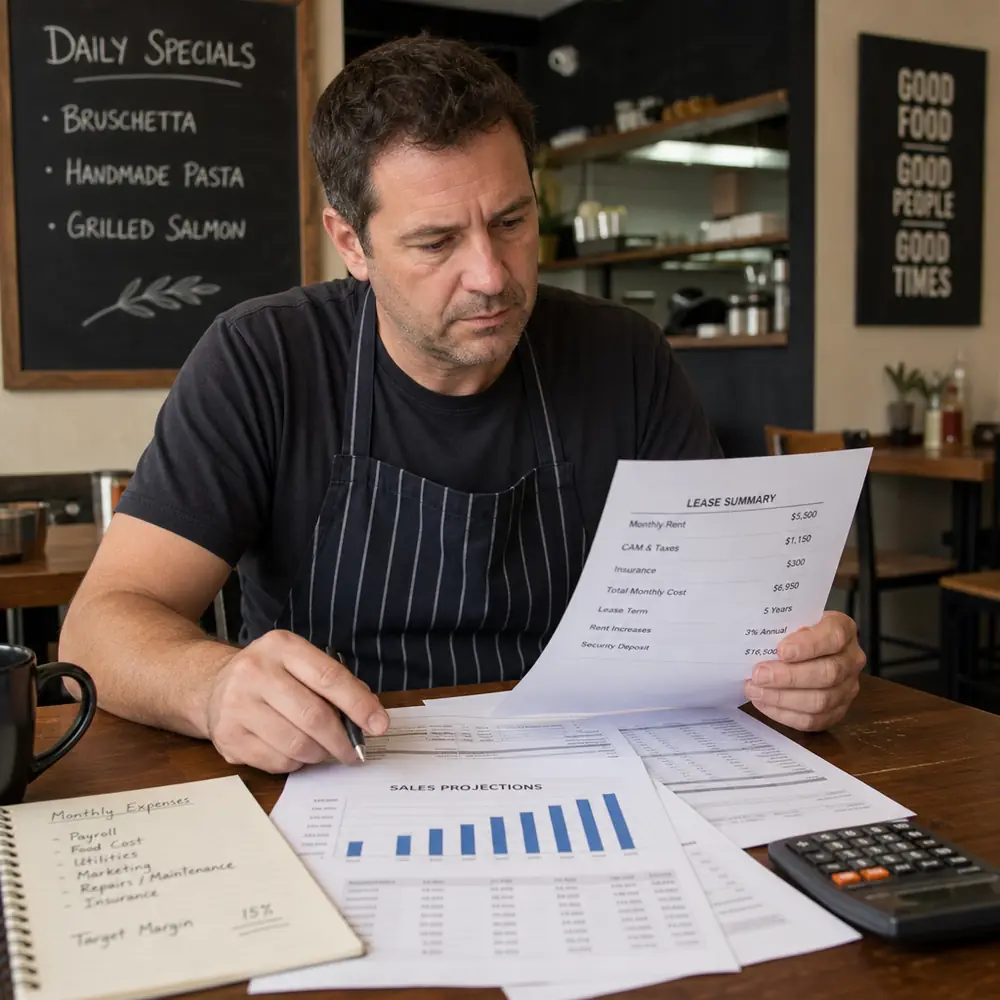
How to calculate restaurant rent as a percentage of sales
The basic formula is simple: divide annual rent by annual gross sales, then multiply by 100. To calculate restaurant rent as a percentage of sales accurately, use annual numbers instead of one strong or weak month. Restaurants are seasonal, and a single month can make rent look better or worse than it really is.
Use this quick process:
- Estimate annual gross sales. Be realistic. Use comparable locations, seat count, service style, hours, average check, and expected covers.
- Add annual base rent. Multiply monthly base rent by 12.
- Add other occupancy charges. Include CAM, taxes, insurance, and required property-related expenses if you want the true occupancy ratio.
- Divide by annual sales. Annual rent or occupancy cost divided by annual gross sales gives the percentage.
- Stress-test the result. Run the numbers again using lower sales, higher costs, and slower opening months.
For example, if annual base rent is $90,000 and projected annual sales are $1,500,000, the base restaurant rent percentage is 6%. If additional occupancy costs add $45,000 per year, total occupancy cost becomes $135,000, or 9% of sales. That may be workable for some concepts, but it leaves less room for error than a lower-cost site.
This is also why the average restaurant rent as percentage of sales can be misleading. A quick-service restaurant, fine dining concept, coffee shop, bar, bakery, and full-service neighborhood restaurant may all have different labor models, ticket sizes, buildout needs, and traffic patterns. The percentage only makes sense when it is tied to the economics of the specific restaurant.
Why the same rent percentage can feel different for every concept
A 7% occupancy cost may feel comfortable for one restaurant and painful for another. The difference usually comes down to margins, volume, and operating complexity. A small counter-service concept with efficient staffing may be able to handle a different rent load than a full-service restaurant with higher labor demands and more square footage devoted to dining, storage, restrooms, and kitchen production.
Consider how these factors affect affordability:
- Sales per square foot: A compact space with high sales can support stronger commercial rent rates than a large dining room with slow turns.
- Labor intensity: Full-service restaurants often need more staff per guest than limited-service concepts.
- Food and beverage mix: Alcohol, coffee, catering, delivery, and high-margin add-ons can change the economics.
- Daypart strength: A restaurant that sells breakfast, lunch, dinner, and late-night has more chances to generate revenue from the same rent.
- Seasonality: Tourist areas, college towns, beach markets, and business districts may have uneven monthly sales.
- Buildout cost: A cheap lease is not cheap if the space requires major plumbing, ventilation, electrical, or kitchen upgrades.
The best site is not always the cheapest site. A higher-rent corner with visibility, parking, and strong foot traffic may outperform a low-rent space that customers never notice. Still, higher rent should be justified by a believable sales forecast, not wishful thinking. Use Restaurant Site Finder to stress-test demand before you commit.
What is a percentage rent restaurant lease?
A percentage rent restaurant lease is a lease where the tenant pays base rent plus an additional percentage of sales after reaching a negotiated sales threshold, often called a breakpoint. In plain English, the landlord gets a fixed minimum rent, and if the restaurant performs well, the landlord shares in the upside. This structure is more common in retail environments, shopping centers, food halls, and locations where the landlord believes the site can help drive sales.
For the restaurant, percentage rent can sometimes be acceptable if the base rent is lower or if the breakpoint is high enough that extra rent only applies after the business is performing well.
A percentage rent restaurant deal needs careful reading. Small wording differences can change the cost dramatically. The key terms usually include:
- Percentage rate: The share of sales owed after the breakpoint.
- Breakpoint: The sales level where percentage rent begins.
- Gross sales definition: What counts as sales for rent purposes.
- Exclusions: Items such as sales tax, refunds, third-party delivery fees, gift card timing, tips, or service charges may need specific treatment.
- Reporting requirements: The lease may require monthly, quarterly, or annual sales reports.
- Audit rights: Landlords often reserve the right to inspect sales records.
- Payment timing: Percentage rent may be paid monthly, quarterly, or annually, depending on the lease.
The breakpoint is especially important. A "natural breakpoint" is commonly calculated by dividing annual base rent by the percentage rent rate. For instance, if annual base rent is $120,000 and percentage rent is 6%, the natural breakpoint is $2,000,000 in annual sales. Above that point, the tenant would owe the agreed percentage on sales over the breakpoint.
Lease terms that change the real cost of rent
Restaurant lease terms can be dense, but several clauses have a direct impact on the rent-to-sales ratio. A lease is not just a monthly price; it is a long-term operating commitment. Before signing, it helps to model the lease year by year.
Pay attention to these terms:
- Annual increases: Fixed increases, CPI adjustments, or step-ups can make a reasonable first-year rent expensive later.
- Free rent period: Helpful during buildout, but make sure you understand when payments begin.
- Tenant improvement allowance: Landlord contributions can reduce upfront cash needs, but they may be reflected in higher rent.
- Renewal options: A good renewal option can protect a successful location from sudden rent shocks.
- Assignment and sublease rights: These matter if you sell the restaurant or need to exit.
- Use clause: The lease should allow your actual menu, service model, alcohol program, catering, delivery, or other planned revenue streams.
- Exclusive use rights: In a shopping center, exclusivity may protect you from a nearby direct competitor.
- Maintenance obligations: HVAC, plumbing, roof, grease systems, and structural repairs can become major hidden costs.
- Personal guarantees: A guarantee can expose the owner personally if the restaurant fails or closes early.
These details affect more than legal risk. They shape cash flow. A restaurant with manageable first-year rent but steep annual increases may cross from healthy to strained before the lease term is over. Read how to find the right location for a restaurant for lease and site checks together.
Practical lease negotiation strategies for restaurant owners
Lease negotiation strategies should focus on flexibility, total cost, and risk control. Many restaurant owners negotiate hard on base rent but overlook clauses that can be just as expensive. The goal is not simply to "win" a lower rent number; it is to create a lease the restaurant can survive during slow months and still benefit from during strong years.
Useful negotiation points include:
- Negotiate from projected sales, not emotion. Decide your maximum affordable occupancy cost before falling in love with the space.
- Ask for a longer buildout or rent-free period. Restaurants often need permits, inspections, equipment installation, and training before opening.
- Cap controllable CAM increases. If the landlord controls the expense, ask for limits on annual increases where possible.
- Clarify repair responsibility. Avoid vague language that shifts major building systems to the tenant.
- Push for realistic percentage rent terms. If percentage rent applies, negotiate the rate, breakpoint, exclusions, and payment schedule.
- Protect renewal rights. A successful restaurant creates value in its location, and renewal options help preserve that value.
- Review exit options. Assignment, sublease, kick-out clauses, or limited guarantees may reduce long-term exposure.
It is also wise to compare commercial rent rates in the immediate trade area, not just the broader city. Two spaces a mile apart can perform very differently based on parking, visibility, co-tenancy, traffic flow, and neighborhood patterns. A broker, attorney, accountant, or restaurant consultant can help pressure-test the lease before it becomes a long-term obligation.
A simple affordability checklist before you sign
Before committing to a site, run a conservative version of the numbers. If the lease only works under a best-case sales forecast, the risk may be too high. Restaurants need room for opening delays, staffing challenges, repairs, marketing ramp-up, and uneven demand.
Use this checklist before signing:
- Base rent is close to or below your target restaurant rent percentage.
- Total restaurant occupancy costs are calculated, not guessed.
- Sales projections are conservative and based on realistic capacity.
- The lease allows every revenue stream you plan to use.
- CAM, taxes, insurance, and maintenance obligations are clearly defined.
- Annual rent increases are included in your multi-year forecast.
- Percentage rent terms are understandable and modeled with examples.
- The breakpoint is high enough that extra rent applies only after healthy sales.
- Renewal options, assignment rights, and exit language have been reviewed.
- A qualified professional has reviewed the lease before signature.
If several boxes are uncertain, slow down. A restaurant lease is usually one of the largest fixed commitments in the business, and fixed costs are hardest to manage when sales dip. Pair this checklist with our Go/No-Go location decision guide.
The takeaway on restaurant rent percentage
So, what percentage of sales should rent be for a restaurant? A useful starting point is base rent at about 6% of sales or less, with all-in occupancy cost generally kept under about 10%, but the right number depends on your sales volume, concept, margins, market, and lease terms. Those benchmarks are guides, not guarantees.
The smartest approach is to calculate restaurant rent as a percentage of sales before you negotiate, then test the lease against conservative sales scenarios. A great location can help a restaurant grow, but only if the rent leaves enough oxygen for the rest of the business. When in doubt, focus less on the space you want and more on the numbers your restaurant can actually support.
Run a free site analysis at Restaurant Site Finder to validate demand before you sign, and review restaurant startup costs for the full opening budget picture.
Run a free location analysis
Enter any address to get competitor mapping, market gaps, opportunity scoring, and concept ideas.
Analyze your location free Shop equipment at Horeca Store