Site Selection
How AI Predicts Your Next Restaurant's Success — Before You Sign the Lease
Learn how AI uses demographics, foot traffic, GIS mapping, and revenue forecasting to predict restaurant success before you commit to a commercial lease.
Key Takeaways
- AI replaces gut-feel lease decisions with pattern recognition across demographics, foot traffic, competition, and revenue history.
- Hyper-local block-by-block data beats zip-code averages for accurate sales forecasting.
- Automated due diligence and cannibalization checks help you negotiate leases from a position of strength.
- Run a free AI scan at Restaurant Site Finder, then validate finalists with our Go/No-Go framework.
Opening a new restaurant is one of the most thrilling—and terrifying—ventures an entrepreneur can undertake. You've perfected your menu, designed a stunning interior concept, and assembled a dream team. But then comes the final, sweat-inducing hurdle: the location.
For decades, signing a five- or ten-year commercial lease was largely a leap of faith. You might have sat in your car with a manual clicker, counting the cars driving past a potential storefront, hoping the numbers translated into hungry customers. Today, the game has fundamentally changed. The exact blueprint of How AI Predicts Your Next Restaurant's Success — Before You Sign the Lease is revolutionizing the hospitality world, replacing gut feelings with hard, actionable data.
In this comprehensive guide, we will explore how the modern AI food industry operates, how location intelligence is replacing guesswork, and how you can leverage cutting-edge technology to ensure your next culinary venture thrives from opening day.
The High Stakes of Restaurant Real Estate
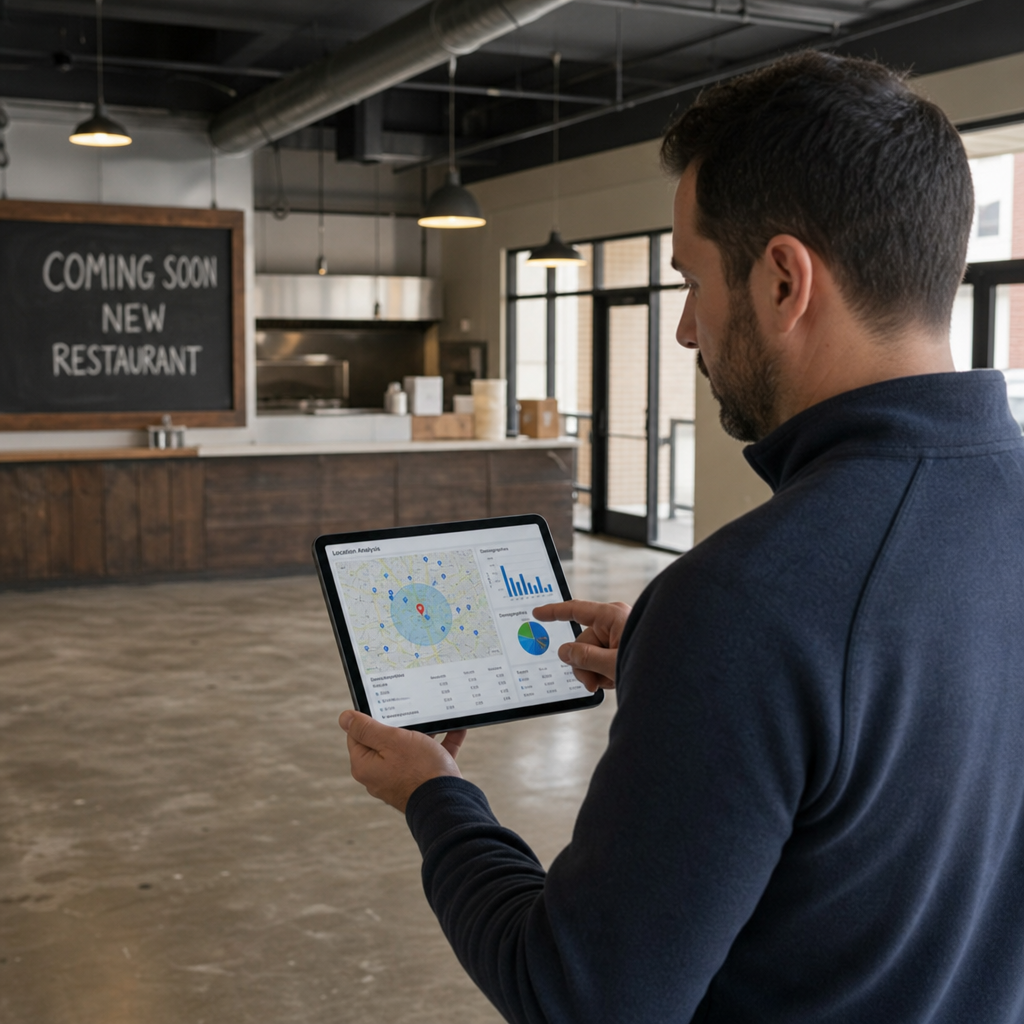
Historically, the restaurant industry has been plagued by a notorious failure rate. While poor management and subpar food are contributing factors, the number one silent killer of a brilliant restaurant concept is a bad location.
Choosing the wrong site traps you in a legally binding, long-term financial commitment that can bleed your operational budget dry. This is why mitigating commercial lease liability through data science has become the gold standard for savvy restaurateurs and investors. You are no longer just renting a building; you are investing in a hyper-local micro-economy.
The Old Way vs. The Smart Way
In the past, hospitality groups relied heavily on historical intuition and manual surveys. When comparing traditional feasibility studies vs AI location intelligence, the differences are staggering.
A traditional feasibility study might take weeks or months to compile. It relied on outdated census data, manual traffic counts, and static demographic snapshots. By the time the report was printed, the data was already stale.
Conversely, modern AI location intelligence is dynamic, drawing on millions of real-time data points. It doesn't just tell you who lived in the neighborhood five years ago; it tells you who walked past the building last Tuesday at 2:00 PM, where they went afterward, and how much discretionary income they have.
Decoding the Magic: How Artificial Intelligence Evaluates a Location
You might be wondering, how does machine learning forecast restaurant revenue with any degree of accuracy?
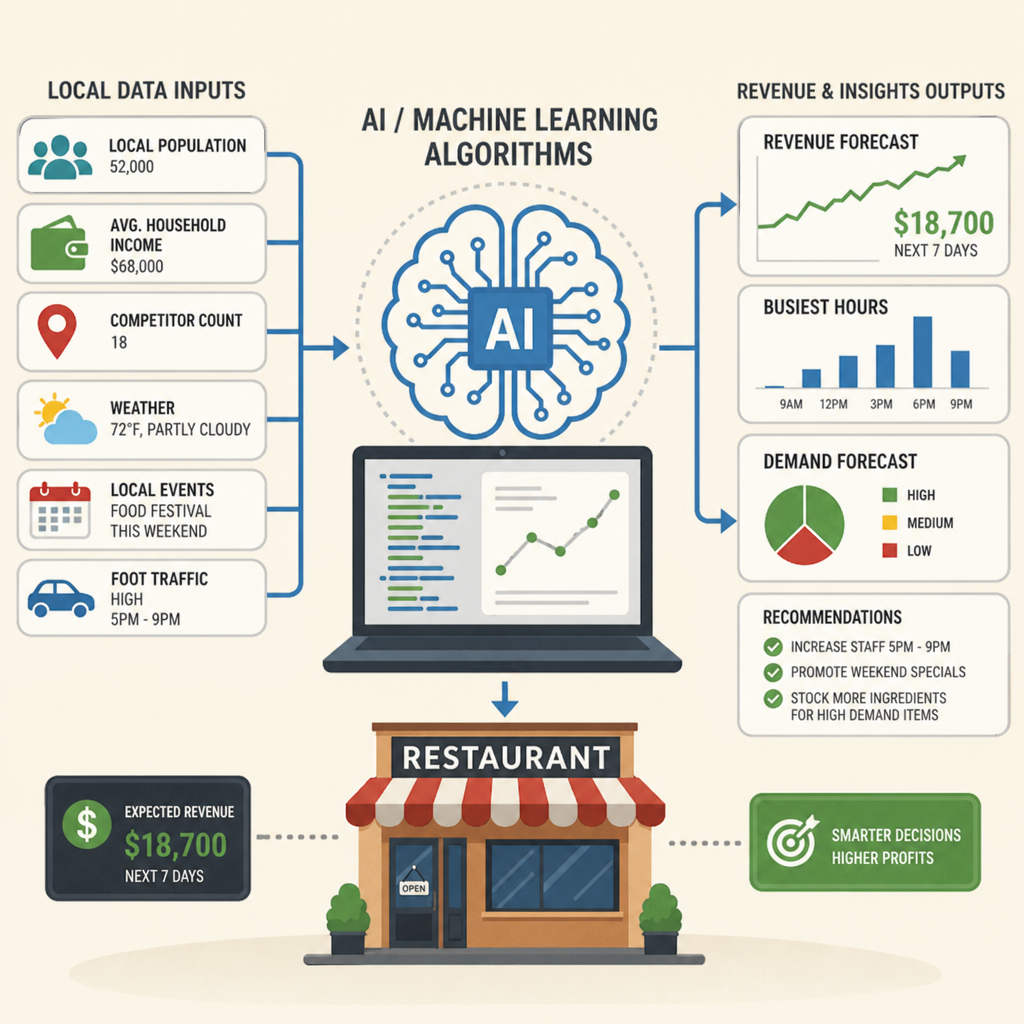
The answer lies in pattern recognition at a scale impossible for the human brain to process. Machine learning algorithms are fed massive datasets containing the historical performance of thousands of existing restaurants. The AI analyzes variables such as street visibility, nearby complementary businesses, local weather patterns, parking availability, and even the direction of commuter traffic.
When you input a potential new address into restaurant analytics software, the AI compares that site's unique "digital fingerprint" against its vast database of successes and failures. If your proposed location shares 95% of its characteristics with highly profitable restaurants in similar markets, the system forecasts a high likelihood of success.
By utilizing predictive analytics for restaurant site selection, AI removes the emotional bias from the equation. It doesn't care that the brickwork is charming or that the landlord is friendly; it only cares about the mathematical probability of your target customers walking through the door and spending money.
The Core Data Pillars of AI Site Selection
To truly understand how this technology works, we need to look under the hood. The engines driving AI restaurant success prediction rely on several deeply interconnected pillars of data.
1. Advanced Demographics and Psychographics
It is no longer enough to know the average age and income of a neighborhood. AI dives deep into demographic profiling for food service profitability. It looks at household composition, education levels, and spending habits to determine if a market can sustain your specific price point.
But AI goes a step further by integrating psychographic mapping for target customer acquisition. Psychographics measure attitudes, interests, and lifestyles.
- Are the people in this neighborhood health-conscious gym-goers who would love a fast-casual vegan bowl concept?
- Are they dual-income, no-kid (DINK) professionals who prioritize craft cocktails and late-night tapas?
By mapping these lifestyle traits, AI ensures your restaurant's brand identity aligns perfectly with the mindset of the local population.
2. Mobility and Human Movement
A location might look great on a map, but if people don't physically move past it, your customer acquisition costs will skyrocket. This is where mobile location data for market share forecasting comes into play.
By analyzing aggregated, anonymized cell phone ping data, AI platforms can track the ebb and flow of a city. This enables highly accurate pedestrian foot traffic pattern analysis. See our foot traffic analysis guide for methodology.
For example, a breakfast bakery needs to be on the "morning side" of a commuter street. AI can tell you not just how many people walk down a street, but exactly what times of day the street is busiest, where those people are commuting from, and how long they tend to dwell in the area.
3. Spatial Analysis and Geographic Intelligence
A core component of modern site scouting involves geographic information systems for hospitality planning (GIS). GIS technology layers data over digital maps, allowing algorithms to see spatial relationships that humans might miss.
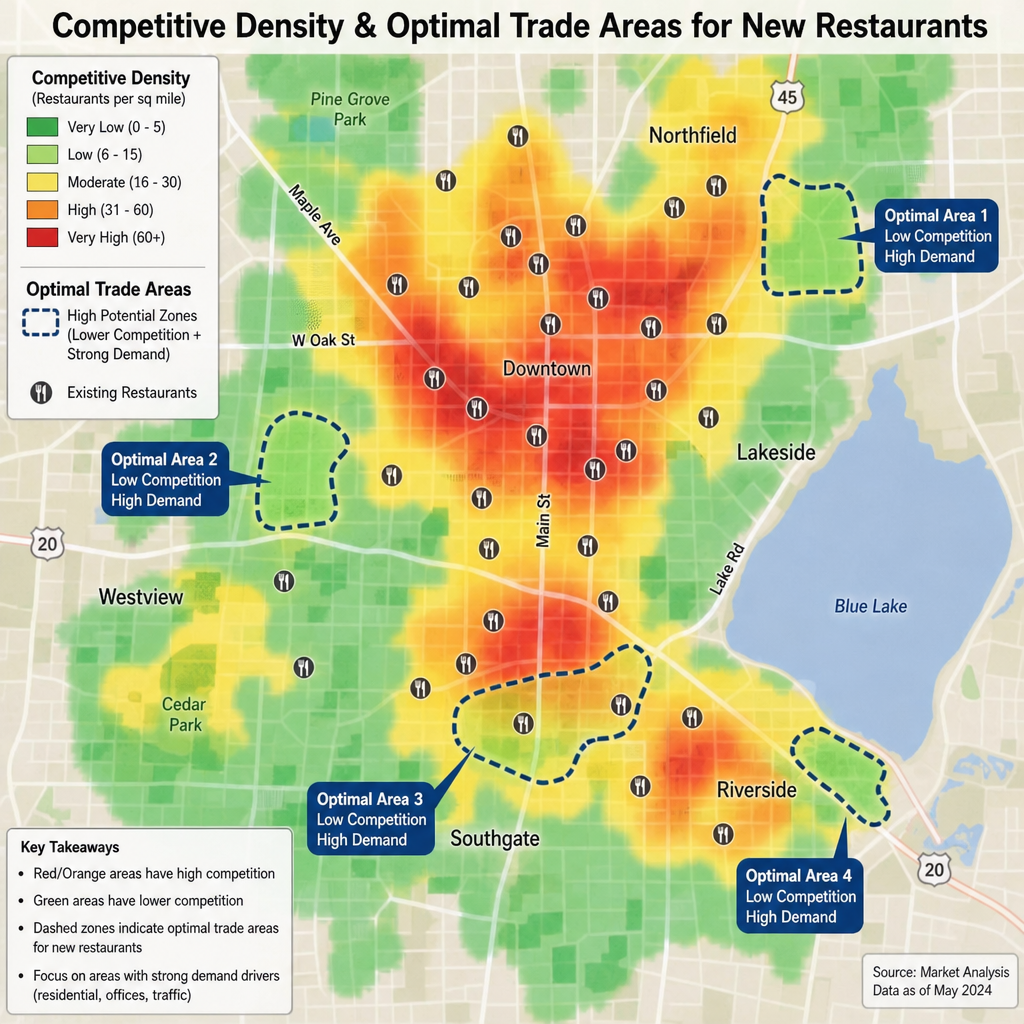
GIS is vital for identifying optimal trade areas for new eateries. A "trade area" is the geographic radius from which a restaurant draws the majority of its customers. Historically, people assumed a trade area was a perfect circle (e.g., a 3-mile radius). AI knows that natural and man-made barriers—like rivers, major highways, or train tracks—alter how people travel. GIS maps irregular, highly accurate trade areas based on real drive times and walking routes, ensuring you aren't overestimating your potential customer base.
4. Evaluating the Competition
Is a neighborhood saturated with Italian restaurants, or is there a gaping hole in the market? AI platforms excel at competitive density mapping for dining establishments.
However, AI doesn't just look for direct competitors; it looks for synergy. A great AI tool will tell you if locating your high-end steakhouse near an upscale theater and a luxury hotel will boost your sales through symbiotic traffic. It analyzes the entire ecosystem to determine if your concept will fight for scraps or dominate a lucrative niche.
Can AI Predict Restaurant Sales Based on Zip Code?
A common question among new franchise owners and independent operators is: can AI predict restaurant sales based on zip code?
The short answer is yes, but the more accurate answer is that AI doesn't stop at the zip code level. Relying solely on zip codes is actually a flawed strategy in the modern era. A single zip code can encompass a bustling, wealthy commercial district on one end and a struggling, sparse industrial zone on the other.
Instead, modern AI uses hyper-local, block-by-block data. It can forecast your first-year, second-year, and third-year revenue by looking at the specific street corner you are considering. By combining your brand's historical data (average ticket size, table turnover rate) with the hyper-local environmental data (foot traffic, competitor pricing), machine learning algorithms can generate astonishingly accurate revenue models.
This level of precision is the ultimate key to reducing restaurant failure risk with big data. If the AI predicts that your maximum realistic revenue at a specific location will barely cover your lease and labor costs, you can walk away before making a multi-million-dollar mistake.
Transforming the Due Diligence Process
In commercial real estate, time kills deals. If you find a promising location, you must act fast before another buyer swoops in. However, rushing leads to catastrophic oversights.
This friction is being solved by automated due diligence for hospitality real estate. What used to require hiring consultants, waiting weeks for reports, and paying thousands of dollars can now be done in an afternoon. AI platforms can instantly generate site reports detailing zoning restrictions, historical environmental hazards, crime rates, and future municipal development plans (like a new subway stop being built down the block).
By automating this due diligence, restaurant operators can confidently negotiate leases, knowing they have a comprehensive, data-backed understanding of the property's true value.
Top Technologies Powering the Revolution
If you are ready to bring data into your expansion strategy, you need to know what tools are available. While the landscape is evolving rapidly, the top AI tools for restaurant site scouting generally fall into a few categories:
- Foot Traffic Aggregators: Tools (like Placer.ai) that specialize in mobile location data, allowing you to see exactly where your competitors' customers are coming from.
- Revenue Forecasting Platforms: AI engines designed specifically to ingest your Point of Sale (POS) data and model future revenue for new sites based on machine learning.
- Comprehensive GIS Mapping: Platforms (like Esri's ArcGIS) that provide deep demographic, psychographic, and spatial mapping to visualize market gaps.
For a full comparison of leading platforms, see our 2026 Buyer's Guide to Restaurant Location Analytics. Investing in top-tier restaurant analytics software might seem like an added expense upfront, but compared to the cost of a failed restaurant build-out, it is one of the highest-ROI investments a hospitality group can make.
Actionable Tips for Using AI in Your Next Launch
Understanding the theory is great, but how do you actually apply this to your upcoming restaurant launch? Here is a practical playbook for integrating AI into your site selection process:
Define Your Customer Avatar with Data, Not Guesses: Before you look at a single piece of real estate, define who your best customer is. Don't just say "millennials." Say "Millennials earning over $75k, who value organic ingredients, and frequently visit boutique fitness centers." The more specific you are, the better the AI can hunt for these people.
Run a "Cannibalization" Analysis: If you already own one successful restaurant and want to open a second location in the same city, use AI to ensure you won't steal your own customers. AI can model exactly how much sales transfer will occur if you open three miles down the road.
Negotiate from a Place of Power: Use AI revenue forecasts to negotiate your lease. If a landlord is asking for top-of-market rent, but your data shows the pedestrian traffic doesn't support those numbers, you can use the AI reports as objective leverage to negotiate a lower rate or secure better tenant improvement allowances.
Combine AI with Human Intuition: AI is brilliant, but it is not infallible. It might not know that a specific intersection floods during heavy rain, or that a street is notoriously difficult to parallel park on. Use AI to create a shortlist of the top 3 highly profitable locations, then use your human experience and physical site visits to make the final call.
Conclusion
The restaurant industry will always be deeply rooted in human connection, culinary artistry, and exceptional hospitality. An algorithm cannot cook a perfect medium-rare steak, nor can it provide the warm smile that turns a first-time diner into a regular. However, even the most incredible food will go uneaten if the restaurant is hidden in an inaccessible, mismatched location.
The integration of artificial intelligence into the food and beverage sector is no longer a futuristic luxury reserved for massive fast-food conglomerates. It is an accessible, necessary reality for anyone looking to sign a commercial lease today.
Understanding How AI Predicts Your Next Restaurant's Success — Before You Sign the Lease empowers you to take control of your destiny. By embracing demographic profiling, mobile location tracking, and predictive revenue modeling, you strip away the blindfold of guesswork. You step into your new space with confidence, armed with the knowledge that the data, the demographics, and the neighborhood are practically waiting in line for your doors to open. Run a free analysis at Restaurant Site Finder today.
Frequently Asked Questions
Can AI predict restaurant success before signing a lease?
Yes. AI compares a site's digital fingerprint—demographics, foot traffic, competition, visibility, and parking—against thousands of historical restaurant outcomes to forecast revenue probability and flag high-risk leases before you sign.
What data does AI use for restaurant site selection?
Modern platforms combine demographic and psychographic profiling, mobile foot traffic patterns, GIS trade-area mapping, competitor density, and your brand's POS benchmarks to generate location-specific revenue models.
Can AI predict restaurant sales based on zip code?
AI can analyze zip-level data, but block-by-block hyper-local analysis is far more accurate. A single zip code often spans both thriving commercial districts and low-traffic industrial zones.
How is AI location intelligence different from traditional feasibility studies?
Traditional studies rely on stale census data and manual traffic counts that take weeks to compile. AI draws on millions of real-time mobility and spending signals updated continuously.
Is Restaurant Site Finder free for AI location analysis?
Yes. Enter any address for competitor mapping, opportunity scoring, and GO/NO-GO verdicts. Provide email and phone to unlock the full report at Restaurant Site Finder.
Run a free location analysis
Enter any address to get competitor mapping, market gaps, opportunity scoring, and concept ideas.
Analyze your location free Shop equipment at Horeca Store