Site Selection
AI Restaurant Location Analysis - RestaurantSiteFinder
Learn how AI restaurant location analysis uses mobility data, psychographics, and site scoring to turn real estate risk into a data-backed expansion decision.
Key Takeaways
- AI restaurant location analysis replaces gut-feel leases with mobility data, psychographics, and predictive site scores.
- Foot traffic forecasting and competitive density mapping reveal when people visit, who they are, and whether the market is already saturated.
- Franchise and multi-unit brands use catchment modeling to scale without cannibalizing existing stores.
- Run a free analysis at Restaurant Site Finder, then compare finalists with our Go/No-Go framework.
Opening a new restaurant is one of the most exciting, yet notoriously risky, business ventures you can undertake. You can have a Michelin-star chef, a groundbreaking menu, and an impeccable interior design, but if you choose the wrong location, your chances of survival plummet. For decades, the old real estate adage—"location, location, location"—has been the guiding principle for restaurateurs. But today, the question isn’t just where you should open; it’s how you figure out where to open.
Welcome to the era of AI restaurant location analysis.
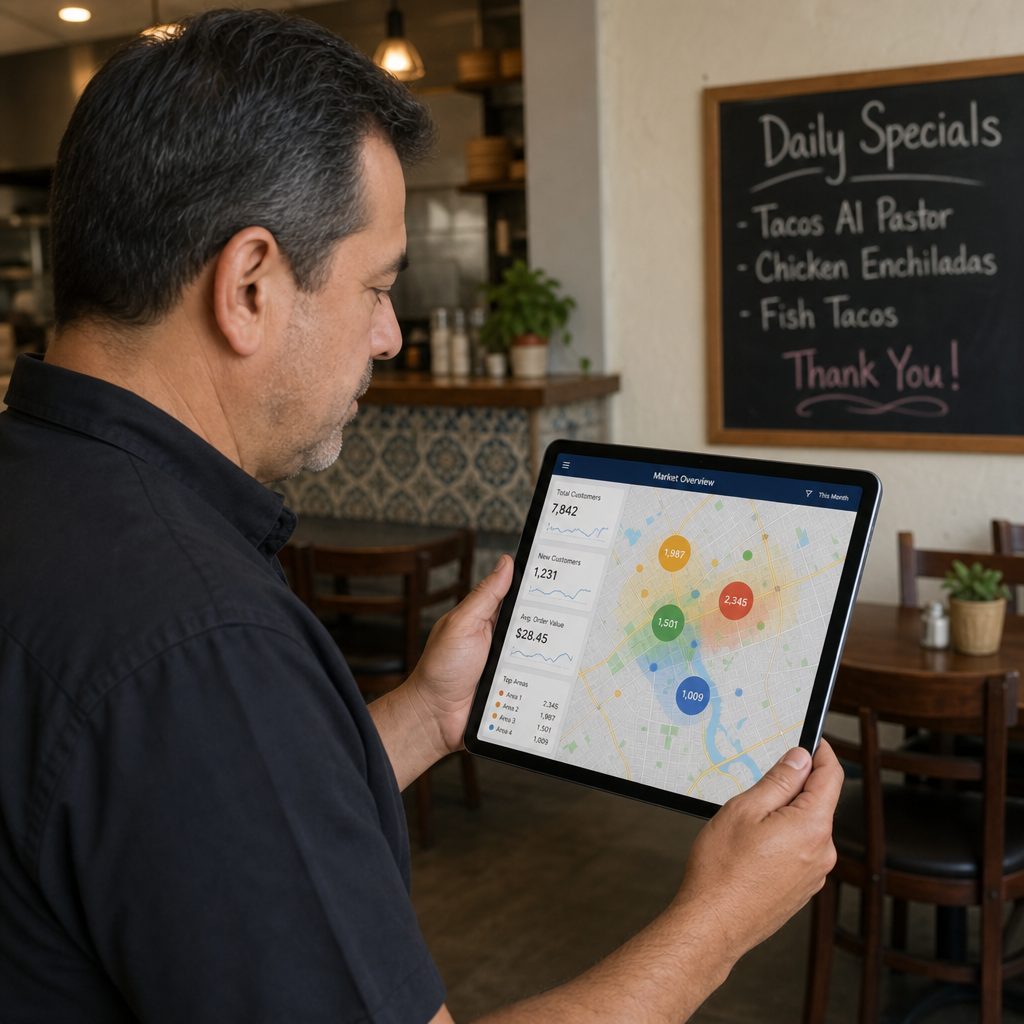
Gone are the days when picking a site relied purely on gut feeling, standing on a street corner with a clicker to count pedestrians, or relying on outdated census data. Today, the most successful food and beverage brands operate as a data-driven restaurant, leveraging immense computational power to guarantee they are opening their doors exactly where their hungry customers are waiting.
In this comprehensive guide, we will explore how cutting-edge technology is redefining restaurant site selection, why forward-thinking hospitality brands are adopting these tools, and how you can use artificial intelligence to secure your next highly profitable location.
The Evolution of Restaurant Site Selection
Historically, finding a great location was as much an art as it was a science. Restaurateurs relied heavily on intuition, basic demographic snapshots, and the advice of local real estate brokers. While human expertise remains invaluable, the sheer volume of data available today makes traditional methods insufficient on their own.
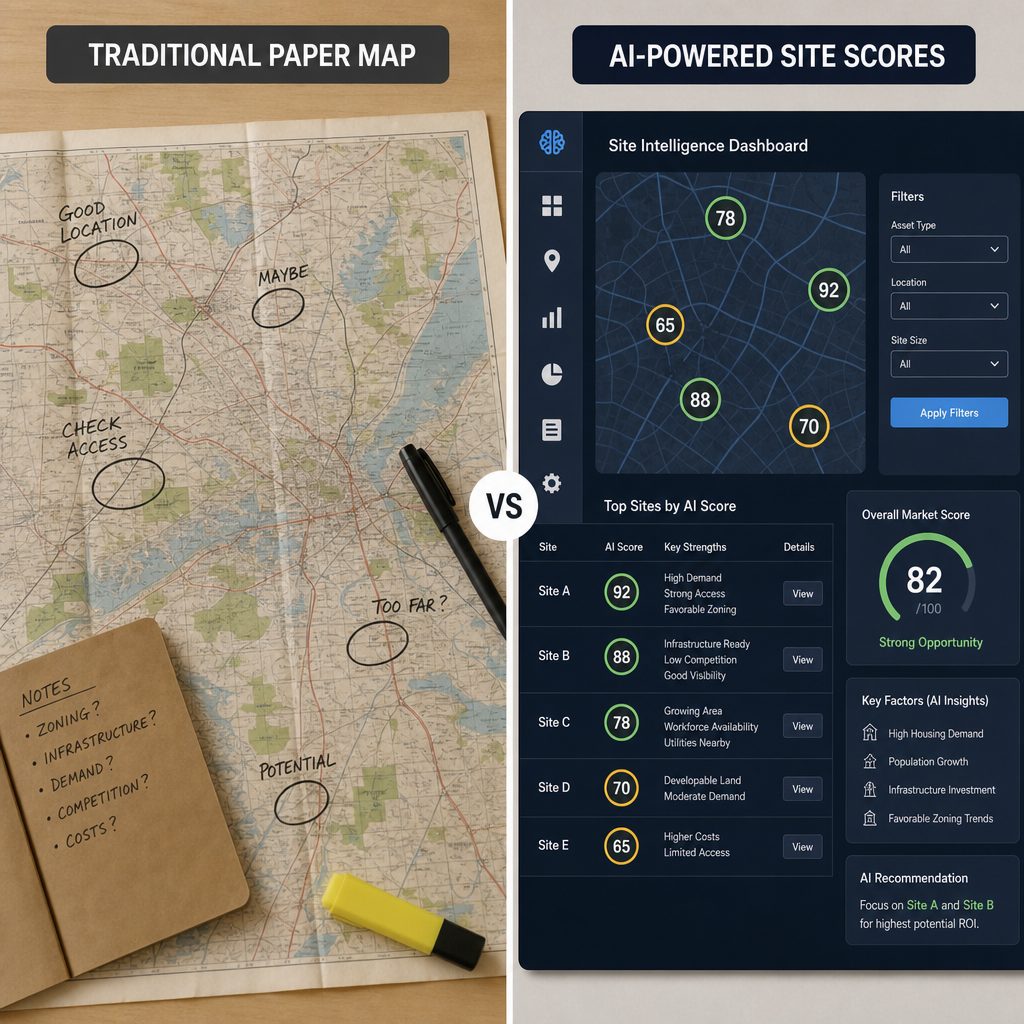
When looking at automated trade area analysis vs traditional scouting, the differences are staggering. Traditional scouting might tell you that a neighborhood has a median income of $75,000 and a population of 20,000 within a three-mile radius. While helpful, it’s a static, one-dimensional picture.
On the other hand, an AI site analysis provides a dynamic, multidimensional view of the real world. It looks at how people actually move, where they spend their money, what times of day the area peaks, and how local events impact foot traffic. This shift from static spreadsheets to dynamic, predictive modeling is exactly why geospatial intelligence for food service expansion has become the gold standard for modern restaurant groups.
For more on why traffic counts alone fall short, see restaurant location intelligence beyond traffic data.
What is AI Restaurant Location Analysis?
At its core, AI restaurant location analysis is the use of artificial intelligence, machine learning, and big data to evaluate and predict the success of a specific geographic location for a food and beverage concept.
By utilizing location intelligence AI, these platforms ingest billions of data points—from smartphone mobility data and credit card transactions to social media trends and local weather patterns. The AI processes this massive dataset to uncover hidden patterns that a human analyst might take months to find, or might miss entirely.
The ultimate goal of using AI for restaurants in this capacity is simple: risk mitigation. Commercial real estate leases are expensive, build-outs are costly, and the margin for error is razor-thin. By relying on robust data, operators are reducing site selection risk with spatial analytics, ensuring that every dollar invested in a new build has the highest possible probability of yielding a strong return.
Learn how prediction models work in practice in How AI Predicts Your Next Restaurant's Success.

How Artificial Intelligence Transforms Geospatial Data
To truly understand how powerful these tools are, we need to look under the hood at the specific types of data being analyzed and how AI interprets them.
Decoding Foot Traffic and Movement
A location might look incredibly busy, but are those people actually your target demographic, or are they just rushing to catch a commuter train?
Through the use of machine learning models for foot traffic forecasting, AI platforms can predict not just how many people will walk past your storefront, but when they will walk past, and why. By analyzing urban mobility patterns and dining habits, AI can differentiate between a bustling weekday lunch crowd and a quiet weekend residential neighborhood.
For quick-service operators, movement data is particularly crucial. Analyzing vehicular flow and mobility data for optimizing drive-thru placement can make or break a fast-food concept. The AI assesses traffic congestion, the ease of making a right-hand turn into your lot, morning commute routes versus evening return routes, and how long vehicles typically idle in the area.
Dive deeper in our AI foot traffic analysis guide.
Understanding the Modern Diner
Demographics (age, gender, income) tell you who lives in an area. Psychographics tell you what they value.
One of the most powerful features of modern AI tools is the psychographic segmentation of local diners. Big data allows you to understand the lifestyle choices of a neighborhood. Are the residents fitness enthusiasts who frequently visit boutique gyms and buy organic groceries? Or are they late-night entertainment seekers who frequent bars and concert venues?
Knowing this allows you to place a high-end vegan cafe directly in the path of the health-conscious demographic, rather than hoping they stumble upon it in a generic retail strip.
Strategic Expansion and Market Domination
When you are planning to scale your concept from one location to five, or from fifty to five hundred, the complexity of site selection multiplies exponentially. This is where predictive site selection for hospitality becomes your ultimate competitive advantage.
Mapping the Competition
Entering a new market requires a deep understanding of who is already operating there. But you don't just want a list of nearby restaurants; you want to understand the area's capacity.
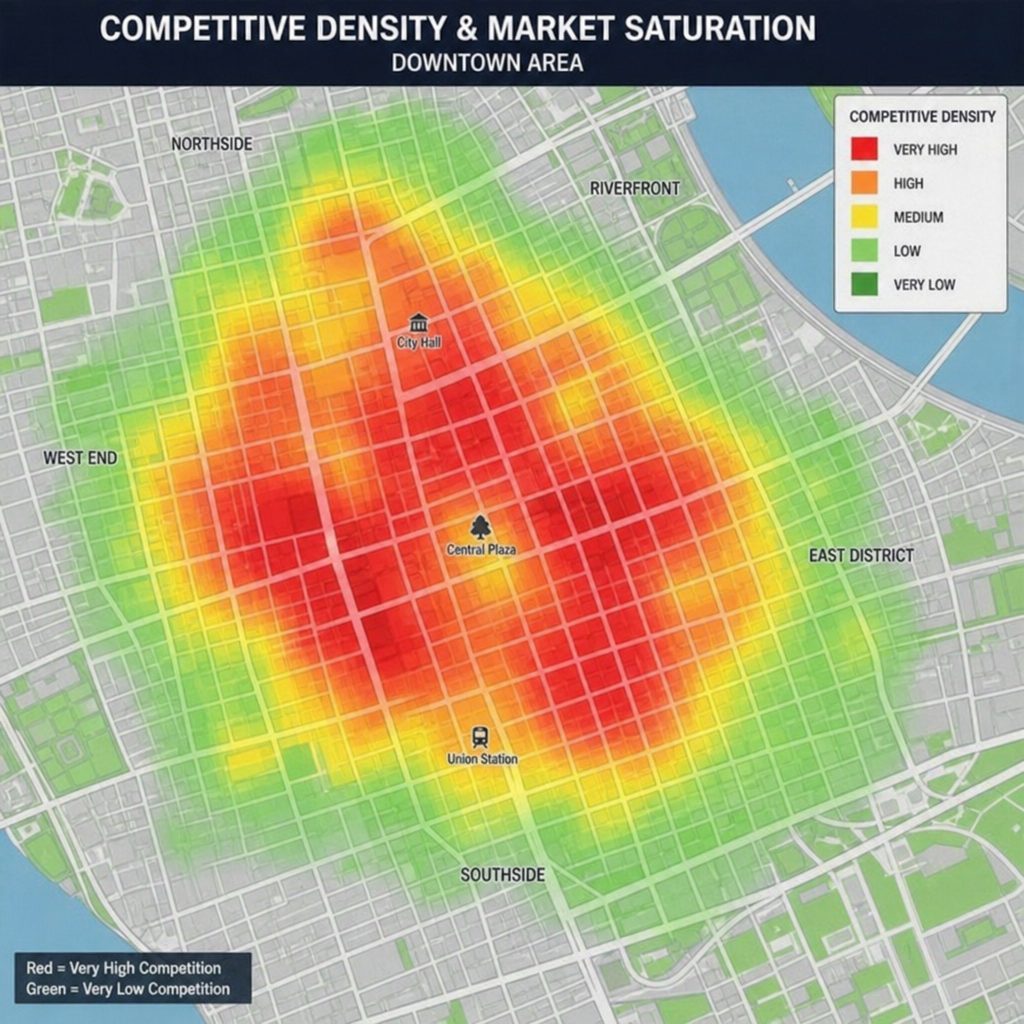
Through competitive density mapping for market saturation, AI analyzes the concentration of similar concepts. It can tell you if a neighborhood is entirely oversaturated with burger joints, meaning a new entrant would struggle to gain market share. Conversely, it can identify a "food desert" for a specific cuisine. If the data shows high demand for premium coffee but the nearest specialty cafe is three miles away, you've just found a highly lucrative gap in the market.
If you are wondering how to use big data for restaurant territory mapping, the process involves feeding your AI platform your ideal customer profile and letting it cross-reference that with competitor locations. The system will then visually outline "territories" where your brand is highly likely to thrive without cannibalizing your own existing stores or stepping into a saturated war zone.
Scaling with Confidence
For franchise operators, growth is the lifeblood of the business. However, selling a franchise territory to an operator without solid data is a recipe for high turnover and damaged brand reputation.
AI excels at identifying high-growth catchment areas for franchises. A "catchment area" is the geographic sphere from which a location draws its customers. Rather than drawing a simple 5-mile circle on a map, AI uses actual drive-time data, physical barriers (like rivers or highways), and consumer behavior to draw highly accurate, custom trade areas. It can project how a neighborhood will grow over the next five to ten years based on incoming residential developments and commercial zoning permits.
Adapting the Offering
A fascinating, and often overlooked, benefit of spatial analytics is leveraging points of interest data for menu localization.
A "Point of Interest" (POI) could be a major hospital, a university campus, a large tech park, or a tourist attraction. If your AI analysis shows that your chosen site is heavily influenced by a nearby hospital, you might adapt your menu to include faster, grab-and-go options for nurses on short breaks, or family-style comfort meals for visiting relatives. If the data shows proximity to a university, you might introduce budget-friendly late-night specials. The data doesn't just tell you where to open; it informs what you should sell when you get there.
Can Data Science Predict Restaurant Profitability by Neighborhood?
This is the multi-million dollar question every restaurateur asks: Can data science predict restaurant profitability by neighborhood?
The short answer is yes. While no system can predict the future with 100% certainty—since operational execution, food quality, and customer service remain in the hands of the human operators—data science can provide incredibly accurate revenue forecasts.
It achieves this through real estate site scoring algorithms for quick service restaurants and full-service dining alike. These algorithms take your historical sales data from your most successful existing locations and reverse-engineer it. The AI asks: What unique mix of variables makes our best location successful? It might be a specific blend of daytime office workers, evening residential density, and proximity to major transit hubs.
Once the AI builds this "DNA" of your perfect site, it scores potential new real estate listings against this profile. A site that matches 95% of your ideal variables receives an 'A' score, meaning it is highly likely to hit your profitability targets.
Furthermore, relying on data is the best method for overcoming site selection bias with objective algorithms. Humans are naturally biased. A founder might fall in love with a building because of its exposed brick architecture or because it’s in their favorite neighborhood, ignoring the glaring lack of parking or poor visibility. AI has no emotional attachment. It looks coldly and objectively at the numbers, saving operators from making expensive, emotion-driven mistakes.
Practical Steps: Implementing AI for Restaurants
Transitioning to a data-driven approach might sound intimidating, especially for independent operators or small hospitality groups. However, utilizing AI restaurant location analysis is more accessible today than ever before. Here are actionable steps to integrate these powerful tools into your expansion strategy:
- Define your current best customers. Before AI can find your next location, you need to understand your current one. Analyze your point-of-sale (POS) data and loyalty programs. Know your average ticket size, peak hours, and customer demographics.
- Partner with the right technology. You don’t need to hire an in-house team of data scientists. SaaS platforms dedicated to restaurant site selection—including free tools like Restaurant Site Finder—offer competitor mapping, mobility signals, and opportunity scoring in a clear dashboard.
- Input your custom site criteria. Establish your non-negotiables. Do you require a minimum of 20,000 cars passing by daily? Do you need a minimum household income of $80,000? Let the software filter out the noise.
- Evaluate the analog alongside the digital. AI is a tool, not a replacement for human observation. Once the AI highlights a high-scoring location, physically visit the site. Sit in your car at 12:00 PM on a Tuesday. Observe the actual human behavior to validate what the algorithms are telling you.
- Analyze cannibalization risks. If you already have multiple locations, use territory mapping tools to ensure a new site will generate new revenue, rather than simply stealing customers from your existing restaurant three miles down the road.
When you're ready to decide, use our Go/No-Go restaurant location framework.
The Future of Hospitality Real Estate
The restaurant industry is famously competitive. In an environment where food costs fluctuate and labor is increasingly expensive, you cannot afford to gamble on your real estate.
By embracing AI restaurant location analysis, you are not just finding a place to put your kitchen; you are strategically embedding your brand into the daily lives and movement patterns of your ideal customers. From utilizing machine learning models for foot traffic forecasting to mapping competitive density, these tools transform uncertainty into actionable strategy.
Whether you are launching your very first cafe or aggressively scaling a national franchise, leaving your site selection to chance is no longer an option. Let the data lead the way, trust the algorithms to eliminate your blind spots, and build your culinary empire on a foundation of unshakeable geospatial intelligence.
Are you ready to take the guesswork out of your expansion strategy? Try the free AI-powered analysis at Restaurant Site Finder and get competitor mapping, market gap detection, and an opportunity score for any address—before you sign the lease.
Run a free location analysis
Enter any address to get competitor mapping, market gaps, opportunity scoring, and concept ideas.
Analyze your location free Shop equipment at Horeca Store