Site Selection
Key Factors in Restaurant Location Analysis
Discover the key factors in restaurant location analysis—demographics, psychographics, foot traffic, trade areas, competition, and predictive modeling—that turn site selection into a data-backed decision.
Key Takeaways
- Modern restaurant location analysis replaces gut feel with demographics, psychographics, mobility data, and trade-area mapping.
- Foot traffic, competitive density, and points of interest decide whether demand can actually convert into visits.
- Ghost kitchens need delivery logistics, not storefront visibility—site criteria change with the business model.
- Run a free scan at Restaurant Site Finder, then validate finalists with our 2026 site selection guide.
Opening a new restaurant is an exhilarating venture, but it comes with significant financial risk. For decades, restaurateurs relied on a mix of gut instinct, basic census data, and driving around neighborhoods looking for “For Lease” signs. Those days are over. Today, success hinges on restaurant location intelligence—a data-backed discipline that merges market analysis, mobility science, and predictive modeling.
Whether you are launching your first independent bistro, expanding a regional chain, or setting up a delivery-only ghost kitchen, where you place your brand will dictate your foot traffic, operational costs, and long-term profitability.
In this guide, we explore the critical components of a modern location strategy, how advanced location analytics can safeguard your investment, and why mapping the right data points is the foundation of profitable restaurant expansion.
The Evolution of Site Selection
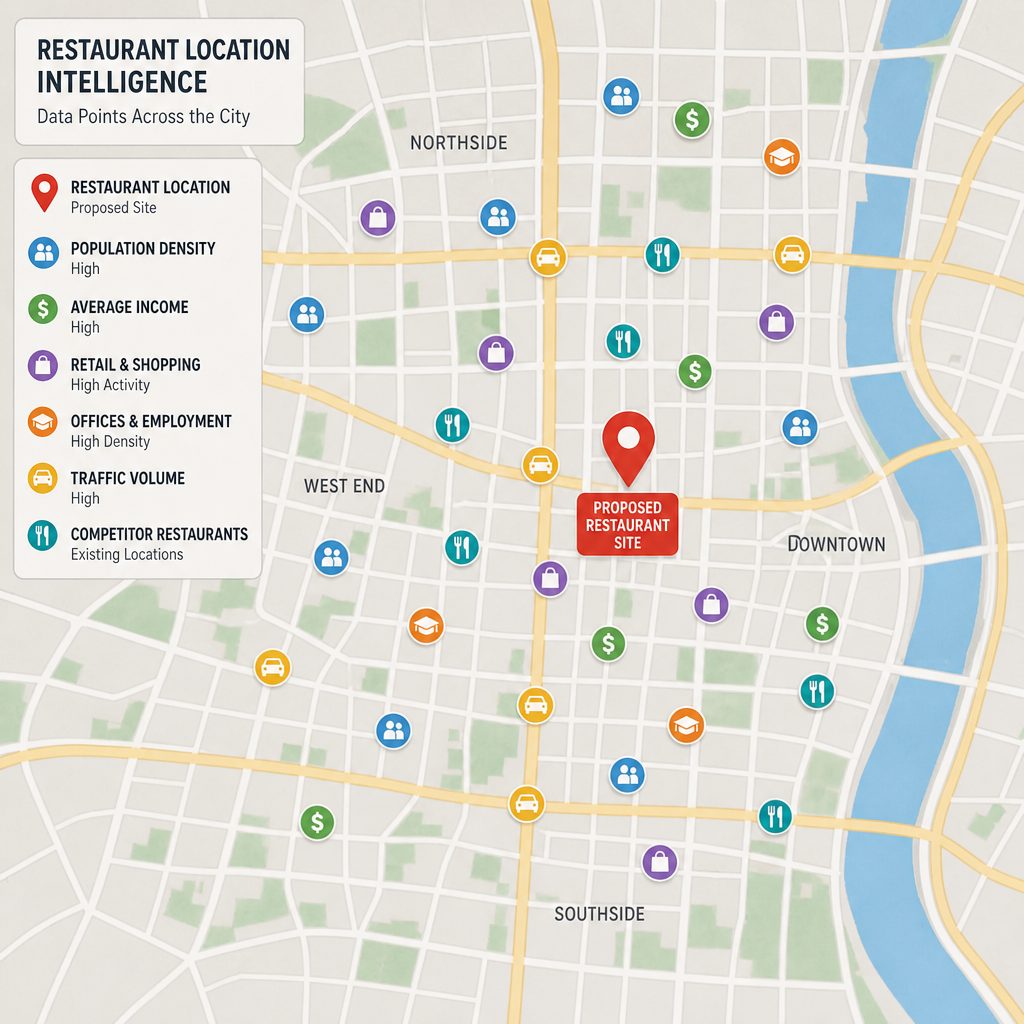
To understand the power of modern tools, we first need to look at how the industry has changed. When analyzing traditional site selection vs geospatial analytics, the difference in accuracy and depth is dramatic.
Historically, traditional site selection relied heavily on static demographics and historical traffic counts. An operator might count cars at an intersection for an hour, look at a ten-year-old census tract, and sign a lease. That approach leaves massive blind spots around true customer behavior, competitor saturation, and shifting commute patterns.
Today, leveraging big data for restaurant site scouting is no longer optional; it is the industry standard. Advanced analytics pull together dynamic datasets—ranging from mobile phone pings to credit card spending—so you can evaluate a corner with the same rigor you apply to your menu and food cost. See also why traffic data alone isn’t enough.
Understanding Your Future Diners: Demographics and Psychographics
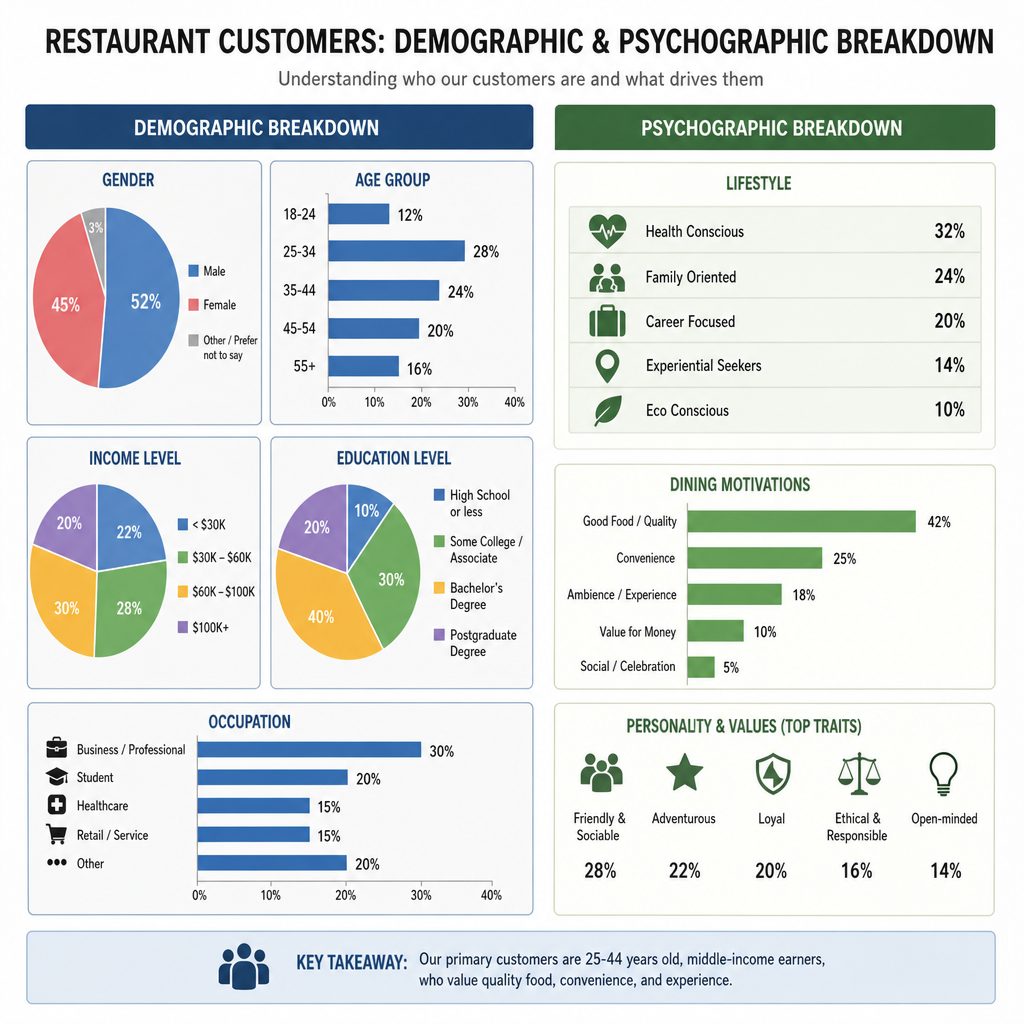
You cannot choose a location without intimately understanding who you are serving. A thorough market analysis requires going beyond simple population counts.
What Are the Best Demographic Markers for Dining?
When digging into restaurant demographics, you might wonder: what are the best demographic markers for dining? While the answer varies slightly depending on your concept, the most reliable indicators include:
- Disposable income — Can the local population afford your average ticket size?
- Household composition — Are the surrounding neighborhoods filled with single young professionals, or families with young children? A sports bar thrives on the former; a family-friendly pizza buffet relies on the latter.
- Daytime vs. nighttime population — A bustling downtown area might have an enormous daytime population of office workers but empty out entirely by 6:00 PM. This is critical if your concept relies on dinner traffic.
Diving Deeper: Customer Psychographics
While demographics explain who your buyers are, psychographics explain why they buy. Customer psychographic profiling for hospitality looks at lifestyle choices, values, interests, and spending habits.
For instance, an organic, plant-based cafe doesn't just need a high-income demographic; it needs a population that values health, sustainability, and fitness. By mapping these lifestyle traits, you can place the concept where intent already exists—not where population density alone looks impressive.
Mobility and Foot Traffic Analysis
A beautiful restaurant with a brilliant menu will still fail if no one walks past it. Visibility and accessibility are paramount.
Analyzing neighborhood foot traffic patterns has become a cornerstone of modern site selection. Rather than relying on manual counts, modern tools use anonymized mobile location data to trace exactly how people move through an area—by hour, daypart, and day of week.
Furthermore, tracking real-time consumer mobility trends is essential in a post-pandemic world. The shift toward remote and hybrid work drastically altered commuter routes. A downtown corner that saw consistent lunch rushes five years ago may underperform today, while suburban corridors that once felt quiet now carry stronger daytime dining demand. For methodology, read our AI foot traffic analysis guide.
Mastering the Trade Area
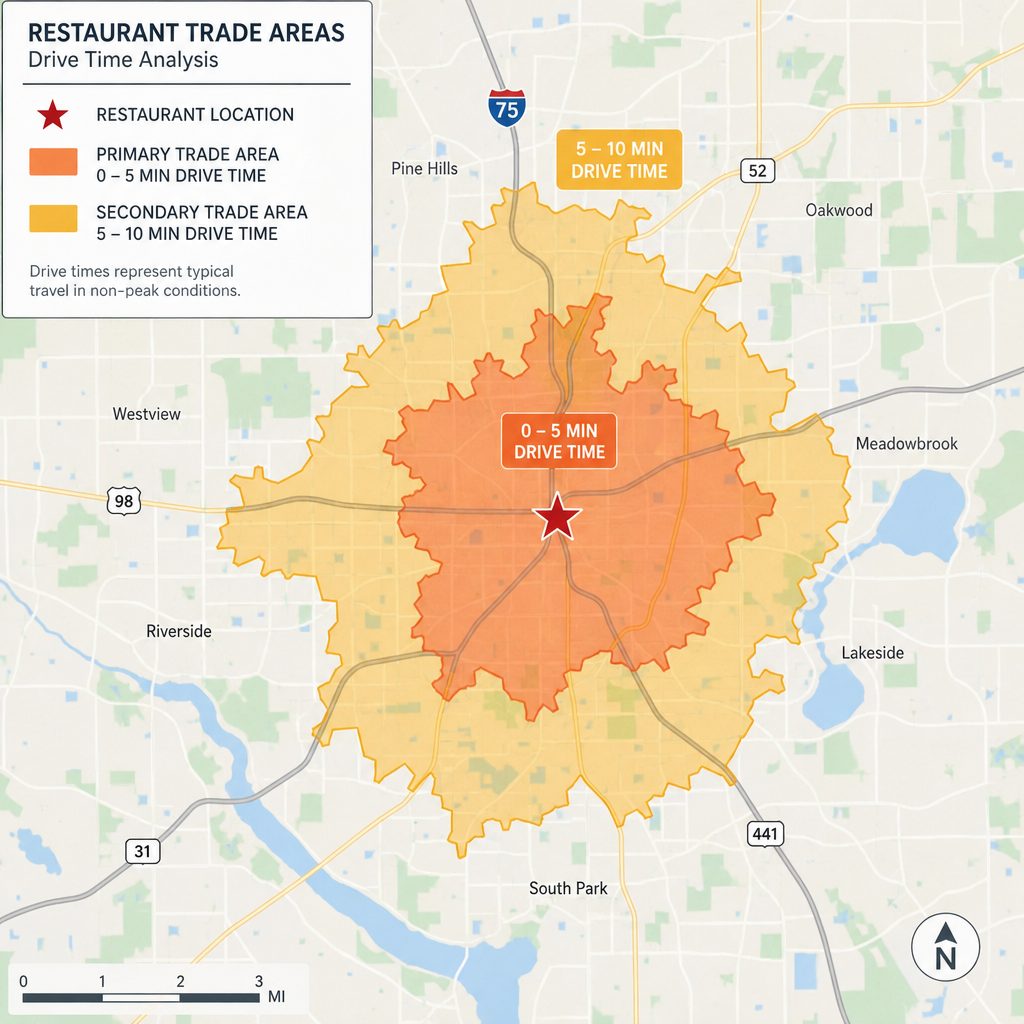
Your trade area is the geographic zone from which you will draw the majority of your customers. Learning how to conduct a trade area analysis is a critical skill for any operator or real estate manager.
Steps to Conduct a Trade Area Analysis
- Define the core boundaries. Traditionally, trade areas were drawn as simple one-, three-, and five-mile rings around a location. Today, we use drive-time and walk-time polygons. A three-mile ring means little if a river, railway, or limited-access highway cuts the real catchment in half.
- Identify physical and psychological barriers. A multi-lane highway might only take two minutes to cross in a car, but it acts as a massive psychological barrier for pedestrians.
- Analyze the inflow. Use location data to see where devices spotted in your trade area originate from. Are they locals, or are they commuters traveling from thirty miles away?
To make sense of these complex boundaries, geospatial data visualization for food service is incredibly valuable. Transforming rows of complex data into intuitive, color-coded heat maps allows decision-makers to see opportunity and risk at a glance. Go deeper with our trade area analysis guide.
Competitive Intelligence and Market Saturation
No restaurant exists in a vacuum. A great location with the perfect demographic can still be a terrible investment if the market is already oversaturated with identical concepts.
A robust competitive analysis involves more than just noting the names of the restaurants across the street. A thorough approach requires assessing competitor density and market saturation. If you are the fifth burger concept on the same block, even strong traffic may not save a weak differentiation story.
The Power of Points of Interest (POI)
By using points of interest data for competitive mapping, operators can see the entire commercial ecosystem. POI data doesn’t just map direct competitors; it maps complementary businesses.
For example, a fast-casual salad concept will benefit greatly from being mapped near high-end gyms, yoga studios, and corporate office parks. Conversely, if you notice a thriving neighborhood with strong residential density but a gap in late-night dining, that white space can be more valuable than a “busy” corner already packed with similar menus.
Adapting to New Business Models: Ghost Kitchens
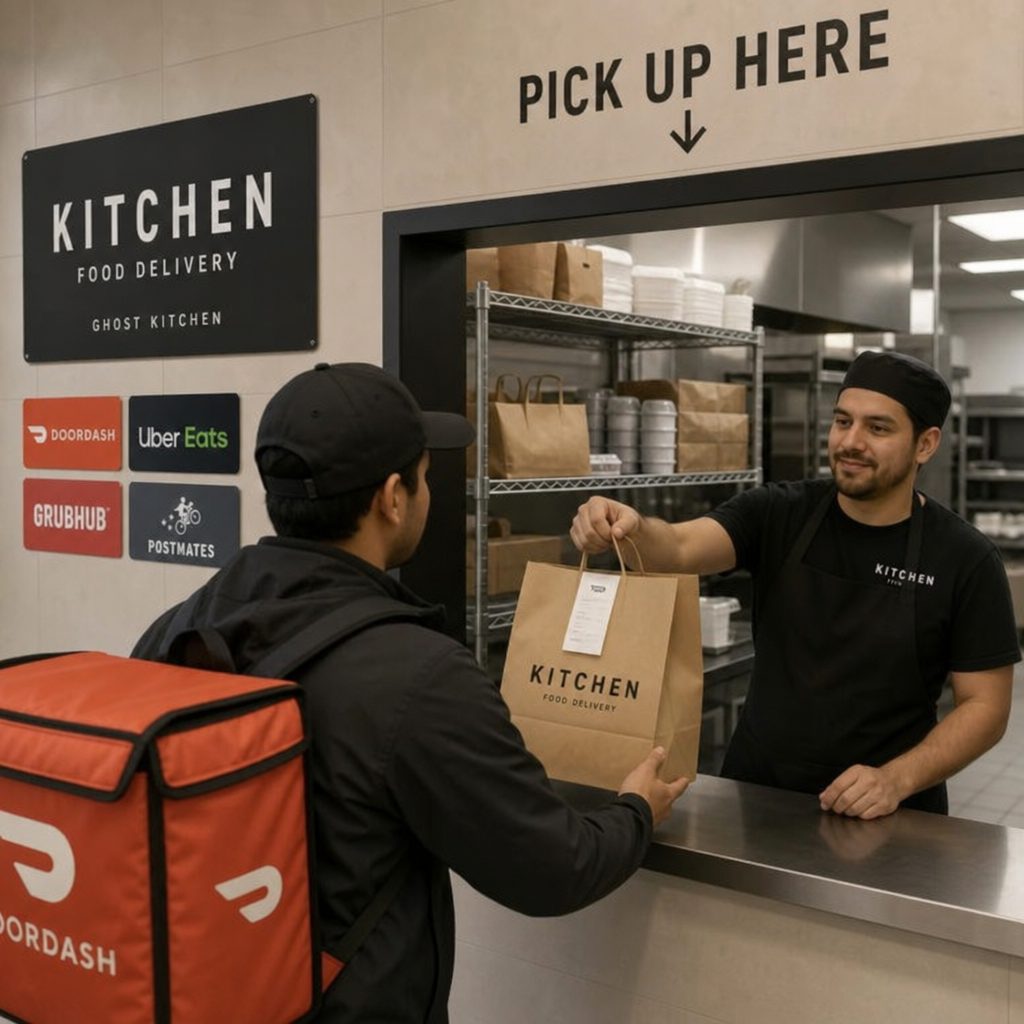
The rise of digital ordering has birthed entirely new operational models, profoundly changing location strategy. Enter the ghost kitchen—a delivery-only facility with no consumer-facing dining room.
For these facilities, foot traffic and curbside visibility are completely irrelevant. Instead, the focus shifts entirely to delivery logistics. For off-premise models, optimizing delivery radius for ghost kitchens is the primary site filter: drive times to dense residential zones, kitchen access for couriers, and proximity to multiple demand pockets.
When mapping a site for a ghost kitchen, operators look for lower-rent industrial or secondary retail spaces that sit squarely in the middle of high-density residential zones. The geospatial data requirements change—but the need for location intelligence does not.
External Factors: Urban Planning and Real Estate Risks
Even with perfect demographics and foot traffic, external municipal factors can make or break your site. You must also ask: how does urban planning impact restaurant viability?
Urban planning dictates zoning laws, parking minimums, liquor license caps, and future infrastructure projects. A vibrant street corner today could become a nightmare tomorrow if the city plans a two-year road reconstruction project that blocks your entrance.
Ultimately, this level of diligence is about mitigating commercial real estate investment risks. Signing a commercial lease is a massive, multi-year financial liability. By utilizing deep location analytics before you sign, you protect the investment that every other operational decision depends on.
Choosing the Right Technology
Gathering all this information manually is impossible. The modern food service industry relies heavily on sophisticated software to crunch billions of data points in seconds.
Investing in the top restaurant business intelligence tools for multi-location chains is a necessity for operators looking to scale aggressively. These platforms integrate internal sales data with external mobility and demographic layers so you can compare markets consistently.
Partnering with leading restaurant location intelligence companies—or starting with accessible tools like Restaurant Site Finder—can take the guesswork out of early screening. For AI-led approaches, see our guide on AI restaurant location analysis.
The Ultimate Goal: Predictive Modeling
Ultimately, the goal of all this data is predicting restaurant sales performance for new locations. By feeding a business intelligence tool the data from your existing, highly successful locations, the software reverse-engineers what made those sites work—and scores new candidates against that DNA.
When you can accurately project first-year sales based on geospatial data, securing funding from banks, investors, or franchisors becomes exponentially easier. Pair scoring with a structured Go/No-Go decision framework before you commit.
Conclusion
The phrase "location, location, location" has been the golden rule of real estate for generations. However, the definition of a "good location" has fundamentally changed. It is no longer just about a busy intersection or a charming storefront.
Today, success requires true restaurant location intelligence. It requires merging the art of hospitality with the hard science of location analytics. By analyzing neighborhood foot traffic, understanding diner psychographics, mapping trade areas accurately, and stress-testing competition and zoning, you turn expansion from a gamble into a managed decision.
Whether you are scouting your first site or your five-hundredth, letting data drive your real estate decisions is the most reliable recipe for long-term culinary success.
Ready to evaluate your next address? Try the free analysis at Restaurant Site Finder for competitor mapping, market gap detection, and an opportunity score—before you sign the lease.
Run a free location analysis
Enter any address to get competitor mapping, market gaps, opportunity scoring, and concept ideas.
Analyze your location free Shop equipment at Horeca Store