Site Selection
Using AI to Choose the Perfect Location for a Restaurant Business
Using AI to choose the perfect location for a restaurant business, demographics, foot traffic, competitor analysis, accessibility, validation checklists, expansion strategy, and blending data with human judgment.
Key Takeaways
- Using AI to choose the perfect location for a restaurant business adds data-backed clarity to site selection without replacing local knowledge or on-the-ground validation.
- AI can analyze demographics, foot traffic rhythms, competitor density, accessibility, and expansion fit, turning raw data into a shortlist, scores, and risk summaries you can act on.
- Treat AI as decision support: validate recommendations with site visits, lease review, and operational planning before signing.
- Screen candidate addresses free at Restaurant Site Finder, then apply our Go/No-Go framework before committing.
Choosing where to open a restaurant is one of the biggest decisions an owner can make, and it affects everything from daily foot traffic to staffing, delivery demand, rent pressure, and long-term growth. Using AI to choose the perfect location for a restaurant business does not replace local knowledge or entrepreneurial instinct, but it can make the decision far more informed. Instead of relying only on a busy-looking street or a landlord's promise, restaurant owners can use data to understand who lives nearby, when people move through an area, what competitors are doing, and whether the numbers support the concept.
Why does restaurant location matter so much?
Restaurant location matters because even a great menu can struggle if the surrounding market does not match the concept, price point, or customer habits. A casual lunch spot needs different traffic patterns than a destination dinner restaurant, and a family-friendly café may depend on different neighborhood signals than a late-night quick-service brand. Good restaurant site selection connects the food, service model, target audience, and operating costs to a place where demand is realistic.
The old advice still holds: location can make or break a restaurant. But today, "good location" means more than a visible corner or a popular shopping strip. It includes delivery radius, nearby work patterns, residential density, parking access, competitor saturation, local spending behavior, and even how the area changes by daypart.
That is where AI becomes useful. It can analyze far more variables than a person can comfortably compare in a spreadsheet. More importantly, it can uncover patterns that are easy to miss, such as a neighborhood that looks quiet during a daytime visit but has strong evening demand, or an area with high foot traffic that does not align with your target customer.
The shift from gut feeling to data-backed decisions
Restaurant owners have always used some form of location intelligence. They count cars, observe pedestrians, look at nearby anchors, talk to brokers, and study competitors. Those instincts are valuable because restaurants are local, human, and highly dependent on context.
AI adds another layer. Instead of asking, "Does this site look promising?" it helps you ask, "Which signals make this site promising, which signals create risk, and how does it compare with other options?" That shift is powerful because restaurant leases are expensive commitments. Once you sign, redesign the space, hire the team, and launch the brand, changing your mind is not simple.
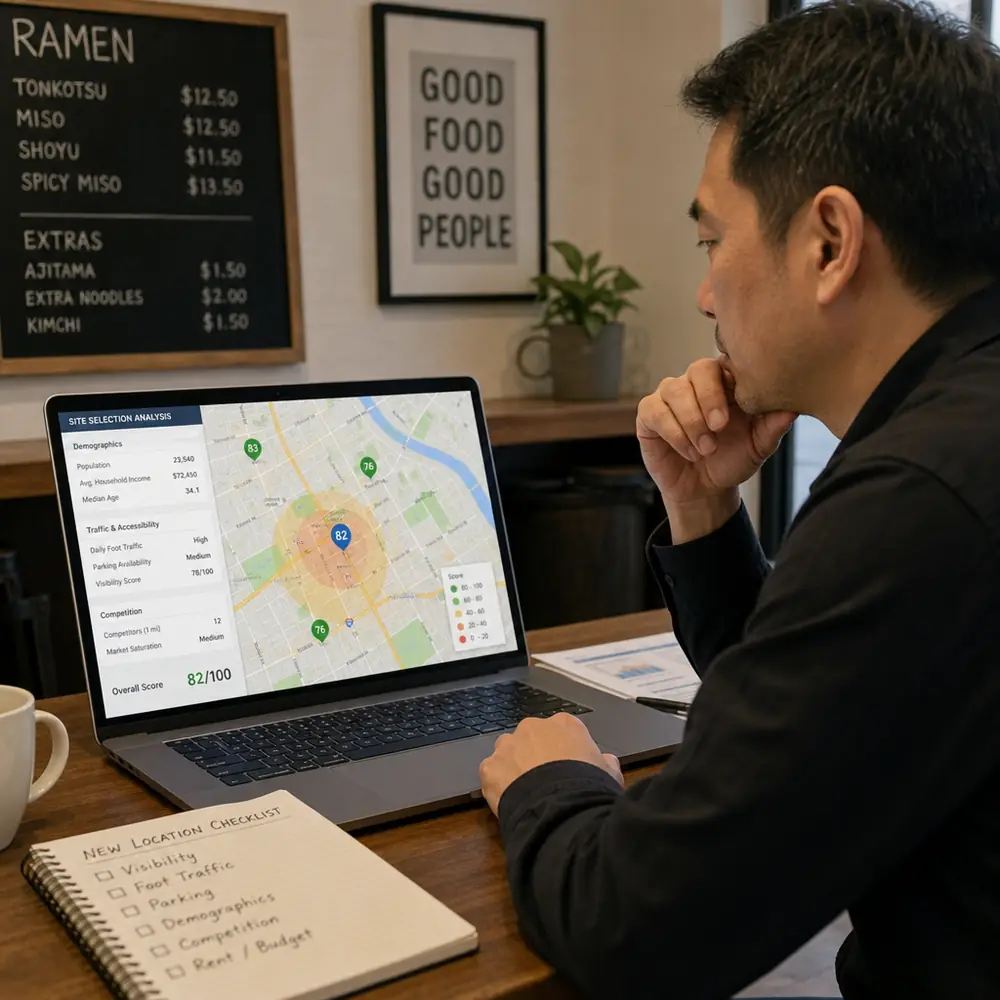
A data-backed approach can help with several common decisions:
- Choosing between two similar spaces in different neighborhoods
- Deciding whether a second location should mirror the first or serve a new audience
- Estimating whether lunch, dinner, delivery, or weekend traffic will drive revenue
- Understanding whether competitors validate demand or crowd the market
- Matching a restaurant concept to local income, lifestyle, and movement patterns
- Avoiding a beautiful space that lacks the customer base to sustain it
The goal is not to eliminate risk. Restaurants will always involve taste, timing, service, hospitality, and luck. The goal is to make smarter bets. See AI restaurant location analysis for a deeper look at how modern tools work.
What AI can analyze in restaurant site selection
AI restaurant location analysis works best when it brings together different types of information and turns them into practical insights. One data point rarely tells the whole story. A high-income neighborhood, for example, is not automatically a great place for every restaurant. A dense office district may be excellent for weekday lunch but weak for weekend dinner.
Useful analysis often includes these categories.
Customer demographics and lifestyle fit
A restaurant needs enough people nearby who are likely to want what it offers. AI can help analyze population density, age groups, household types, income ranges, commuting patterns, and lifestyle indicators. For example, a fast-casual salad concept may look for office workers, fitness-oriented consumers, and strong weekday daytime traffic. A family-style restaurant may care more about residential neighborhoods, schools, weekend activity, and parking convenience.
This does not mean reducing customers to data points. It means checking whether the local market gives your concept a fair chance. A mismatch between audience and offer can create a constant uphill battle, even with great food.
Foot traffic and movement patterns
Busy areas are not all busy in the same way. Some streets peak in the morning. Others come alive after work. Some draw tourists, while others serve residents or commuters. AI can help interpret movement patterns by time of day, day of week, and season.
That matters because restaurant revenue is tied to rhythm. A breakfast café needs morning movement. A bar-forward concept needs evening and late-night activity. A delivery-focused restaurant may care less about walk-in volume and more about residential density within a short radius. Restaurant foot traffic analysis with AI can help quantify those rhythms before you sign a lease.
Competitor and complement analysis
Competitors are not always bad. In many cases, nearby restaurants prove that people already visit the area to eat. The real question is whether the market has room for your concept and whether your positioning is different enough.
Location intelligence AI can help map direct competitors, indirect alternatives, complementary businesses, and demand clusters. A taco shop may benefit from being near nightlife. A bakery may do well near coffee shops, schools, or offices. A higher-end restaurant may want proximity to entertainment, hotels, or affluent residential areas.
The key is to look beyond simple counts. Ten restaurants nearby may be a warning sign in one market and a demand signal in another. AI can help frame that question more clearly.
Accessibility and convenience
Customers may love your concept, but friction still matters. Parking, transit access, walkability, visibility, bike routes, rideshare convenience, and traffic flow can all influence visit frequency. For quick-service restaurants, easy access can be especially important. For destination dining, customers may tolerate more effort, but only if the experience feels worth it.
AI can help compare how easy it is for different customer segments to reach a location. It can also show whether natural travel paths support impulse visits or whether the site requires intentional planning.
How does AI restaurant location analysis actually work?
AI restaurant location analysis works by combining location-based data, customer behavior signals, market information, and business rules to score or compare potential sites. The system looks for patterns between places, people, competitors, and demand, then helps decision-makers understand which locations best match the restaurant's concept. The output is usually not a magic answer; it is a clearer view of opportunity and risk.
Think of it like a smarter research assistant. You give it a business goal, such as opening a premium coffee shop, a quick-service chicken concept, or a neighborhood wine bar. Then the analysis compares possible areas based on the variables that matter most for that model.
A practical workflow might look like this:
- Define the restaurant concept clearly. Include cuisine, service style, average check expectations, daypart focus, dine-in versus delivery mix, space needs, and target customers.
- Select the geographic search area. This could be a city, district, trade area, or expansion zone.
- Gather relevant location data. Useful inputs may include demographics, traffic patterns, competitor locations, nearby businesses, mobility trends, public transit, parking, and real estate details.
- Weight the most important criteria. A delivery-first brand may prioritize residential density and courier efficiency, while a full-service restaurant may prioritize visibility, ambiance, and dinner traffic.
- Compare sites side by side. AI can score options, flag weaknesses, and explain why one location may outperform another for a specific concept.
- Validate with human research. Owners should still visit the area, speak with locals, review lease terms, assess buildout realities, and test assumptions.
The best results come when AI is treated as decision support, not a decision-maker. It can narrow the search and sharpen the questions, but it cannot taste the food, judge hospitality, or fully understand the emotional pull of a neighborhood.
Turning raw data into practical location intelligence
Raw data is not automatically useful. A long list of demographic numbers or traffic estimates can overwhelm more than it helps. The value of location intelligence AI comes from turning those inputs into decisions a restaurant team can actually use.
For example, instead of simply showing that an area has strong pedestrian traffic, a useful system might show when that traffic appears, whether it overlaps with likely meal periods, and whether nearby people match the restaurant's customer profile. Instead of listing competitors, it might group them by cuisine, price point, service style, and distance.
Practical outputs might include:
- A shortlist of neighborhoods that fit the concept
- A score for each possible site based on weighted criteria
- A map of direct competitors and complementary businesses
- A trade-area estimate showing where customers may come from
- A daypart analysis for breakfast, lunch, dinner, late night, and weekends
- A risk summary highlighting weak traffic, high competition, or poor access
- A comparison between the proposed location and existing successful locations
This is where AI becomes more than a dashboard. It helps the team move from "interesting information" to "here is what we should investigate next." Restaurant Site Finder packages many of these inputs into a free report you can run before touring properties.
Signs a location may be a strong fit
AI can highlight promising signals, but restaurant owners should know what those signals mean in the real world. A strong site usually has several advantages working together rather than one impressive feature.
Look for signs such as:
- Audience alignment: The surrounding population matches the concept's likely guests.
- Consistent demand: Traffic exists during the times the restaurant expects to earn revenue.
- Accessible approach: Customers can reach the location without unnecessary friction.
- Visible positioning: The site is easy to notice, describe, and remember.
- Complementary neighbors: Nearby businesses bring people who may also want your offer.
- Manageable competition: Similar concepts exist, but the market is not obviously overcrowded.
- Operational fit: The space supports kitchen needs, seating plans, storage, pickup flow, and staff movement.
- Realistic economics: Rent, buildout, labor access, and sales potential appear compatible.
A location with only one advantage can be tempting. A famous street may have visibility but impossible rent. A cheap lease may hide weak demand. AI helps identify whether a site has a balanced set of strengths or whether one shiny feature is distracting from deeper problems. Pair this with how to find the perfect restaurant location for a full manual checklist.
Common mistakes AI can help restaurant owners avoid
One of the biggest benefits of AI in restaurant site selection is not just finding good locations. It is avoiding bad assumptions. Many restaurant owners fall in love with a space because it feels right, looks stylish, or sits in a neighborhood they personally enjoy.
That emotional connection is understandable, but it needs a reality check. AI can help challenge assumptions before they become expensive commitments.
Common mistakes include:
- Confusing traffic with demand. Lots of people passing by does not mean they want your food, at your price, at that time.
- Ignoring daypart mismatch. A lunch-focused concept may struggle in an area that is busy mainly at night.
- Underestimating access issues. Poor parking, awkward turns, or weak visibility can reduce visits.
- Copying a competitor without understanding why it works. A nearby restaurant may succeed because of brand loyalty, lease history, or a unique operating model.
- Overlooking delivery dynamics. A dine-in location may not be ideal for delivery coverage, and a delivery-friendly zone may not support walk-ins.
- Assuming one successful location guarantees another. Expansion requires understanding what made the original site work and whether those conditions exist elsewhere.
AI is especially useful because it can introduce objectivity at the exact moment optimism tends to take over. If the data and the dream disagree, that does not always mean abandoning the site. It means asking better questions. AI predicts restaurant success before lease explores how predictive scoring can flag these risks early.
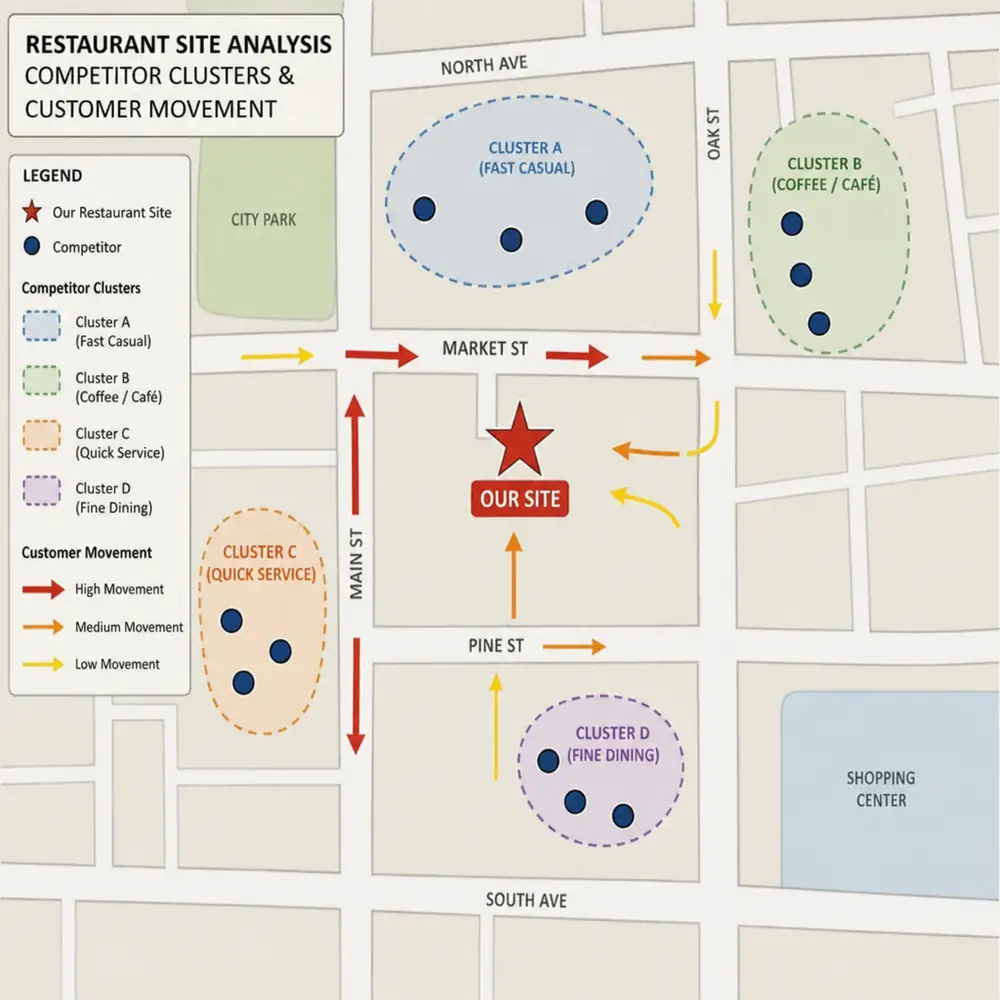
What should you check before trusting an AI recommendation?
Before trusting an AI recommendation, check the quality of the data, the relevance of the scoring criteria, and whether the output makes sense on the ground. AI can produce polished results from incomplete or poorly matched inputs, so restaurant owners should treat every recommendation as a starting point for deeper validation. A good recommendation should be explainable, not mysterious.
Start by asking what data is being used and how current it is. Outdated movement patterns, incomplete competitor lists, or broad demographic assumptions can weaken the analysis. Then look at how the model weights different factors. If rent exposure, delivery radius, or daypart demand matters to your concept, those variables should not be treated as minor details.
A simple validation checklist can help:
- Visit the site at different times, including peak and quiet periods.
- Walk the area like a customer and note visibility, safety, access, and nearby activity.
- Compare the AI findings with broker information, public data, and your own observations.
- Review nearby restaurants in person, not just on a map.
- Talk with neighboring businesses when possible.
- Examine lease terms carefully with qualified professional guidance.
- Test whether the location supports operations, not only marketing potential.
The best restaurant decisions blend data with street-level reality. If an AI tool says a site is strong but the block feels empty during your core sales window, investigate the gap. If the tool warns of weak demand but the neighborhood is visibly changing, explore whether the data is lagging behind local momentum.
AI supports expansion strategy, not just first locations
For restaurant groups, franchise operators, and owners planning a second or third unit, AI can be especially helpful. Expansion is not just about finding another available space. It is about understanding which parts of the original success are repeatable.
An owner might learn that the first location performs well because it sits near offices, gyms, and dense apartment buildings. Another concept may depend on weekend family traffic, strong parking, and schools nearby. Once those patterns are defined, AI can search for similar conditions in new trade areas.
This can also prevent accidental cannibalization. Opening too close to an existing location may split demand rather than grow it. Opening too far away may create supply chain, management, or brand awareness challenges. Location analysis can help estimate whether a new site expands the customer base or simply shifts sales from one unit to another.
For growing brands, this creates a more disciplined expansion playbook. Instead of chasing every available lease, the team can focus on markets that resemble its best opportunities. See restaurant location intelligence beyond traffic data for multi-unit planning.
The human side still matters
AI can make restaurant location decisions smarter, but restaurants are not built by algorithms. The best locations still need a compelling concept, welcoming service, strong operations, consistent food quality, and a team that understands the community.
A neighborhood is more than its data profile. Local culture, street energy, customer expectations, and community relationships shape how a restaurant is received. AI may tell you where demand could exist, but the restaurant has to earn loyalty after opening.
This is why the strongest approach is a partnership between technology and human judgment. Let AI handle pattern recognition, comparison, and early risk detection. Let experienced operators, chefs, managers, and local advisors interpret what those patterns mean for the actual restaurant.
A smarter way to choose your next restaurant location
Choosing a restaurant location will never be completely risk-free, but it can be far more disciplined than simply picking a space that feels busy. AI gives restaurant owners a clearer way to compare sites, understand customers, study competitors, and test assumptions before committing to a lease.
The real advantage is confidence. Not blind confidence, but informed confidence based on a better view of the market. When you combine AI restaurant location analysis with local visits, operational planning, and sound financial review, you give your restaurant a stronger foundation before the first guest ever walks through the door.
The perfect location is rarely perfect in every way. But with the right data, the right questions, and a clear understanding of your concept, you can choose a location that gives your restaurant room to grow. Run a free site analysis at Restaurant Site Finder, then walk the finalists with our Go/No-Go location decision guide before you sign.
Run a free location analysis
Enter any address to get competitor mapping, market gaps, opportunity scoring, and concept ideas.
Analyze your location free Shop equipment at Horeca Store