Site Selection
Leveraging AI for Restaurant Market Insights
Learn how AI market analysis for restaurant location uses mobility data, psychographics, competitor mapping, and revenue forecasting to turn site selection into a data-driven science.
Key Takeaways
- AI market analysis for restaurant location replaces static census rings and gut feel with real-time mobility, psychographic, and competitive data.
- Geospatial isochrones reveal your true trade area, not perfect circles on a map.
- Predictive models forecast revenue, optimize delivery zones, and automate site scoring for franchise expansion.
- Run a free AI location scan at Restaurant Site Finder.
Opening a restaurant is an exciting venture, but it comes with notoriously high stakes. For decades, restaurateurs have relied on the old real estate adage: "location, location, location." But how do you actually find the perfect spot? In the past, it was a mix of gut feeling, basic demographic reports, and sitting in your car with a clicker counting pedestrians.
Today, the landscape has fundamentally changed. The rapid integration of the AI food industry into commercial real estate has transformed site selection from a guessing game into an exact science. By conducting an AI market analysis for restaurant location, operators can predict foot traffic, map competitor density, and forecast revenue with stunning accuracy.
In this comprehensive guide, we explore how modern technology is reshaping the way food and beverage concepts expand. We dive deep into actionable strategies, explore advanced data sources, and show you exactly how to turn complex algorithms into profitable decisions.
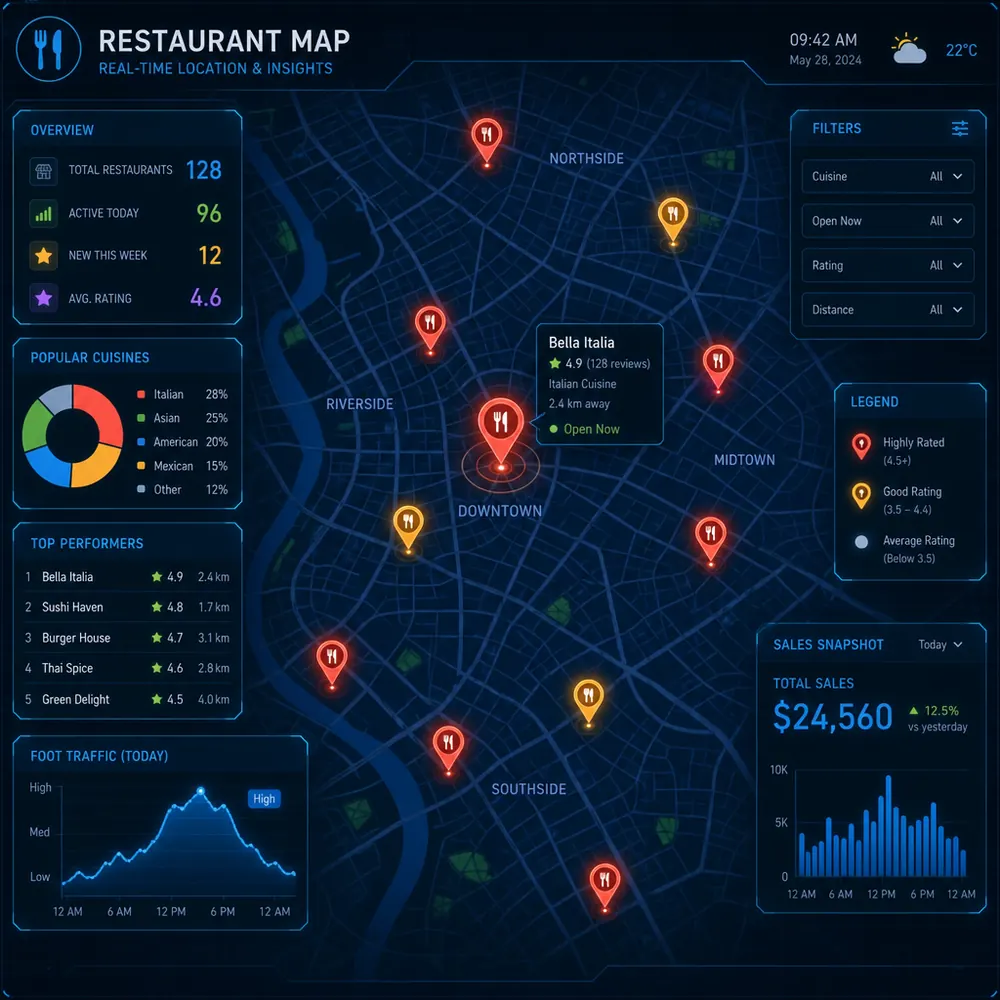
The Shift: Moving From Intuition to Intelligence
For a long time, evaluating a potential restaurant site was a manual, time-consuming process. Brokers would hand over a static PDF containing outdated census data, and business owners would cross their fingers, hoping the neighborhood would embrace their concept.
When evaluating AI versus manual methods for market research, the differences in speed, accuracy, and depth of insight are staggering. Manual methods rely on historical, static data that often fails to capture the dynamic nature of a city. On the other hand, AI thrives on real-time, fluid data. Machine learning algorithms can ingest billions of data points, from smartphone pings to credit card transactions, to create a living, breathing model of a neighborhood.
This shift toward intelligent market research restaurants use today allows operators to ask complex questions and get immediate, data-backed answers. Instead of asking "How many people live within a 3-mile radius?" you can now ask, "How many of our target customers walk past this specific storefront on a Tuesday at noon, and how likely are they to spend $20 on a fast-casual lunch?"
Understanding the Core of AI Location Intelligence
To grasp how AI market analysis for restaurants works, you must first understand location intelligence. Location intelligence is the process of deriving meaningful insights from geospatial data to solve spatial problems.
Moving Beyond the Simple Radius
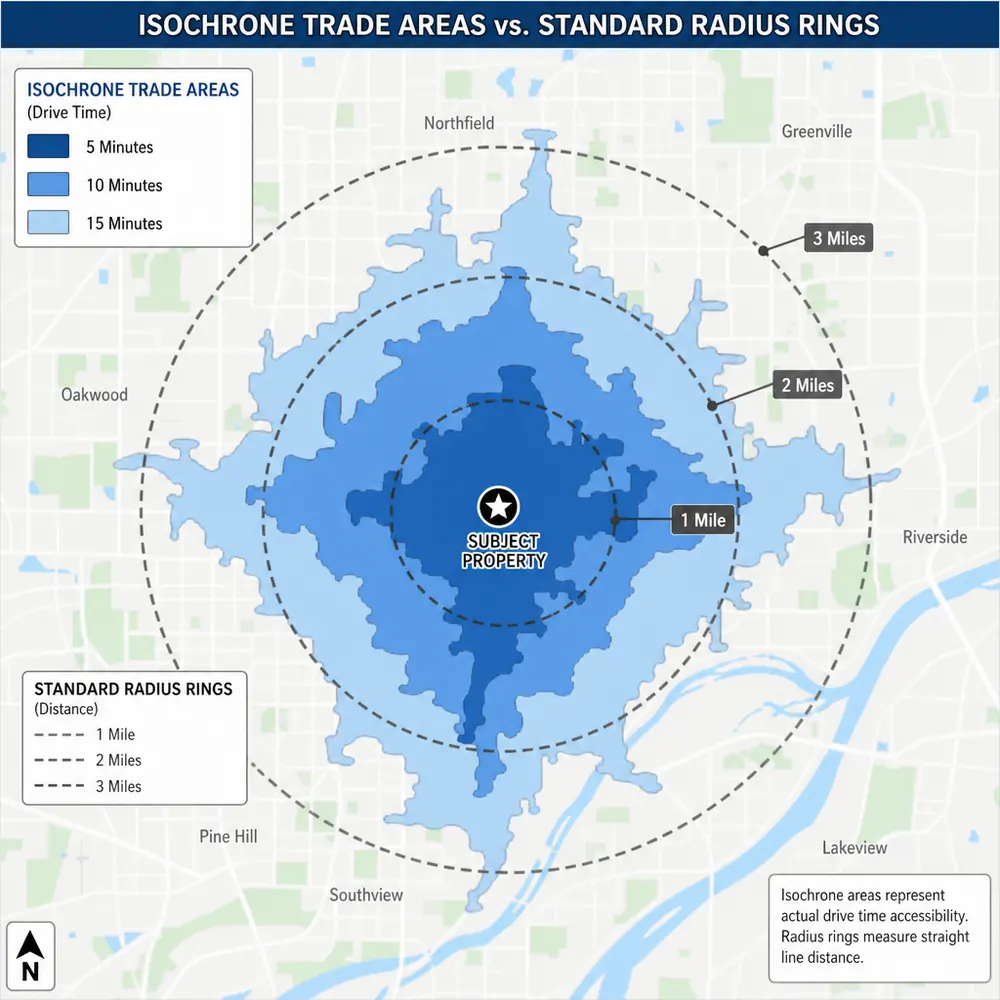
Traditionally, market analysts would draw a 1-, 3-, or 5-mile ring around a proposed site to define its potential customer base. But human beings don't travel in perfect circles. A 1-mile walk could take five minutes, or it could take forty minutes if there is a major highway or a river in the way.
This is why determining trade areas with geospatial intelligence is a game-changer. Instead of static rings, AI uses "isochrones", polygons that map out exact travel times based on walking, driving, or public transit. By integrating real-time traffic data, one-way streets, and geographical barriers, geospatial AI reveals your actual trade area, ensuring you aren't overestimating your accessible customer base.
For a deeper dive, see our trade area analysis guide.
Fueling the Machine: Advanced Data Sources
AI is only as good as the data it consumes. A common question among emerging franchisors and operators is: what are the best data sources for restaurant feasibility studies? To build an accurate predictive model, AI requires a layered approach, stacking various types of data to create a holistic view of the market.
1. Demographic Data
While standard census data is foundational, AI enhances it. Identifying high-growth neighborhoods with demographic data involves looking at trend lines rather than just current snapshots. Machine learning models can analyze building permit data, new residential developments, and gentrification patterns to predict what the local population will look like in three to five years, allowing you to secure leases in up-and-coming areas before rents skyrocket.
2. Mobility and Foot Traffic Data
Understanding how people move is arguably the most critical component of site selection. By securely and anonymously analyzing consumer behavior patterns through mobility data (derived from opted-in mobile device GPS pings), AI reveals where your potential customers work, live, and play.
If you are wondering how to use machine learning for foot traffic analysis, the process involves feeding historical and real-time mobility data into an algorithm to detect patterns. The AI can filter out people who are just driving past your location at 50 mph versus those who are walking leisurely on the sidewalk. It can tell you not just how many people pass by, but when they pass by.
Read more in our restaurant foot traffic analysis with AI guide.
3. Psychographic Profiling
Demographics tell you who people are (age, income, gender); psychographics tell you why they buy (values, lifestyles, hobbies).
How does psychographic profiling influence site selection? Imagine you are opening a high-end, plant-based restaurant. A neighborhood might have a high median income and the right age demographic, but if the psychographic data shows that the residents prioritize traditional steakhouses and value-driven fast food, your concept will likely struggle. AI tools aggregate social media trends, online purchasing behaviors, and lifestyle segmentation databases to ensure the cultural vibe of the neighborhood matches your brand identity.
4. Competitor Data
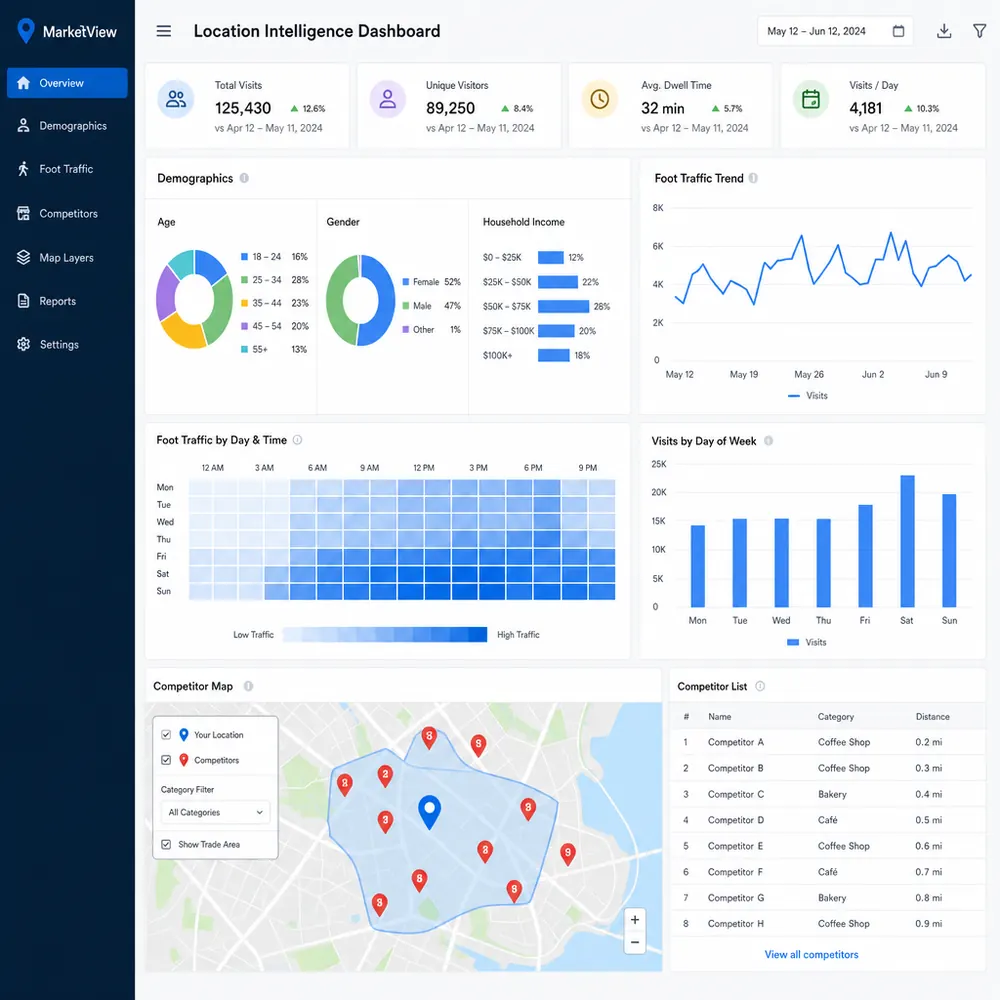
Opening next door to a direct competitor can be fatal, but locating near complementary businesses can boost your sales. Mapping competitor density using automated spatial tools allows you to see exactly where your rivals are located and how much of the market share they control. AI can scrape business registries, review platforms, and delivery apps to create dynamic maps of the competitive landscape, helping you identify underserved "white space" in the market.
Actionable Applications: Solving Real-World Location Problems
Once the data is aggregated, the real magic happens. Here is how operators use restaurant data analysis and machine learning to solve specific, high-stakes real estate challenges.
Mastering Urban Site Selection
Choosing a location in a dense urban environment is uniquely difficult. A storefront on the north side of a street might thrive, while the exact same concept on the south side of the street fails because it lacks morning sunlight or happens to be on the wrong side of the morning commuter flow.
Solving urban site selection challenges with predictive modeling requires highly granular data. Predictive models analyze micro-geographies, looking at variables like street visibility, crosswalk placements, proximity to subway exits, and even the presence of scaffolding. By feeding these highly specific variables into an AI model, operators can avoid "cursed" locations that look good on paper but fail in reality.
Optimizing for the Delivery Economy
The rise of food delivery has fundamentally altered how restaurants view real estate. If 60% of your business comes from UberEats or DoorDash, paying premium rent for high pedestrian visibility might be a waste of capital.
Instead, forward-thinking brands are optimizing delivery zones with demand heatmaps. AI analyzes historical delivery order data, neighborhood density, and drive-time analytics to identify the absolute best locations for ghost kitchens or delivery-heavy storefronts. These demand heatmaps highlight areas with a high concentration of target customers but low restaurant density.
Revenue Forecasting and Risk Mitigation
Opening a restaurant requires immense capital. Signing a five-year commercial lease is a massive liability. Therefore, reducing commercial real estate risk with location intelligence is the primary reason large brands invest in these technologies.
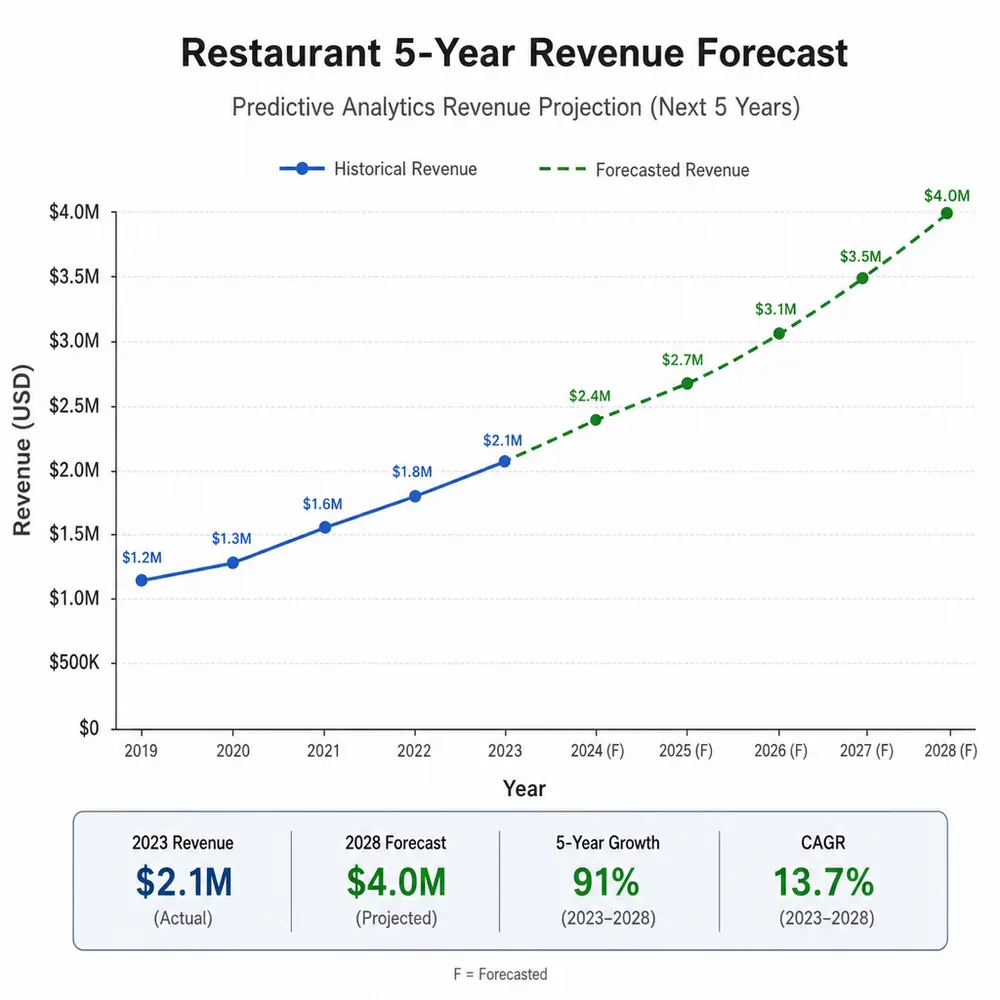
Instead of guessing how much money a new site will make, brands rely on machine learning models for revenue forecasting. Here is how it works:
- You feed the AI the historical financial data of all your existing restaurant locations.
- The AI identifies the specific site attributes that correlate with your highest-performing stores.
- You input the data for a proposed new location.
- The AI compares the new site's attributes against your historical data and generates a projection of Year 1, Year 2, and Year 3 revenue.
This level of predictive analytics for restaurant site selection gives stakeholders, investors, and banks the confidence they need to fund new projects.
Scaling Up: Franchise Growth and Automation
For multi-unit operators and franchise brands, the challenge isn't just finding one good location, it's finding fifty. Scaling a brand requires standardized, repeatable processes.
Integrating GIS Technology
Geographic Information Systems (GIS) have been around for a while, but AI has supercharged them. Integrating GIS technology into franchise expansion strategy allows corporate teams to map out entire regions, states, or countries to visualize their total addressable market.
Using GIS, a franchisor can perform "cannibalization analysis." If a franchisee wants to open a new location three miles away from an existing store, AI-driven GIS tools can simulate the impact and predict exactly what percentage of sales the new store will steal from the old store.
Automated Site Scoring
Reviewing real estate brochures one by one is incredibly tedious. To streamline the pipeline, brands are realizing the immense benefits of automated site scoring for food businesses.
With automated site scoring, a real estate manager can simply drop a pin on a digital map. Within seconds, the AI analytics engine runs thousands of calculations and assigns the site a grade, such as an A, B, C, or D, based on how well it aligns with the brand's ideal customer profile.
Post-Launch: Tracking Success and Staying Agile
The role of AI does not end once the ribbon is cut and the doors are open. Ongoing restaurant data analysis is essential for long-term survival.
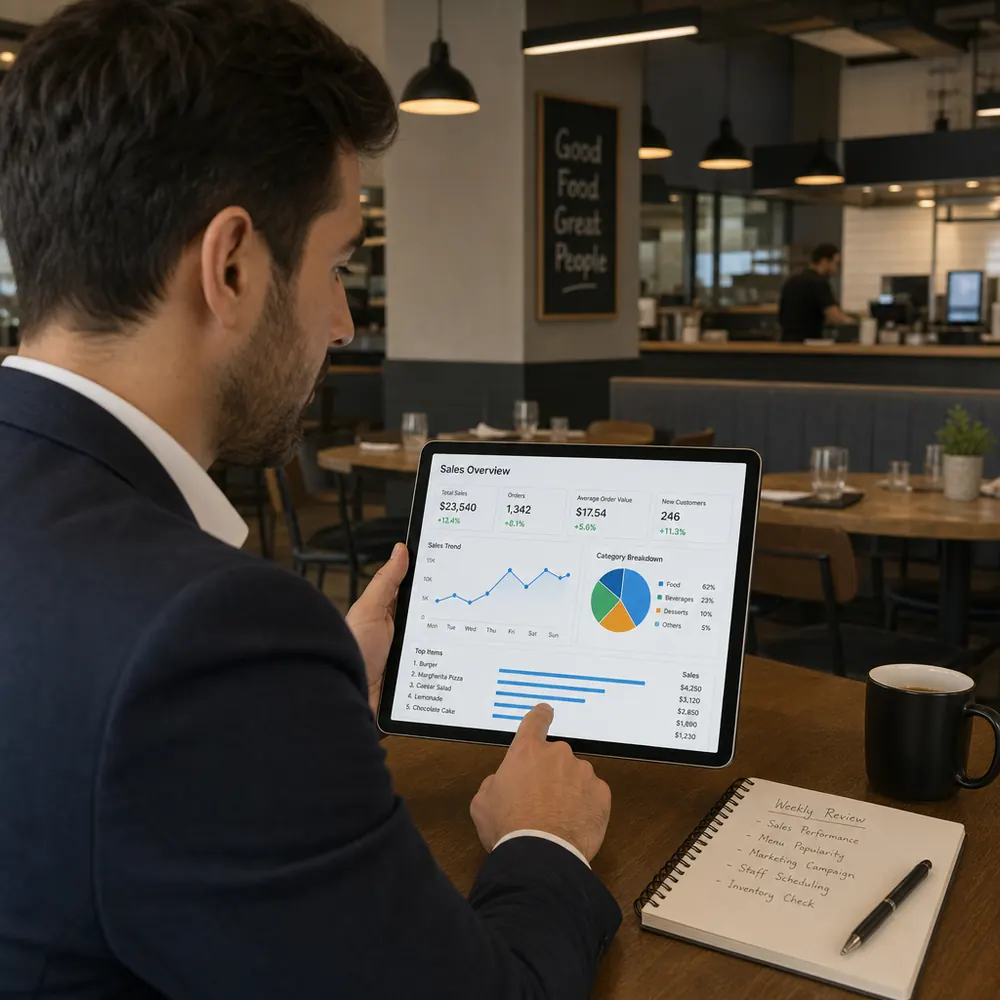
Operators must continually monitor restaurant performance metrics alongside local market changes. By integrating your Point of Sale (POS) system with your location intelligence software, you can track how external factors impact your sales.
To do this effectively, brands must build a robust tech stack. Utilizing modern restaurant analytics tools allows operators to view all their data in one centralized dashboard. These platforms combine internal data with external data to provide a 360-degree view of business health.
Adapting to Rapidly Changing Trends
The hospitality landscape is notoriously fickle. Keeping a pulse on restaurant market trends is crucial. During the pandemic, we saw a massive shift from urban centers to suburban drive-thrus. Today, we are seeing a resurgence of experiential dining and specialized dietary concepts.
AI market analysis tools constantly scrape the internet for localized search trends, social media hashtags, and food delivery app data. If there is a sudden, localized spike in searches for "gluten-free bakeries" in your trade area, AI can flag this trend before your competitors realize what is happening.
Best Practices for Implementing AI Market Analysis
If you are ready to move away from gut instincts and embrace the power of data, here are actionable steps to integrate AI into your real estate strategy:
- Define Your Ideal Customer Profile (ICP) rigidly: AI cannot find the perfect location if it doesn't know who your customer is.
- Don't rely on a single data point: High foot traffic means nothing if it's the wrong traffic. Always layer mobility, demographic, and competitor data.
- Leverage localized knowledge: Use AI to generate a shortlist of "Grade A" sites, then send a human to physically walk the neighborhood.
- Invest in the right software: Look for platforms with dynamic isochrones, mobile location data integration, and customizable revenue forecasting models.
- Clean your internal data: Bad data in means bad predictions out.
The Future of AI in the Restaurant Industry
As we look toward the future, the capabilities of AI in the restaurant space will only become more profound. We are moving toward an era of hyper-personalization and predictive operations. Future iterations of AI market analysis for restaurant location will likely incorporate augmented reality (AR) to allow operators to virtually "walk" through a digitally simulated, data-overlaid version of a neighborhood before signing a lease.
Furthermore, as smart city infrastructure grows, the availability of real-time, localized data will explode. Sensors monitoring pedestrian density, traffic flow, and even local weather micro-climates will feed directly into restaurant analytics platforms.
The divide between the operators who embrace these technologies and those who stick to traditional methods will widen. In a highly competitive, low-margin industry, the brands that win will be the ones that leverage data to eliminate blind spots, minimize risk, and position themselves, literally, for success.
Conclusion
Finding the perfect location for a restaurant no longer requires a crystal ball; it requires the right algorithm. By replacing outdated, manual research methods with sophisticated AI market analysis for restaurant location, operators can drastically increase their chances of long-term success.
From determining trade areas with geospatial intelligence and identifying high-growth neighborhoods with demographic data, to optimizing delivery zones with demand heatmaps and utilizing machine learning models for revenue forecasting, the tools available today are nothing short of revolutionary.
Whether you are an independent chef opening your first brick-and-mortar or a national franchise director mapping out a 100-unit expansion, integrating predictive analytics and location intelligence is no longer just a luxury, it is the new industry standard.
Start with free AI analysis today. Enter any US address at Restaurant Site Finder for competitor mapping, opportunity scoring, and concept fit analysis, then read our AI restaurant location analysis guide for the full framework.
Frequently Asked Questions
What is AI market analysis for restaurant location?
It uses machine learning, mobility data, demographics, psychographics, and competitor mapping to evaluate whether a specific address can support your restaurant concept.
What data sources power AI restaurant site selection?
Census and trend demographics, anonymized smartphone mobility data, psychographic lifestyle segments, competitor density maps, POS history, and delivery order patterns.
How does AI determine trade areas?
AI uses geospatial isochrones based on actual walk, drive, or transit times, accounting for highways, rivers, and traffic patterns instead of static mile-radius rings.
Can AI forecast restaurant revenue at a new site?
Yes. Machine learning compares a proposed location against your best-performing stores to project Year 1–3 revenue before you sign a lease.
Is Restaurant Site Finder free for AI location analysis?
Yes. Enter any US address at restaurantsitefinder.com.
Run a free location analysis
Enter any address to get competitor mapping, market gaps, opportunity scoring, and concept ideas.
Analyze your location free Shop equipment at Horeca Store