Site Selection
RestaurantSiteFinder vs Placer.ai vs Buxton vs ESRI: Which Restaurant Site Selection Tool Actually Wins in 2026?
Compare RestaurantSiteFinder, Placer.ai, Buxton, and ESRI across foot traffic, psychographics, GIS mapping, and usability to find the best site selection tool for your brand in 2026.
Key Takeaways
- Placer.ai wins on foot traffic and trade-area mapping; Buxton on psychographics; ESRI on custom GIS; RestaurantSiteFinder on usability and value for F&B operators.
- Enterprise QSR brands benefit most from Placer.ai; small-to-medium franchises and independents from RestaurantSiteFinder.
- Static demographic rings are obsolete—2026 site selection requires mobile telemetry, AI forecasting, and real-time demographic correction.
- Run a free comparison scan at Restaurant Site Finder, then read our full 2026 buyer's guide.
Opening a new restaurant has always been a high-stakes endeavor, but as we navigate through 2026, the margin for error in real estate has practically vanished. Gone are the days when a restaurateur could simply stand on a street corner with a clicker to count passing cars, or rely entirely on a commercial broker's "gut feeling." Today, successful expansion requires sophisticated data.
But with so many advanced platforms on the market, operators are faced with a complex question: RestaurantSiteFinder vs Placer.ai vs Buxton vs ESRI: which restaurant site selection tool wins in 2026?
Each of these platforms claims to offer the ultimate solution for restaurant location analysis, but they approach the challenge from very different angles—ranging from mobile foot traffic tracking to deep psychographic profiling.
In this comprehensive guide, we will break down the top restaurant site selection tools, compare their core strengths, and help you determine which platform provides the most accurate, actionable data for your hospitality brand.
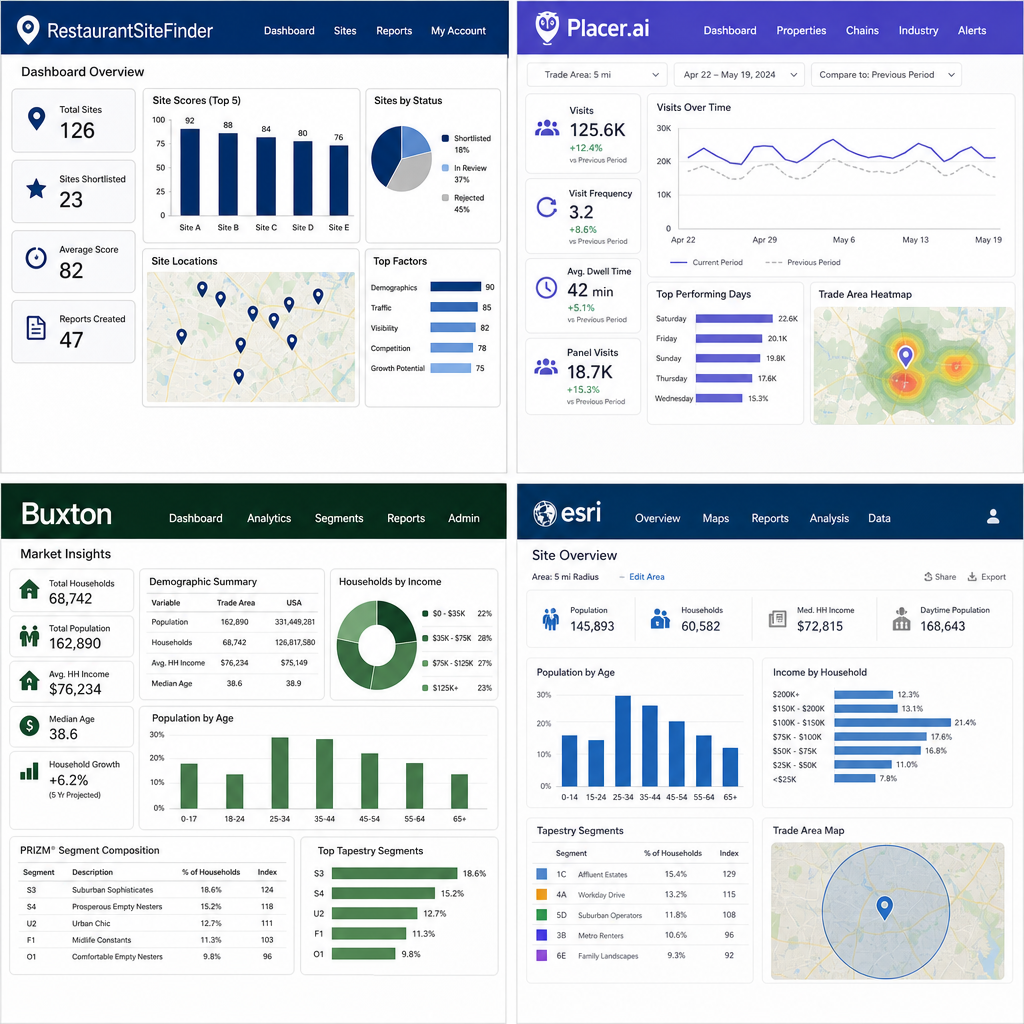
The Evolution of Site Selection Methods in 2026
Before comparing the specific platforms, it helps to understand how site selection methods have evolved. In the early 2020s, many brands relied on basic demographic rings (e.g., population within a 3-mile radius). By 2026, that approach is dangerously obsolete.
Modern site selection software relies on dynamic, real-time data. Three major technological leaps define the current landscape:
- AI and Machine Learning: The integration of AI-driven demand forecasting for QSR sites (Quick Service Restaurants) allows brands to predict drive-thru volume based on local traffic patterns, weather, and shifting consumer habits.
- Advanced Location Data: Operators are now leveraging mobile telemetry data for site selection accuracy. Instead of guessing where customers come from, modern tools track anonymized smartphone pings to see exactly where visitors live, work, and shop.
- Real-Time Demographic Correction: A major challenge in recent years has been outdated census data. Modern platforms have developed proprietary algorithms for overcoming inaccurate demographic data in site modeling, ensuring that operators are looking at who actually lives in an area today, not five years ago.
With these advancements in mind, let's dive into the contenders for the best restaurant site selection software 2026 has to offer.
1. Placer.ai: The Foot Traffic Titan
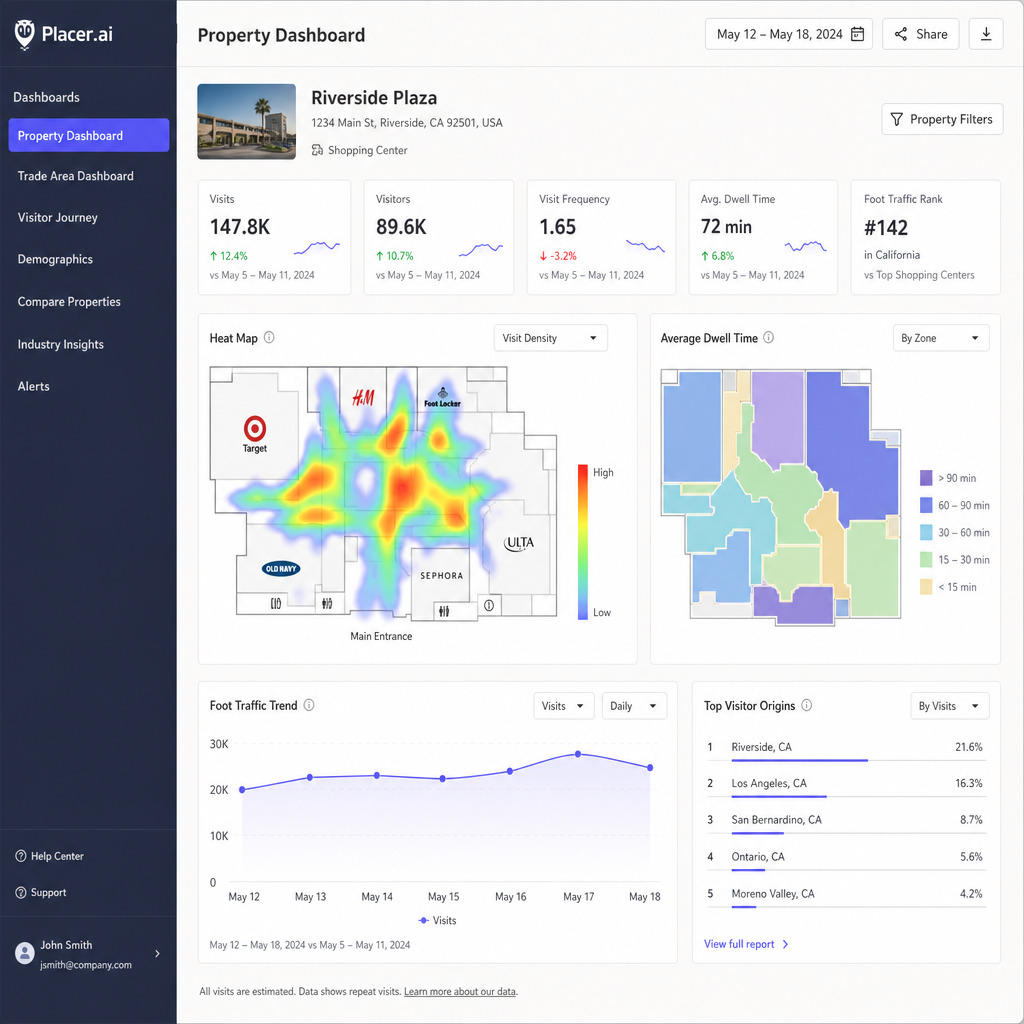
If there is a buzzword in commercial real estate right now, it's "foot traffic analytics," and Placer.ai is the undisputed heavyweight in this arena. Placer.ai utilizes anonymized mobile location data to provide hyper-accurate insights into consumer movement.
Core Strengths for Restaurants
When it comes to understanding how to use foot traffic data for restaurant location, Placer.ai serves as a masterclass. The platform allows you to draw a polygon around any existing retail center, competitor's restaurant, or vacant lot to see exactly how many people visit, how long they stay, and where they go afterward.
- Cannibalization Analysis: Easily see if a proposed new location will steal traffic from your existing stores.
- Co-Tenancy Synergy: Discover which grocery stores or big-box retailers share your exact customer base.
- Competitor Benchmarking: Track the foot traffic of rival brands in real-time.
The Drawbacks
While incredibly powerful, Placer.ai is a premium, enterprise-level product. Its pricing can be prohibitive for independent operators or single-unit franchisees. Consequently, many emerging brands find themselves searching for Placer.ai alternatives for restaurant foot traffic monitoring that offer scaled-down features at a lower price point.
Actionable Tip: Use Placer.ai's "True Trade Area" feature. Instead of drawing a 5-mile circle, let the software show you the actual organic shape of where your customers are driving from based on real road networks and travel times.
2. Buxton: The Customer Profiling Expert
While Placer.ai tells you where people are moving, Buxton focuses heavily on who those people are. Buxton has built its reputation on consumer analytics and matching your brand's best customers to lookalike audiences across the country.
Core Strengths for Restaurants
Buxton shines when it comes to psychographic segmentation in restaurant site selection. It goes far beyond basic income and age demographics, categorizing consumers by their lifestyles, spending habits, and values. Are the people in this neighborhood "Budget-Conscious Suburban Families" or "Trendy Urban Foodies"? Buxton tells you.
When comparing Esri Business Analyst vs Buxton customer profiling, Buxton generally offers a more intuitive, out-of-the-box solution specifically tailored to retail and hospitality brands looking to score sites based on customer match.
- Custom Scoring Models: Buxton builds a bespoke predictive model based on the performance of your current top-tier restaurants.
- Marketing Integration: The data you use to select a site can be directly exported to run targeted digital ads for your grand opening.
The Drawbacks
Buxton is heavily reliant on historical data and deep integrations with your existing Point of Sale (POS) and loyalty programs. If you are a brand new concept with no existing customer data, you won't be able to leverage the platform's full potential. See our Buxton alternative review for F&B-focused options.
3. ESRI (Business Analyst): The GIS Powerhouse
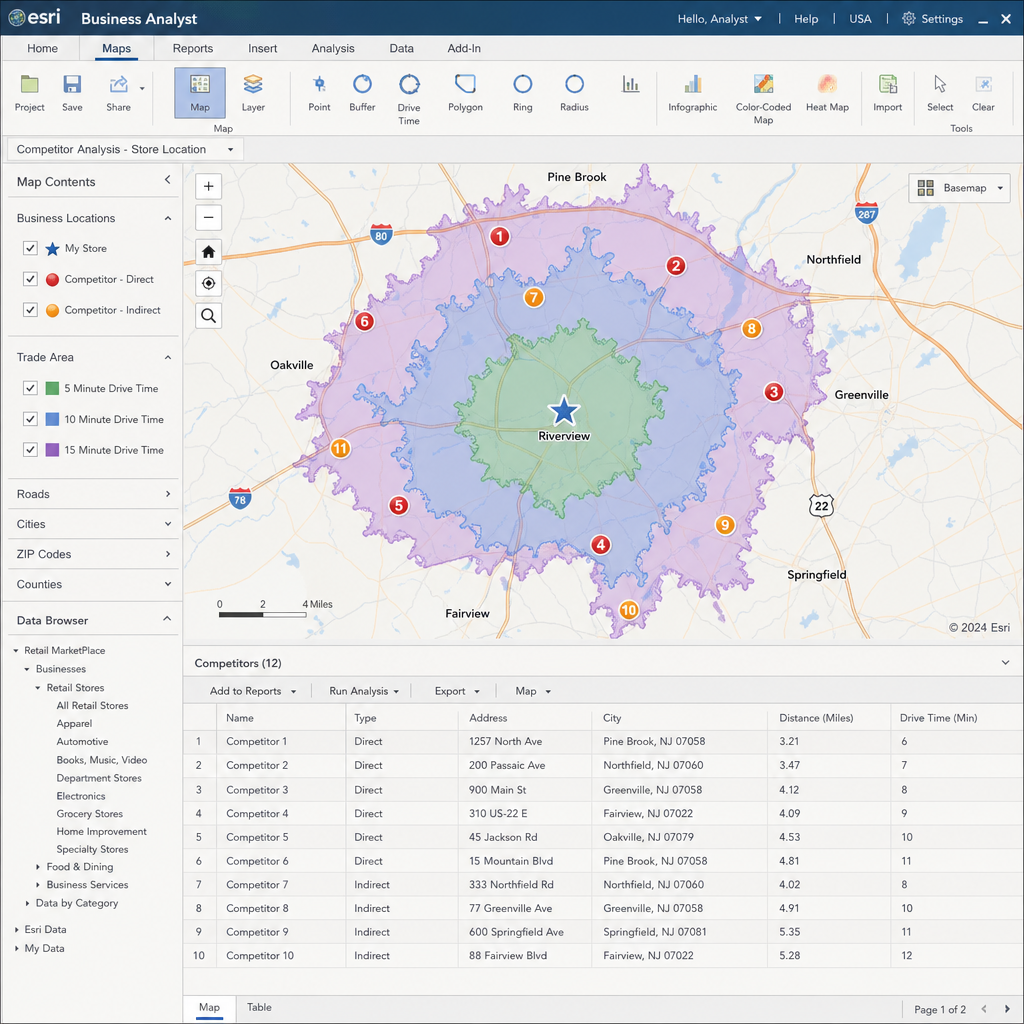
ESRI is the gold standard for Geographic Information Systems (GIS). Their Business Analyst suite is a heavy-duty platform utilized by massive global brands, urban planners, and governments.
Core Strengths for Restaurants
If you want granular control over your spatial data, ESRI is unmatched. It is one of the most robust location intelligence platforms for multi-unit restaurant chains looking to map out regional or national expansion strategies.
ESRI excels at evaluating competitor market share using GIS tools. You can layer hundreds of data points—from local zoning laws and traffic counts to drive-time polygons and competitor saturation—onto a single, highly customizable map.
- Total Customization: If you have the technical skills, there is virtually no limit to the spatial analysis you can perform.
- Predictive Modeling: Offers incredibly advanced predictive analytics for restaurant site selection, allowing data scientists to build complex algorithms to forecast sales.
The Drawbacks
ESRI is complex. It has a steep learning curve and usually requires a dedicated GIS analyst to operate effectively. For a restaurant owner whose main focus is food and operations, ESRI can feel overwhelming.
Actionable Tip: When conducting a trade area analysis for new restaurants using ESRI, always layer in local traffic barrier data (like rivers, train tracks, or divided highways). A location might look great on paper, but if it's on the wrong side of a median, your lunchtime traffic will plummet.
4. RestaurantSiteFinder: The Niche Specialist
As the name implies, RestaurantSiteFinder is purpose-built for the food and beverage industry. Unlike ESRI or Placer.ai, which serve everyone from real estate developers to city planners, RestaurantSiteFinder focuses strictly on restaurant planning software.
Core Strengths for Restaurants
This platform strips away the dense, unnecessary GIS features and gives restaurateurs exactly what they need: an easy-to-use interface with metrics that matter to hospitality. It aggregates demographic data, competitor locations, and basic traffic counts into digestible reports.
People often ask: is RestaurantSiteFinder better than ESRI for small franchises? In 2026, the answer for most small-to-medium operators is a resounding yes.
- Industry-Specific Metrics: Focuses on average check sizes, local dining-out expenditures, and daytime vs. nighttime population counts.
- User-Friendly: You do not need a degree in data science to pull a site report. It is built for franchise developers and independent operators.
- Cost-Effective: Typically much more affordable than the enterprise titans, making it one of the most accessible location analysis tools on the market.
The Drawbacks
Because it is a streamlined tool, it lacks the deep, raw mobile telemetry of Placer.ai and the highly customizable spatial processing of ESRI.
Feature Showdown: Comparing the Best Data-Driven Real Estate Platforms for Restaurateurs
To truly determine the winner, we have to look at the ROI of location intelligence tools for hospitality. A tool is only valuable if the revenue generated by a successful location drastically outweighs the cost of the software. Let's compare how these platforms handle the most critical aspects of site selection.
1. Accuracy of Trade Area Mapping
- Placer.ai: Wins easily. By using mobile pings, it draws real-world trade areas based on actual human behavior rather than theoretical drive times.
- ESRI: A close second, offering incredibly precise drive-time polygons, though they are based on algorithms rather than live human movement.
- Buxton & RestaurantSiteFinder: Both offer solid, traditional trade area mapping, but rely on underlying mapping software rather than proprietary mobile movement data.
2. Depth of Customer Profiling
- Buxton: The absolute winner. If you need to know exactly what radio station your target customer listens to and what brand of SUV they drive, Buxton's psychographic data is unrivaled.
- ESRI: Excellent demographic and tapestry segmentation, but requires more manual analysis.
- Placer.ai & RestaurantSiteFinder: Better for spatial movement and basic demographics rather than deep behavioral psychology.
3. Ease of Use and Accessibility
- RestaurantSiteFinder: The undisputed champion of usability. It allows restaurateurs to get actionable insights in minutes without undergoing weeks of software training.
- Placer.ai: Very intuitive dashboard, but interpreting the massive amounts of data can sometimes require a learning curve.
- Buxton: Highly customized, meaning the Buxton team does a lot of the heavy lifting for you, but you are reliant on their proprietary models.
- ESRI: The most difficult to learn. Requires dedicated GIS professionals.
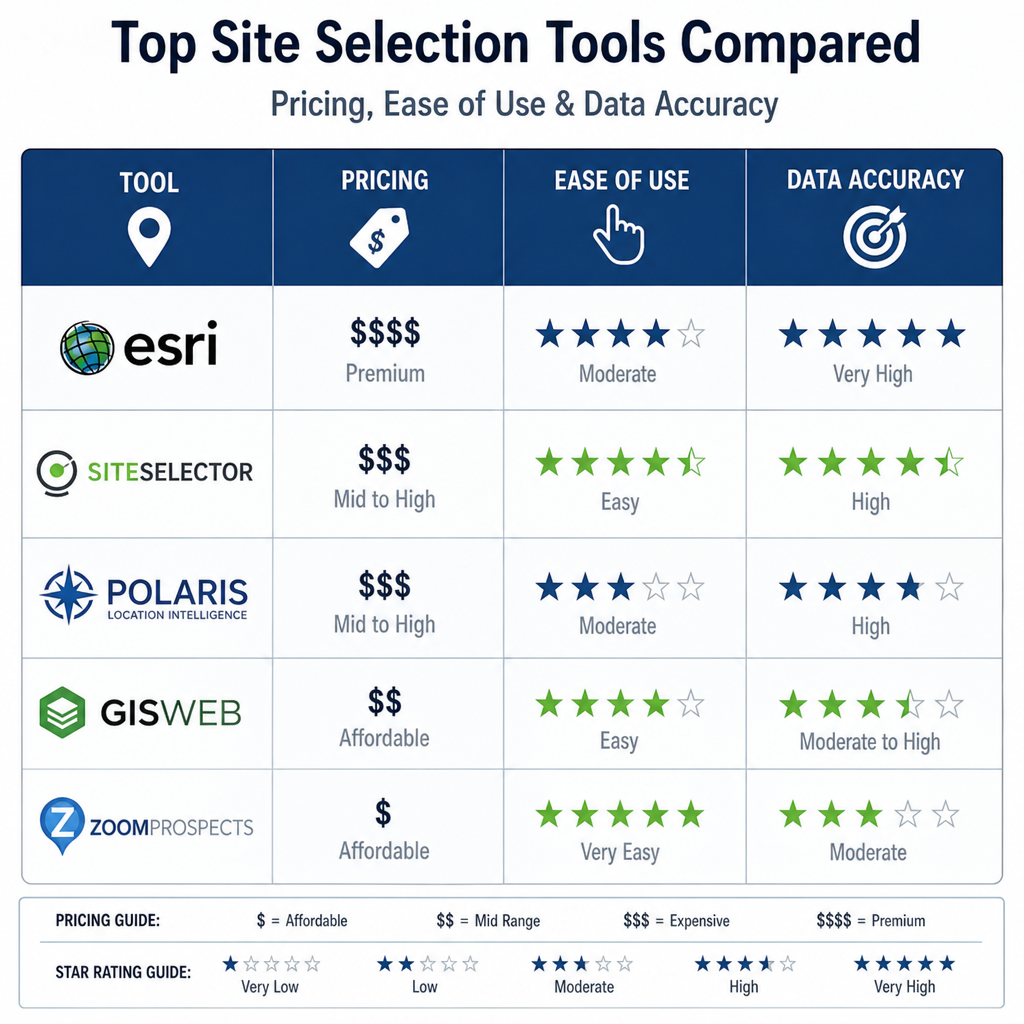
How to Choose the Right Tool for Your Brand
Selecting the right platform depends entirely on your brand's size, budget, and growth goals.
- Choose Placer.ai if: You are a fast-growing brand focused on co-tenancy, competitor cannibalization, and you want to understand exactly where your physical traffic is coming from.
- Choose Buxton if: You have a highly specific target demographic (e.g., a high-end vegan organic cafe) and need to find exact consumer matches in unfamiliar regional markets.
- Choose ESRI if: You are a massive, multi-unit enterprise with an in-house real estate analytics team that wants total control over complex spatial models.
- Choose RestaurantSiteFinder if: You are a small franchise, a regional multi-unit operator, or an independent restaurateur who needs fast, affordable, industry-specific data without the enterprise-level bloat.
Conclusion: Which Tool Actually Wins in 2026?
So, returning to our main question—RestaurantSiteFinder vs Placer.ai vs Buxton vs ESRI: which restaurant site selection tool wins in 2026?
The truth is, there is no one-size-fits-all answer, but there is a clear winner based on your operational tier.
For large-scale enterprise brands and QSR giants, Placer.ai is the defining tool of 2026. The shift toward mobile telemetry and real-time footfall analysis makes traditional demographic circles obsolete. If you are signing 50+ leases a year, Placer.ai's dynamic data provides the highest ROI by preventing multimillion-dollar real estate mistakes.
However, for small-to-medium franchises and independent operators, RestaurantSiteFinder takes the crown. It remains one of the best restaurant site selection tools because it contextualizes complex data into a format that food-service operators actually understand, all at a fraction of the cost of ESRI or Buxton.
Ultimately, the real loser in 2026 is the restaurateur who relies solely on "gut instinct." By investing in the best data-driven real estate platforms for restaurateurs, you mitigate risk, validate your assumptions, and ensure that your next grand opening is positioned exactly where your best customers are already waiting. Run a free analysis at Restaurant Site Finder today.
Frequently Asked Questions
Which restaurant site selection tool is best in 2026?
It depends on your brand size. Placer.ai leads for enterprise foot traffic and cannibalization analysis. Buxton excels at psychographic profiling. ESRI suits large chains with GIS teams. RestaurantSiteFinder is best for small-to-medium operators needing fast, affordable F&B-specific data.
Is RestaurantSiteFinder better than Placer.ai for restaurants?
Placer.ai offers deeper raw mobile telemetry for enterprise brands. RestaurantSiteFinder is better for independent operators and regional franchises who need industry-specific GO/NO-GO scoring without enterprise pricing or complexity.
How does Buxton compare to ESRI for site selection?
Buxton delivers out-of-the-box psychographic customer profiling tailored to retail and hospitality. ESRI offers unlimited GIS customization but requires dedicated analysts and is better suited to massive multi-unit enterprises.
What is the most important feature in restaurant site selection software?
Trade area accuracy, customer demographic match, competitor density mapping, and ease of use. The right mix depends on whether you prioritize foot traffic (Placer.ai), psychographics (Buxton), custom GIS (ESRI), or F&B-specific scoring (RestaurantSiteFinder).
Is Restaurant Site Finder free?
Yes. Enter any address for competitor mapping, opportunity scoring, and concept suggestions. Provide email and phone to unlock the full GO/NO-GO report at Restaurant Site Finder.
Run a free location analysis
Enter any address to get competitor mapping, market gaps, opportunity scoring, and concept ideas.
Analyze your location free Shop equipment at Horeca Store