Site Selection
Restaurant Location Analysis: 15 Factors to Check Before Signing a Lease
Restaurant location analysis, 15 factors to check before signing a lease: concept fit, demographics, daypart demand, visibility, access, parking, foot traffic, competition, lease economics, buildout, labor, regulations, operating costs, site comparison, and red flags.
Key Takeaways
- Restaurant location analysis before signing a lease should confirm the site can support sales, service model, labor, delivery, and rent, not just look busy on a tour.
- Check all 15 factors: concept fit through unit-level operating costs, then compare sites with the same assumptions and stress tests.
- Walk the block at your key dayparts; layer in demographics, competition, and lease economics before committing.
- Screen candidate addresses free at Restaurant Site Finder, then apply our Go/No-Go framework.
A great restaurant lease can become a growth engine, while the wrong one can drain cash before the concept has a fair chance. Restaurant location analysis helps you evaluate demand, access, competition, operating costs, and customer fit before you commit. Use this guide as a practical restaurant location analysis checklist for comparing sites, asking better questions, and building a location strategy that matches your concept.

What should restaurant location analysis tell you before you sign?
Restaurant location analysis should tell you whether a specific site can realistically support your sales, service model, labor needs, delivery radius, and rent burden. It is not just about finding a busy street; it is about matching the right restaurant placement to the right customers, dayparts, competitors, access points, and cost structure. Good restaurant site selection turns a promising address into a tested business assumption, not a guess.
The best restaurant location analysis combines field observation with data. Walk the block at breakfast, lunch, dinner, and late night if relevant. Then layer in location intelligence, restaurant demographics analysis, traffic patterns, nearby anchors, competitor density, and lease economics. The goal is simple: understand who is nearby, why they would choose you, and whether the site can make money after occupancy and operating costs.
1. Concept fit with the trade area
Start with the restaurant, not the real estate. A corner that works for a high-volume coffee shop may fail for a destination tasting menu, and a suburban drive-thru corridor may be wrong for a wine bar that depends on evening foot traffic.
Ask whether the local rhythm matches your concept. Are customers commuting, shopping, working, studying, living nearby, or visiting for entertainment? Your menu price, service speed, hours, parking needs, and atmosphere should feel natural in that setting. This is the foundation of restaurant placement.
2. Customer demographics and lifestyle patterns
Restaurant demographics analysis goes beyond population count. Look at age range, household income, family composition, office worker density, tourist presence, student population, and lifestyle habits.
A strong demographic match does not guarantee sales, but a poor match creates constant friction. For example, a premium lunch concept needs enough people nearby who can afford and justify that meal frequently. A family casual restaurant may need households, schools, weekend traffic, and convenient parking more than nightlife density.
3. Daypart demand
A site can look busy at noon and empty by 6 p.m. Before signing, study demand by daypart: breakfast, lunch, afternoon, dinner, late night, weekdays, weekends, and seasonal peaks.
This matters because rent is fixed even when sales are not. If your concept depends on dinner but the area is mostly office traffic, you may need stronger delivery, catering, or events to close the gap. If your model relies on all-day volume, a single strong daypart may not be enough. See how to choose a restaurant location based on foot traffic for daypart observation techniques.
4. Visibility from the street
Visibility reduces the burden on paid marketing. Check sightlines from sidewalks, traffic lanes, parking entrances, transit stops, and nearby intersections.
Look for anything that blocks attention: trees, columns, parked delivery trucks, poor lighting, awkward building setbacks, or neighboring signs. A beautiful dining room behind a hidden entrance may still work, but it usually needs a stronger brand, better wayfinding, or a destination-worthy offer.
5. Accessibility and customer convenience
A good location should be easy to reach, understand, and enter. Customers make small decisions quickly: where to turn, where to park, which door to use, whether the walk feels safe, and whether pickup is simple.
Review drive access, pedestrian paths, curb cuts, bike access, transit proximity, rideshare zones, ADA considerations, and delivery driver flow. If a site creates confusion before the customer reaches the host stand, conversion suffers.
6. Parking, pickup, and delivery logistics
Parking is not equally important for every concept, but convenience always matters. Quick-service, takeout, family dining, and suburban restaurants often depend on easy parking or curbside access. Urban concepts may rely more on pedestrian density, transit, and rideshare.
Do not evaluate only the number of spaces. Study turnover, shared parking rules, enforcement, employee parking, loading zones, delivery app pickup areas, and dinner-hour congestion. A lot that looks empty at 10 a.m. may be full when you need it most.
7. Foot traffic quality
Foot traffic is valuable only when it matches the restaurant's offer. Hundreds of people passing by in a hurry may produce fewer sales than a smaller group actively looking for food.
Observe behavior, not just volume. Are people lingering, shopping, commuting, attending events, or heading straight to cars? Location intelligence platforms often use mobility data, demographics, co-tenancy, competitor mapping, and trade-area analysis to help operators understand movement more clearly. Restaurant foot traffic analysis with AI can supplement on-the-ground observation.
8. Vehicle traffic and speed
High vehicle counts can help, but only if drivers can see you, slow down, and enter safely. A fast road with difficult turns may deliver awareness without visits.
Check traffic direction, median barriers, left-turn access, signal timing, rush-hour backups, and whether your sign is visible early enough for a decision. For drive-thru or fast casual sites, traffic pattern details may be as important as the headline count.
9. Competition and market saturation
Competition is not always bad. Nearby restaurants can create a dining district, bring customers to the area, and validate demand. The problem is saturation without differentiation.
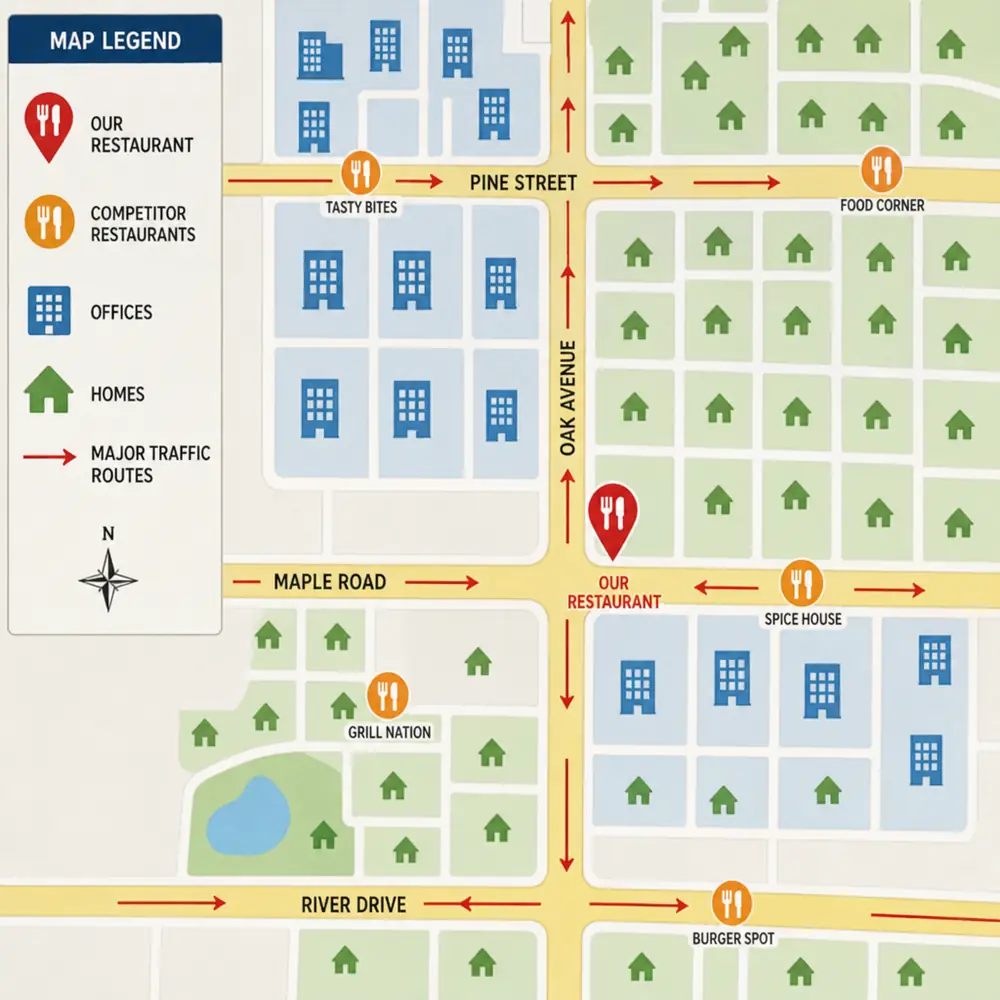
Map direct competitors, indirect competitors, delivery competitors, grocery prepared foods, coffee shops, bars, food halls, and workplace cafeterias. Then ask what gap your restaurant fills. Strong restaurant market research identifies not only who is nearby, but why customers would switch, add another visit, or choose you for a different occasion.
10. Neighboring businesses and demand generators
Co-tenants and nearby anchors shape customer flow. Offices, gyms, schools, theaters, hotels, medical centers, apartments, grocery stores, and transit hubs can all influence daypart demand.
The practical question is whether those neighbors create habits that support your concept. A gym may help a smoothie bar. A cinema may help dessert and late-night dining. A hotel may help breakfast and dinner, but only if guests can find you easily and your menu fits their needs.
11. Lease economics and rent-to-sales pressure
A great-looking site can still be a bad deal if the lease requires sales the market cannot support. Estimate base rent, percentage rent, common area maintenance, taxes, insurance, utilities, maintenance obligations, renewal terms, rent escalations, tenant improvement responsibilities, and personal guarantees.
Build conservative sales scenarios before you negotiate. If the site works only under your most optimistic forecast, it is fragile. Your rent should leave room for labor, food cost swings, marketing, repairs, debt service, and slow opening months. Read what percentage of sales rent should be for benchmark ratios.
12. Buildout complexity and physical condition
Restaurant buildouts can hide expensive surprises. Check hood systems, grease traps, HVAC, electrical capacity, plumbing, gas lines, restrooms, accessibility, patio permissions, storage, flooring, drainage, ceiling height, and prior restaurant infrastructure.
A second-generation restaurant space can save time, but it is not automatically cheaper. Equipment may be outdated, code requirements may have changed, or the layout may not fit your service model. Bring qualified professionals into the process before you treat any buildout estimate as final.
13. Labor market and employee access
Customers are only half the equation. Your team also needs to reach the restaurant reliably. A site with poor transit access, expensive parking, or a long commute from likely labor pools can make staffing harder.
Look at nearby workforce availability, wage expectations, competing employers, public transit, late-night safety, and employee parking. If your concept requires specialized culinary talent or high service levels, labor access should be part of the location strategy from the beginning.
14. Regulations, permits, and zoning
Confirm that the location can legally support your intended use. Review zoning, alcohol licensing constraints, patio rules, signage limits, venting requirements, occupancy limits, live entertainment permissions, waste handling, and hours-of-operation restrictions.
Do this early. A landlord may market a space as restaurant-ready, but your exact concept may still face limitations. The cost of discovering a restriction after signing can be far greater than the cost of due diligence.
15. Unit-level operating costs
Operating costs vary by location. Utilities, waste, pest control, security, delivery fees, insurance, local wages, repairs, taxes, and supply logistics can change the economics of two restaurants with similar sales.
This is where restaurant operating cost analysis per location can help multi-unit operators compare actual or projected unit-level performance. Even a careful spreadsheet can work for a first location if it captures occupancy, labor, food, utilities, repairs, marketing, and debt assumptions clearly. The point is to compare sites based on expected profit, not just expected sales. See restaurant profit margins and unit economics for margin benchmarks.
How do you compare two restaurant sites fairly?
Compare two restaurant sites by scoring the same factors with the same assumptions, then stress-testing the numbers under conservative, moderate, and optimistic scenarios. Do not let one exciting feature, such as a patio or high traffic count, hide weak access, poor demographics, or a lease that leaves no margin for error.
Use this simple process:
- Define the concept requirements. List your must-haves for size, kitchen, service style, parking, alcohol, patio, delivery, hours, and target guest.
- Map the trade area. Estimate realistic drive, walk, and delivery zones rather than relying on a generic radius.
- Observe the site repeatedly. Visit during the dayparts that matter most to your concept.
- Build a competitor map. Include direct and indirect substitutes, not only restaurants with the same cuisine.
- Model unit economics. Compare rent, buildout, labor, utilities, and sales assumptions.
- Document risks. Note what must go right for the site to work and what could break the model.
The best tools support judgment, not replace it
The phrase best tools for restaurant location analysis usually points to a mix of mapping, demographic, mobility, competitive, and financial analysis tools. Enterprise platforms may offer forecasting, trade-area modeling, cannibalization analysis, and field data capture, while lighter tools can help independent operators review competition, demographics, foot traffic, and local demand before a lease decision.
The best restaurant location analysis is not the tool with the most dashboards. It is the process that gives you clearer decisions. Use software to reveal patterns, but still walk the block, talk to neighboring operators when appropriate, review the lease carefully, and validate assumptions with your accountant, attorney, broker, architect, or contractor. Run a free scan at Restaurant Site Finder and compare with our Restaurant Site Finder 15-factor checklist.
Red flags before signing a restaurant lease
Some issues do not automatically kill a deal, but they should slow you down. Treat these as signals to investigate further:
- The landlord cannot clearly explain restaurant use permissions or past tenant issues.
- Rent works only if sales ramp quickly and stay strong.
- Visibility is poor and signage options are limited.
- Parking or pickup access is worse during peak hours than during your tour.
- The space needs major infrastructure upgrades without enough tenant improvement support.
- Nearby competitors are strong and your differentiation is unclear.
- The trade area is busy, but not with your target customer.
- Delivery access, trash handling, grease management, or loading creates operational friction.
- You feel pressure to sign before completing inspections, cost estimates, or permit checks.
A smarter lease starts with disciplined site selection
Restaurant location analysis does not remove risk, but it makes risk visible. When you understand customer fit, access, competition, costs, regulations, and daypart demand, you can negotiate better, walk away sooner, or move forward with more confidence.
Before signing, slow the process down enough to compare the site against your concept and your numbers. A disciplined restaurant site selection process may not feel as exciting as finding the perfect-looking storefront, but it is far more useful. The right location strategy gives your restaurant a stronger chance to become a repeat habit, not just a grand opening curiosity.
Apply our Go/No-Go location decision guide before you sign, and review restaurant rent how much should you pay for full lease economics.
Run a free location analysis
Enter any address to get competitor mapping, market gaps, opportunity scoring, and concept ideas.
Analyze your location free Shop equipment at Horeca Store